
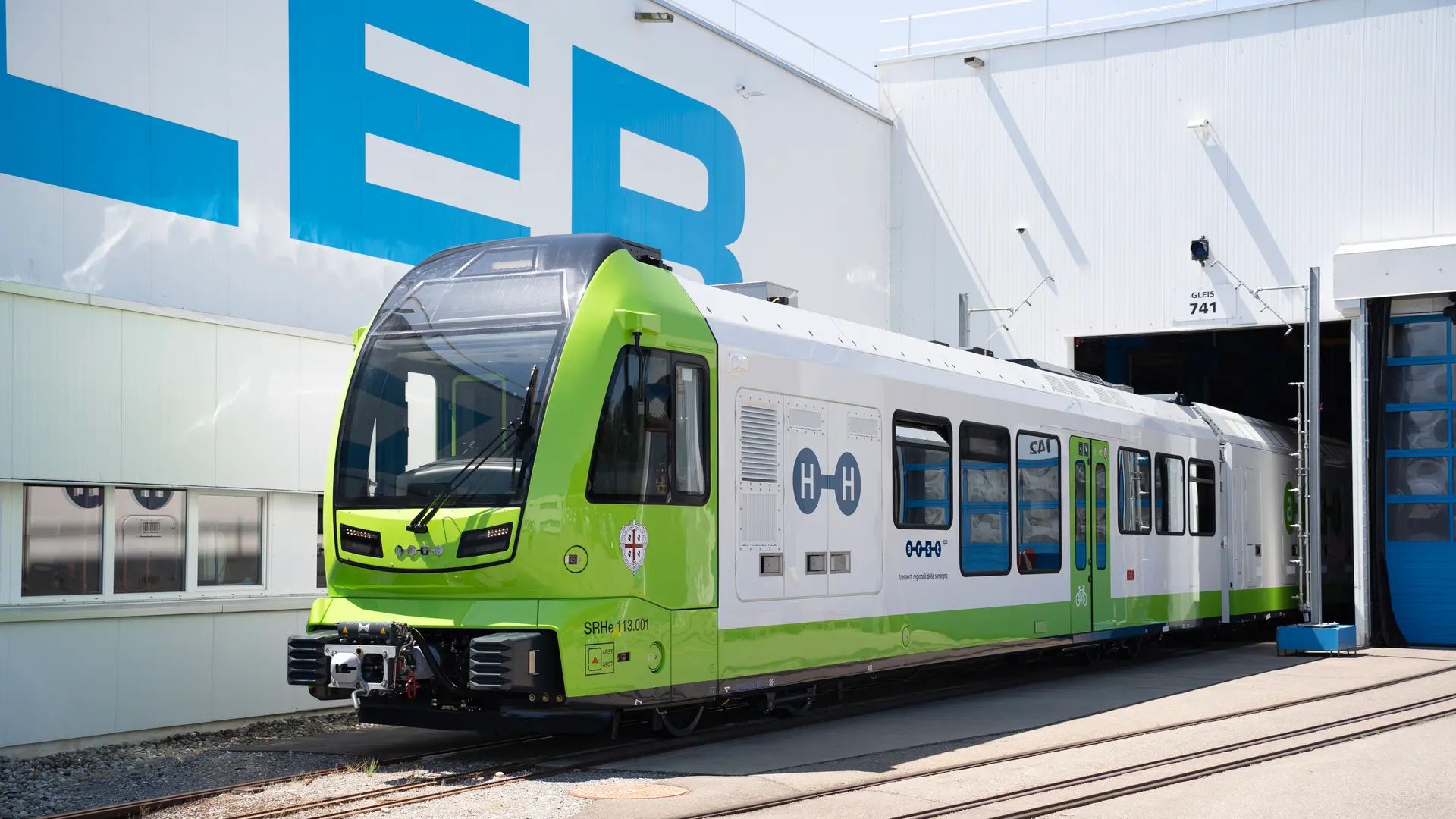
Swiss rail manufacturer Stadler and Sardinian public transport operator ARST are developing what they describe as the world’s first hydrogen-powered train specifically designed for narrow-gauge railway networks.
The new fleet is scheduled to begin passenger operations in 2028, supporting Italy’s efforts to decarbonize regional rail services that have traditionally relied on diesel-powered trains.
Purpose-Built for Narrow-Gauge Networks
The initial fleet of 10 hydrogen trains will operate on ARST’s regional routes linking Alghero Airport with Mamuntanas, as well as the Sassari–Alghero and Sassari–Sorso lines.
According to the project partners, replacing diesel trains with hydrogen-powered vehicles is expected to reduce carbon dioxide emissions by more than 2,100 tonnes annually.
Unlike conventional hydrogen trains, the new vehicles have been specifically engineered to meet the unique operational requirements of narrow-gauge railways, where tight curves and lower axle-load limits have historically limited electrification and the use of heavier rolling stock.
Hydrogen-Powered Electric Propulsion
The trains feature a central Power Pack module that houses hydrogen storage tanks and fuel cells.
Electricity generated by the fuel cells will recharge onboard traction batteries, enabling the trains to operate efficiently on non-electrified railway lines while producing only water vapour during operation.
The hydrogen fuel will be produced locally using electricity generated entirely from solar power, creating a renewable energy supply chain for the rail network.
Barbara Manca, Regional Minister for Transport of the Autonomous Region of Sardinia, said the project positions the island at the forefront of sustainable transport innovation.
“With the commissioning of the first hydrogen-powered train designed for narrow-gauge railways, Sardinia is proving itself a pioneer of technological innovation in the transport sector.”
“The hydrogen trains, which will be deployed on ARST lines, are a shining example for the environment, the local economy and the development of key skills in our region.”
Improving Passenger Experience
In addition to reducing emissions, the trains are expected to provide quieter operation and smoother journeys compared with existing diesel-powered rolling stock.
The new vehicles will feature low-floor boarding for improved accessibility, panoramic windows, air-conditioned passenger cabins and dedicated facilities for train crews, including separate entrances and independent climate control.
Dr. Ansgar Brockmeyer, Head of Marketing and Sales and Deputy Chief Executive Officer of Stadler Group, said the project represents an important milestone in sustainable rail transport.
“Stadler is the only train manufacturer in the world that designs and builds hydrogen trains for narrow-gauge lines. Together with ARST, we have developed a solution that makes a tangible contribution to the decarbonization of rail transport.”
Expansion Across Southern Italy
The Sardinia project forms part of a broader Italian government programme launched in 2023 to reduce emissions from regional railways.
Stadler is also manufacturing nine similar hydrogen trains for Ferrovie della Calabria and two additional units for Sicily’s Ferrovia Circumetnea, where the vehicles are being adapted to operate on the steep gradients surrounding Mount Etna.
Before entering commercial service, all trains will undergo comprehensive operational and safety testing to obtain certification from Italy’s National Agency for the Safety of Railways and Road and Motorway Infrastructure (ANSFISA).
The hydrogen trains are currently being manufactured at Stadler’s production facility in Bussnang, Switzerland, as the company expands its portfolio of zero-emission rail technologies for regional transport networks.