
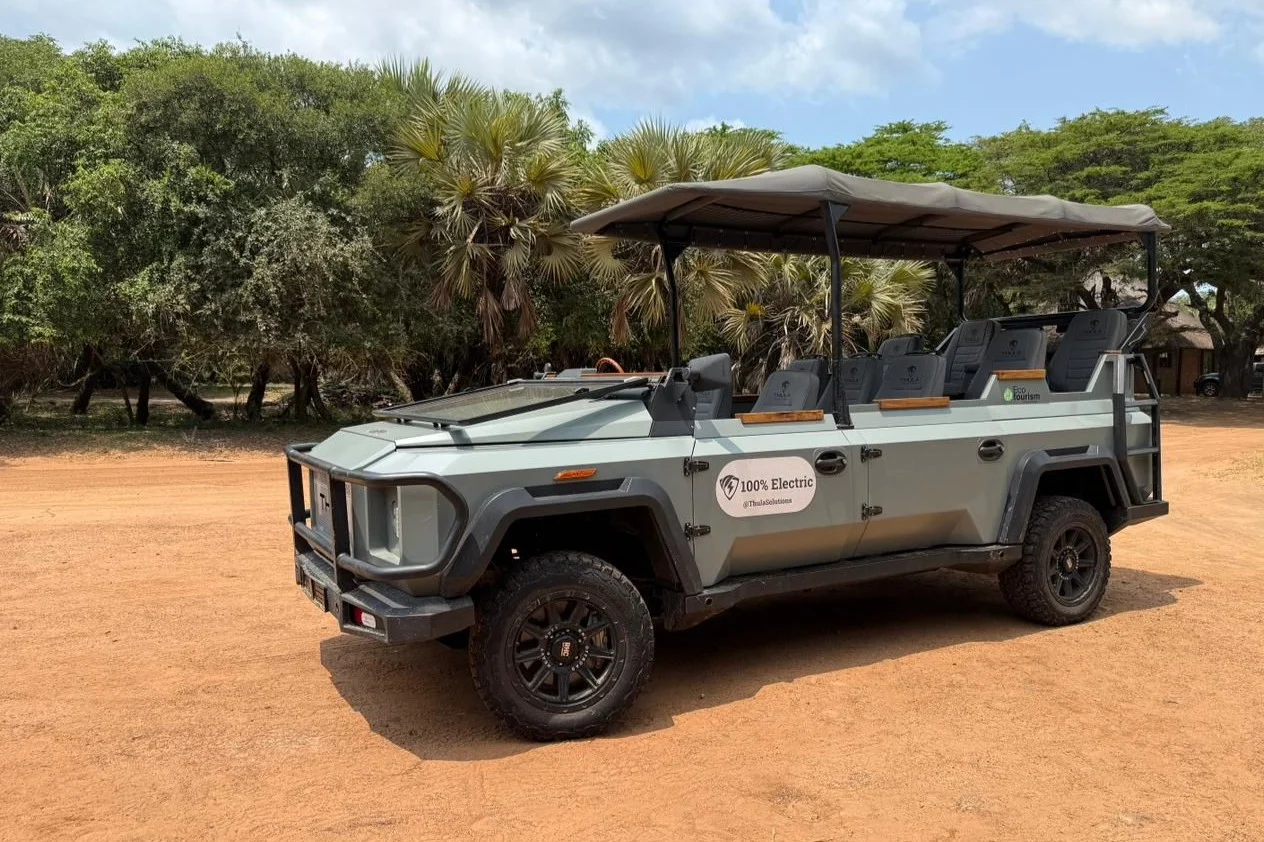
South African company Thula Solutions has introduced a purpose-built electric safari vehicle designed to provide quieter and emission-free wildlife tours at Kruger National Park.
Unlike electric vehicles adapted from conventional off-road models, the Thula was developed from the ground up specifically for safari operations, with a focus on reducing noise and emissions during wildlife observation.
Electric Vehicle Designed For Safari Operations
The battery-electric off-road vehicle is equipped with a 65 kWh battery and has an estimated driving range of about 200 km.
Thula Solutions said the range could support roughly three days of typical safari operations before the vehicle needs to be recharged. The company sees solar-powered lodges as a preferred location for charging, potentially allowing safari operators to pair electric mobility with renewable energy.
The vehicle is largely manufactured in South Africa, with only its electric motors and a limited number of specialised components sourced from overseas.
The development reflects efforts to build a locally produced electric vehicle tailored to the requirements of South Africa’s tourism and wildlife sectors.
Local Partnerships Support Development
The vehicle’s chassis was developed in cooperation with researchers from the Vehicle Dynamics Group at the University of Pretoria.
Cape Town-based Balancell supplied the battery technology, while funding from the Industrial Development Corporation helped Thula Solutions move the project beyond the prototype stage.
The company now plans to establish dedicated production capacity and aims to manufacture approximately 50 vehicles per month.
The move into series production could expand the availability of electric vehicles specifically designed for wildlife tourism, while supporting South Africa’s broader efforts to develop domestic electric mobility and manufacturing capabilities.
By combining a purpose-built off-road platform, battery-electric propulsion and locally sourced manufacturing expertise, Thula Solutions is targeting a niche where reduced vehicle noise and emissions could offer practical benefits for both safari operators and wildlife observation.