
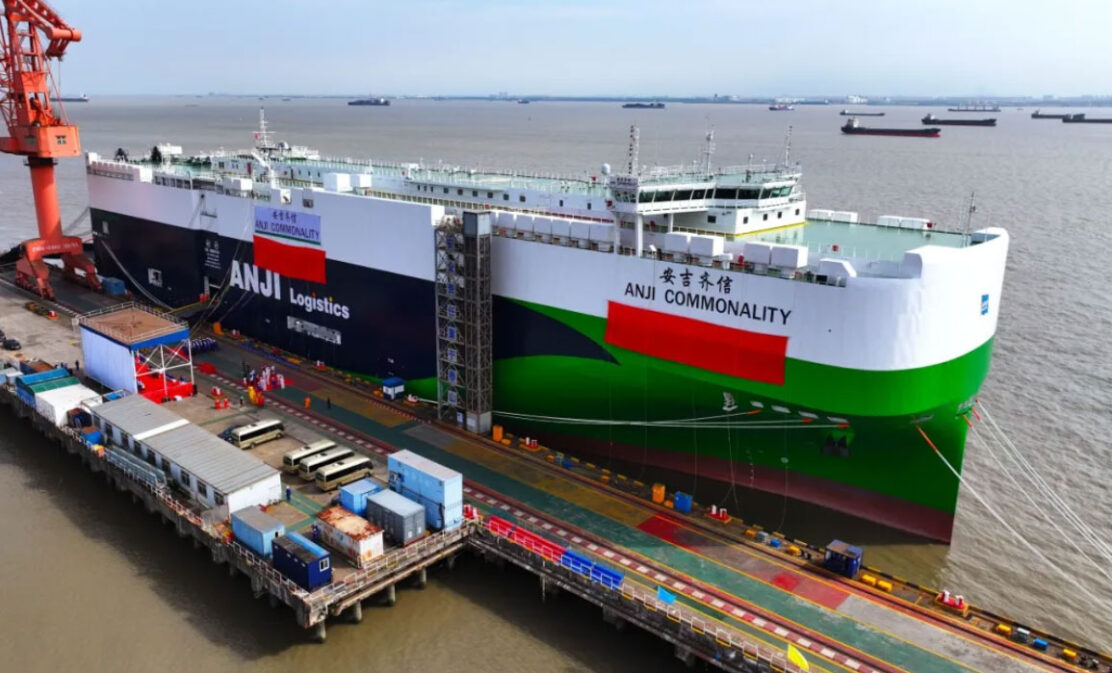
SAIC Motor has taken delivery of a new roll-on/roll-off (ro-ro) vessel, further strengthening its capacity to export vehicles as part of a broader industry trend among Chinese automakers seeking greater control over their global logistics operations.
The newly commissioned vessel, Anji Commonality, was delivered on June 25 at the Jiangnan Shipyard, according to a statement by Anji Logistics, the logistics arm of SAIC. It is the third 7,800-vehicle capacity ro-ro ship built by the shipyard and the fourth ocean-going car carrier added to Anji’s fleet in the first half of 2025.
Designed to transport a wide range of vehicles — including sedans, buses, and trucks — Anji Commonality features environmentally advanced technologies such as WinGD dual-fuel main engines, an LNG fuel supply system, and an intelligent exhaust gas recirculation system. The vessel’s energy efficiency design index (EEDI) has been reduced by over 40 percent compared to the baseline, the company said.
The ship’s maiden voyage will head to Europe, highlighting SAIC’s strategic focus on expanding its global footprint. With the addition of Anji Commonality, SAIC now operates a 37-vessel car carrier fleet — the largest self-operated automotive logistics fleet in China. Anji Logistics currently manages eight international shipping routes, serving Southeast Asia, Mexico, and Europe.
“As overseas demand grows, the need for stable, in-house logistics solutions becomes more pressing for Chinese automakers,” Anji stated in the announcement.
SAIC’s move follows similar actions by other major Chinese car manufacturers. Earlier this week, BYD added its sixth car carrier, BYD Changsha, and launched sea trials for a seventh. In May, Geely Auto introduced its first self-operated vessel, which has since begun delivering vehicles to several European countries, including the UK, Belgium, and the Netherlands.