
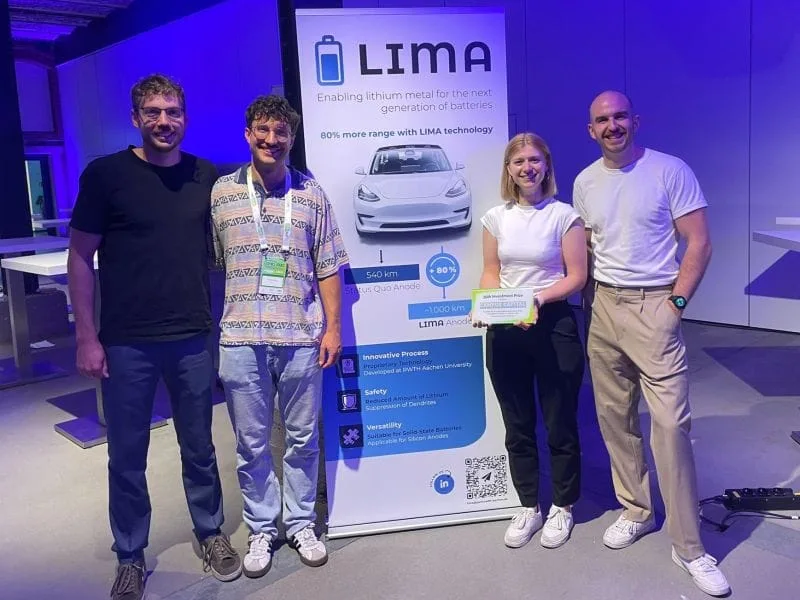
Researchers at RWTH Aachen University’s Chair of Production Engineering of E-Mobility Components (PEM) have developed a new melt coating process known as ‘LIMA’, enabling the efficient production of ultra-thin lithium metal anodes for next-generation batteries. The team plans to commercialize the method through a university spin-off.
The LIMA process involves the controlled application of liquid lithium onto a substrate foil, offering a simpler, scalable, and cost-effective alternative to conventional rolling and lamination techniques.
Traditional methods involve rolling 100-micrometre-thick lithium foils down to 30–70 micrometres before lamination, leading to significant material waste since many applications require only 20–25 micrometres. By contrast, the LIMA process melts lithium directly, eliminating multiple production steps and reducing material losses.
PEM director Professor Achim Kampker said the technology “has the potential to create a European independent production capacity for lithium metal anodes,” underscoring its strategic importance for solid-state battery manufacturing. The process allows for precise control of layer thickness and improved electrochemical properties without the need for mechanical post-processing.
See also: Germany’s RWTH Aachen Advances Testing of Modular Autonomous Electric Bus-Cable Car Concept
The development stems from research led by Gerrit Bockey, who will serve as co-CEO of the planned spin-off company ‘LIMA’. The initiative is supported by Germany’s ‘EXIST – Startups from Science’ programme and includes fellow researchers Jonas Gorsch, Junia Dietert, and Hendrik Minis Pai. The team aims to bring the technology to industrial-scale production to strengthen Europe’s battery manufacturing capabilities.