



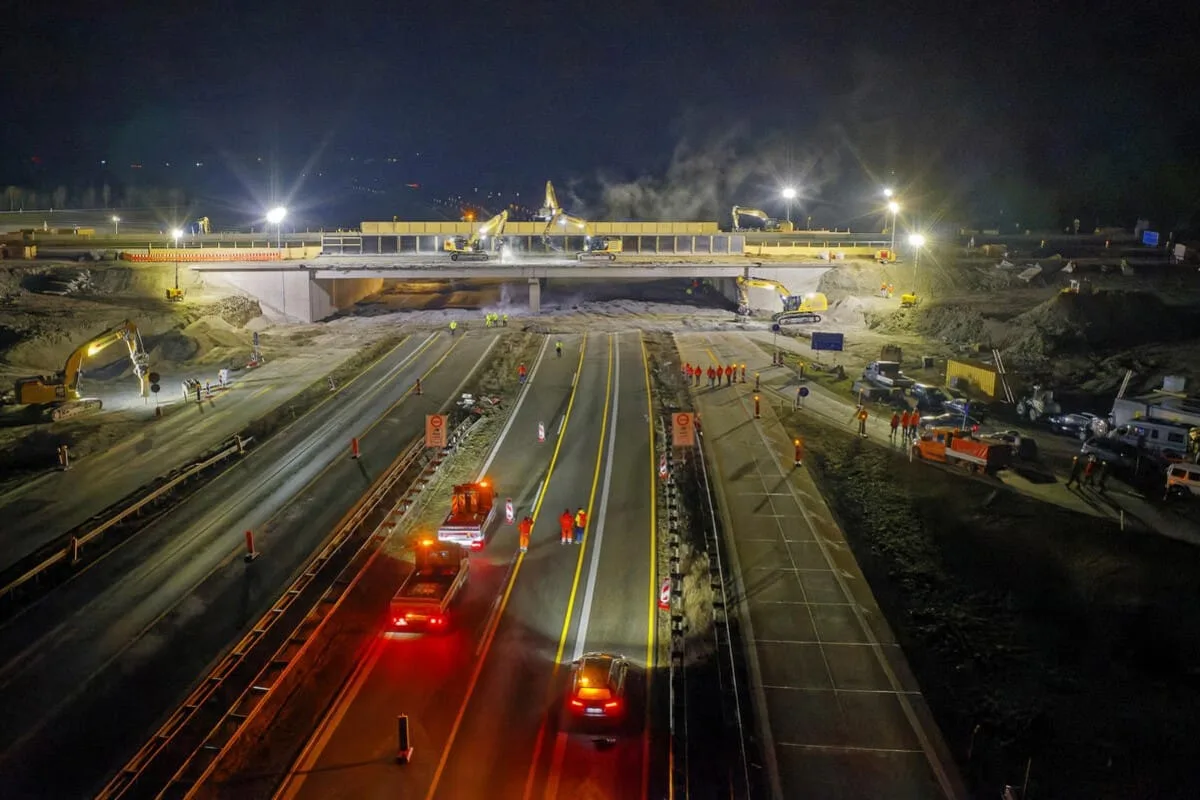
The Production Engineering of E-Mobility Components (PEM) chair at RWTH Aachen University has released an interim report from its VoltaVia project, indicating that electrifying road construction sites is “not only ecologically sensible, but also economically feasible.”
Conducted in partnership with Munich-based construction logistics provider Zeppelin Rental, the two-year VoltaVia initiative aims to explore strategies for decarbonizing road construction sites across Germany, Austria, and Switzerland. Funded by the Austrian Research Promotion Agency (FFG) under the D-A-CH Transport Infrastructure Research program, the project has now reached its halfway point.
See also: RWTH Aachen Unveils Virtual Modelling Tool for Battery Cell Production
Initial findings are based on expert interviews, industry surveys, and a global comparative analysis of drive technologies and energy supply models. According to PEM, electric machinery significantly reduces emissions while simplifying operation and maintenance. However, surveyed construction firms reported higher upfront costs and insufficient charging infrastructure as key obstacles.
The researchers found that a wide range of conventional diesel-powered machinery, including asphalt pavers, hydraulic excavators, and wheel loaders, are already available in electric versions or prototype form. Battery-electric systems are expected to dominate the market in the near to medium term, with hydrogen technologies likely to become relevant for heavy-duty applications requiring higher power.
See also: RWTH Aachen Researchers Develop ‘LIMA’ Melt Coating Process for Ultra-Thin Lithium Metal Anodes
The VoltaVia team’s analysis estimates that “electrification can save up to 960 tons of carbon dioxide on a 16-kilometer construction site,” highlighting the potential environmental benefit. Using real telematics data and efficiency metrics, the project partners developed an energy demand model capable of predicting future electricity and hydrogen requirements. The study also evaluated several energy supply options, including roadside fast-charging systems, mobile battery storage, and hydrogen generators.
“Electrification of road construction sites is not only ecologically sensible, but also economically feasible – which is crucial to ensuring that small and medium-sized enterprises do not fall behind in decarbonization,” said Professor Achim Kampker, Director of PEM.
See also: RWTH Aachen University Secures Road Approval for Modular Fuel Cell-Electric Truck Prototype
In the next phase of the project, researchers will focus on tendering for large-scale pilot programs and assessing their impact on the broader construction industry. Kampker added that the ultimate goal is to identify “practical solutions that enable the widespread implementation of electrification at road construction sites for more efficient and climate-friendly operations.”
The VoltaVia project is supported by the German Federal Ministry of Transport, the Austrian Federal Ministry for Innovation, Mobility and Infrastructure, and the Swiss Federal Roads Office (FEDRO).
Source: Electrive


