
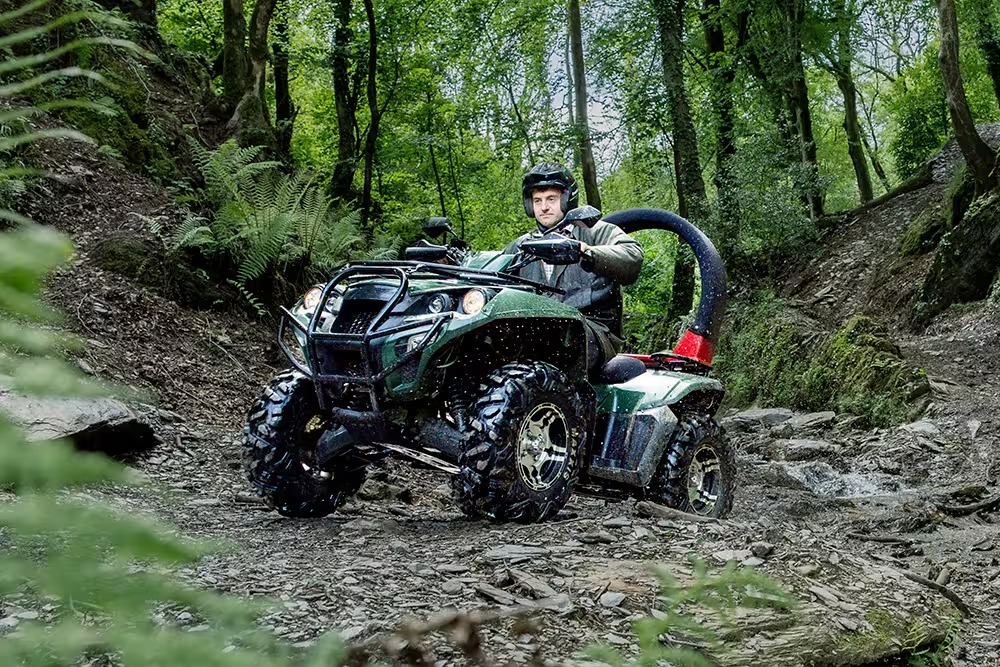
Volt Quads, a UK company producing quad bikes for farmers and landowners, has launched the Volt Quads VQ, an electric ATV that the company says was designed and manufactured in the UK.
The VQ was designed by Fred Chugg, a farmer with decades of experience using quad bikes on his farm in southwest England. According to the company, that experience influenced the vehicle’s development, including its handling of uneven terrain and changing surface conditions.
Volt Quads is initially targeting farmers and landowners, while also identifying potential applications in areas including forestry, conservation, estate management and public services.
The company says the VQ has a five-year ownership cost that is £3,500 lower than that of a comparable petrol ATV. The claim is based on the company’s own cost comparison.
In this Q&A, Chugg discusses the reasons for developing the VQ in the UK, the considerations involved in designing an electric ATV for agricultural use, testing carried out in Austria and the company’s plans for additional models.
Why Develop the VQ in the UK?
What inspired the decision to develop and manufacture the Volt Quads VQ entirely in the UK, and what advantages does this offer customers?
“A lot of farm machinery comes from abroad, and, if there’s one thing we’ve learned from the extreme volatility in trade conditions over the last few years, it is that we are very vulnerable to supply chain shocks.
“Building a bike in the UK means that we are a little more insulated from global price pressures. UK buyers will also not have to deal with added import duties and paperwork, which has become a real pain as a farmer.
“The fact that the bike has been developed in the UK by a British farmer makes it right by design for our unique climate and terrain. Currently, a lot of imported electric ATVs on the market are not robust enough for the wet weather and rugged UK farming terrain.
“As farmers, we knew that a bike made specifically for British farmers would do the job, no questions asked.”
Designing the VQ for Farm Use
Fred, how did your experience as a farmer shape the design of the VQ, and what were the biggest challenges you wanted to solve?
“Beyond moving away from petrol and using surplus solar EV, I wanted a trustworthy bike that could do all I needed it to do on my hilly farm in the South West, without losing any performance.
“The biggest challenge I wanted to solve was to make sure the bike could navigate tight corners and changes in altitude and surface easily. Furthermore, every farmer needs a slightly different bike, so I wanted to make sure it was customisable to fit certain needs.
“The VQ delivers power and torque control much more quickly than a petrol ATV, making it better suited for rugged terrain. It’s also got a variety of drive modes that enable users to select a torque profile to suit their own conditions, as every farm or estate needs something a bit different.”
Costs and Other Considerations
Many farmers are weighing the costs of switching to electric. Beyond fuel savings, what other long-term benefits should they consider?
“There’s many reasons. First, resale values are typically higher for electric bikes, providing an extra financial benefit.
“Second, electric ATVs in general have fewer moving parts, which means there’s less that can get damaged and worn down from regular use on farms.
“Finally, the user benefits from a quieter ride and no tailpipe emissions. It’s kinder to the animals and the wildlife on the farm and pollution free.”
Testing in Austria
What has been the feedback from early users or demonstration events, and has anything surprised you since the VQ’s launch?
“It’s been very positive. We got two riders to test the bike up a 20km alpine trail in Styria, Austria, essentially to stress test it in the toughest environment we could access.
“The riders were very pleased. It climbed the trail and back down to the valley with a third of its charge still in hand and looking as good as new.
“While we were always confident in its performance, it was especially pleasing to see that it did this just as quickly as a petrol quad bike being tested at the same time with no battery or motor problems on a 34°C day.”
Potential Applications Beyond Agriculture
Do you see opportunities for the VQ beyond agriculture, such as conservation, forestry, parks or other commercial applications?
“There are many other opportunities for the VQ. In the land use category, groundkeepers and estate managers could really benefit from having a reliable and sturdy quad bike to get them around.
“There is also demand from forestry and eco-tourist businesses, security, search and rescue, and local authorities for spraying and park management.”
Future Models and European Markets
Looking ahead, what is your long-term vision for Volt Quads, and can customers expect additional models or new technologies in the coming years?
“Our goal is to take as many petrol quads out of the environment as we can. We’re actively seeking a road use certificate to permit sales to the EU so we can get fossil fuel quads out the market there as well.
“Furthermore, we will introduce a lighter two-wheel-drive bike for public sector applications in the next six months.”
Looking Ahead
Volt Quads’ launch of the VQ comes as electric powertrains are being considered for a wider range of off-road and specialist vehicles.
The company is focusing initially on agricultural users and landowners, while also identifying potential applications in forestry, estate management, conservation, security and public services.
Chugg said the company is also seeking approval for EU sales and plans to introduce a lighter two-wheel-drive model for public-sector applications.
The extent to which electric ATVs can replace petrol-powered models will depend on factors such as purchase price, operating costs, range, charging access, performance and suitability for different working environments. For Volt Quads, the VQ represents its approach to applying electric power to a vehicle designed for agricultural and land-based use.