
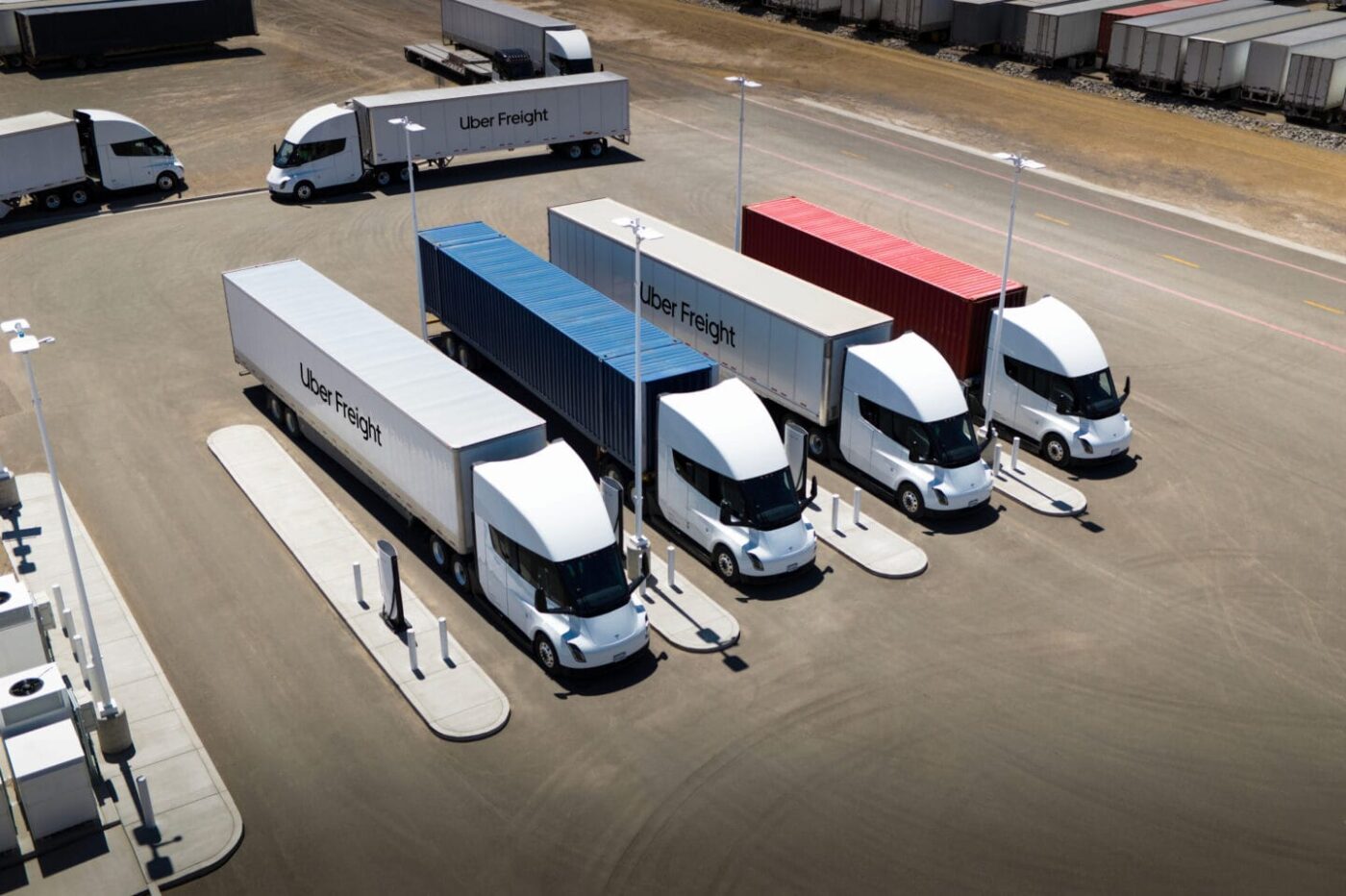
Pilot Travel Centers has reached an agreement with Tesla to install high-power charging stations dedicated to the Tesla Semi at selected truck stop locations across the United States, marking a significant step in the build-out of charging infrastructure for electric heavy-duty vehicles.
The first charging hubs will be built along major freight routes including Interstate 5 and Interstate 10, with additional sites planned on other key transport corridors. Pilot said construction is set to begin in the first half of the year at locations in California, Georgia, Nevada, New Mexico and Texas, with the first stations expected to become operational in the summer of 2026.
See also: Nevoya Deploys 40 Electric Semi Trucks on Houston–Dallas Route
Each site will feature between four and eight chargers using Tesla’s V4 technology, capable of delivering up to 1.2 megawatts per charging point. The system is designed to support rapid charging for heavy-duty trucks, restoring most of the Tesla Semi’s long-haul range in around 30 minutes under optimal conditions.
Under the initial agreement, access to the new charging network will be limited to Tesla vehicles. Pilot said the stations will “initially focus on providing charging infrastructure for Tesla’s Semi trucks,” though the partners may open the network to other manufacturers in the future, mirroring Tesla’s gradual opening of its passenger-car Supercharger network.
See also: Svolt Energy Unveils 80-kWh PHEV Battery Pack, Advances Semi-Solid-State R&D
Pilot operates roughly 900 locations across 44 U.S. states and five Canadian provinces, serving about 1.2 million customers daily. The company, founded in 1958 and headquartered in Knoxville, Tennessee, is wholly owned by Berkshire Hathaway. In 2022, Pilot also announced a separate collaboration with Volvo Group to develop a brand-agnostic charging network for electric heavy goods vehicles.
“Helping to shape the future of energy is a strategic pillar in meeting the needs of our guests and the North American transportation industry,” said Shannon Sturgil, senior vice president of alternative fuels at Pilot. “Heavy-duty charging is yet another extension of our exploration into alternative fuel offerings.”
Tesla’s V4 charging architecture uses a decentralised design with satellite dispensers connected to a central power unit, reducing space requirements compared with conventional high-power truck chargers. While the full 1.2-MW output is available to a single vehicle, the system can also share power across multiple trucks at lower individual charging rates.
The charging rollout comes as Tesla prepares to bring the long-delayed Semi into series production. The company has said manufacturing will begin at a dedicated facility adjacent to Gigafactory Nevada, with an eventual annual capacity of up to 50,000 units. First unveiled in 2017, the electric truck is now expected to enter the market in 2026, with Tesla also signalling plans for a later introduction in Europe.