



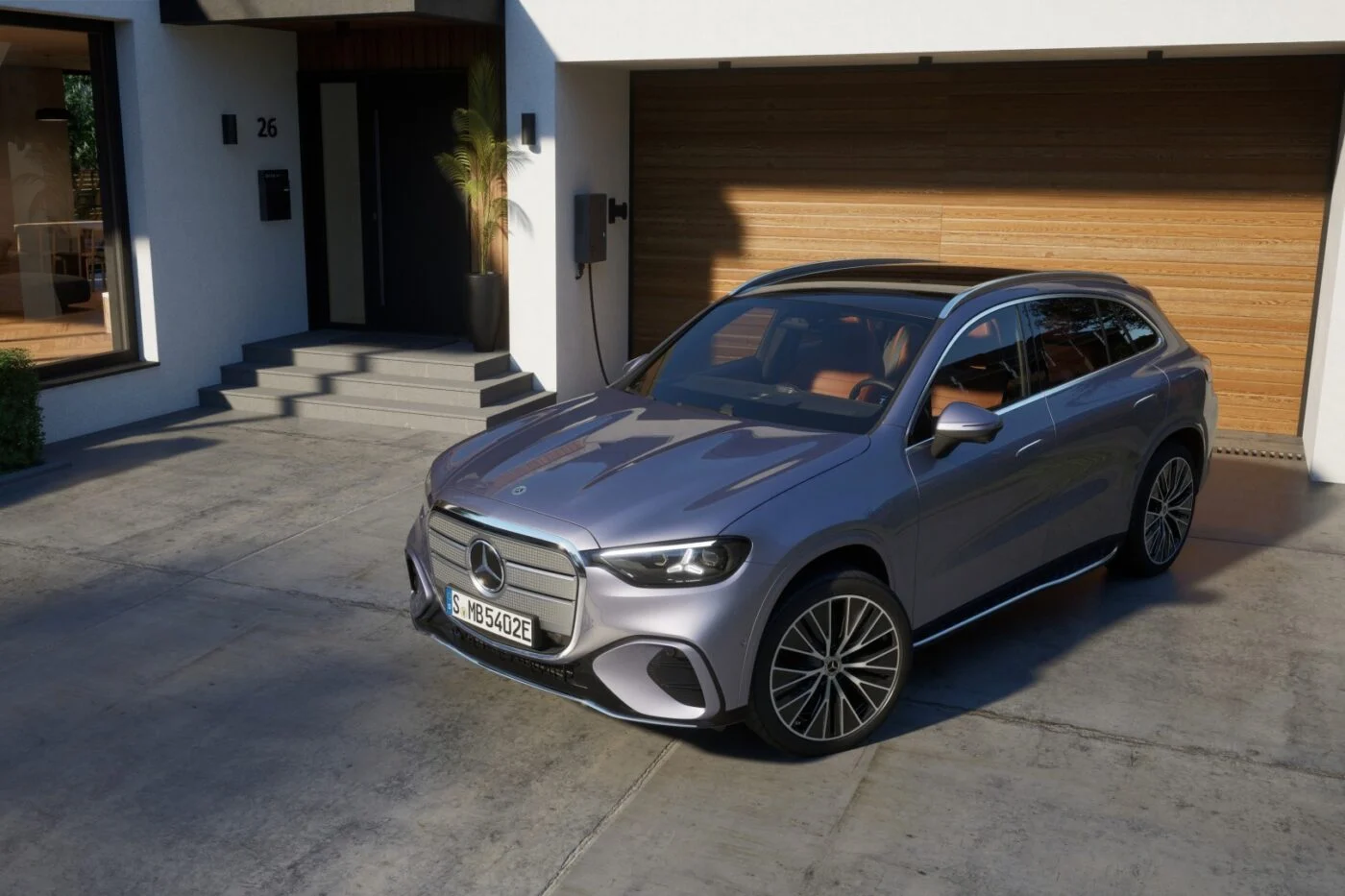
Mercedes-Benz is introducing a vehicle-to-grid (V2G) charging package in Germany that will allow compatible electric vehicles to return electricity to the public grid. Developed with energy technology provider The Mobility House, the offering initially supports the electric GLC and the new C-Class.
The package, called MB.CHARGE Home Pro Intelligent, combines a bidirectional DC wallbox with the Mercedes-Benz Intelligent Pro Eco Tariff. Customers will be able to monitor charging, electricity fed back into the grid and resulting credits through the Mercedes-Benz Charge Home app.
The launch follows Mercedes-Benz’s introduction of two unidirectional home-charging packages in September. While those offerings focus on shifting charging to lower-cost periods, the new bidirectional system also allows energy stored in a vehicle’s battery to be returned to the grid.
Initial Vehicle Compatibility and Expansion Plans
The new package will initially be available for the electric GLC and new C-Class in Germany. Mercedes-Benz plans to extend bidirectional charging to additional electric models, including the VLE, GLA, EQS, CLA, CLA Shooting Brake and GLB.
Depending on the vehicle, the functionality will be activated through an over-the-air software update after the model’s market launch. Mercedes-Benz also plans to introduce the offering in selected markets outside Germany, subject to local conditions.
The company said the package would allow customers to participate more actively in the energy system while potentially reducing their electricity costs.
Bidirectional Wallbox and Technical Standards
The system uses the ChargeLine Bidi, an 11-kW bidirectional DC wallbox supplied by The Mobility House. Mercedes-Benz says the unit supports electric vehicles using both 400-volt and 800-volt electrical architectures and can receive software updates over the air.
A smart meter is required. Availability and operation may also depend on national legislation and the requirements of energy suppliers.
Mercedes-Benz says its solution is based on open, standardized technologies, including ISO 15118-20, with the aim of improving interoperability between compatible vehicles, charging infrastructure and energy management systems.
The company describes the package as the first market-ready bidirectional charging solution of its kind offered by an automaker in Germany based on open and standardized technologies.
Introductory Pricing and Customer Credits
Mercedes-Benz is offering an introductory deal to the first 500 customers, available until the end of March 2027. The bidirectional wallbox will cost €1,990 during the promotion, compared with its regular price of €2,990. Eligible customers will also receive a €250 charging credit.
In addition, customers will receive compensation for each hour their vehicle remains connected to the home wallbox, regardless of whether it is charging, discharging electricity to the grid or temporarily idle.
Mercedes-Benz estimates that customers who connect their vehicles for an average of 12 hours per day could receive more than €500 in annual bonuses under the current arrangement. Based on that estimate, the company says the wallbox investment could be recovered in less than four years with the introductory price, or around six years at the regular price.
These figures are estimates rather than guaranteed returns. Actual compensation depends on how long a vehicle remains connected and available, along with the applicable program conditions.
Part of Mercedes-Benz’s Home Energy Strategy
The V2G package follows the September launch of MB.CHARGE Home Dynamic and MB.CHARGE Home Intelligent. Those packages allow customers to schedule charging during more cost-effective periods but do not provide the same grid-feed-in functionality.
The new offering comes as Germany advances rules for integrating storage systems and charging points into the electricity market through the Federal Network Agency’s MiSpeL framework. The commercial viability of individual V2G arrangements depends on the applicable regulatory and energy-market conditions.
Jörg Bartels, head of powertrain systems at Mercedes-Benz AG, said bidirectional charging would expand the role of electric vehicles in the energy system.
Bidirectional charging is the next logical step in electromobility for us. We are developing the vehicle from a pure consumer into an active component of the energy system. This connects innovative vehicle technology with more efficient use of renewable energies and creates sustainable added value—for our customers as well as for the energy infrastructure.
Thomas Raffeiner, CEO of The Mobility House, said the partnership aims to make vehicle batteries available for energy-market applications.
The electric car is more than a vehicle – it is the battery storage of the future. Together with Mercedes-Benz, we are making bidirectional charging suitable for everyday use. Mercedes-Benz customers can use their vehicle to earn money and reduce their energy costs in the future. At the same time, they contribute to relieving the power grid and to climate protection.
The launch adds Mercedes-Benz to a growing group of automakers and energy providers developing V2G services in Germany. Similar initiatives have been announced by Volkswagen and Elli, BMW and E.ON, Ford and Octopus Energy, and Renault in partnership with The Mobility House.