
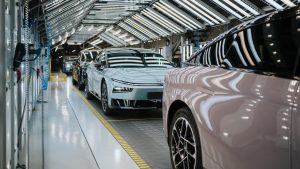



China will reduce the export value-added tax (VAT) rebate rate for new energy vehicles (NEVs) from 13% to 9% starting April 1, 2027, under a policy announced by the Ministry of Finance and the State Taxation Administration on Monday.
The four-percentage-point reduction will lower the tax refunds available to exporters, potentially putting pressure on Chinese automakers’ overseas profitability. The adjustment covers battery-electric and plug-in hybrid passenger vehicles, electric buses and electric truck tractors.
The applicable rebate rate will be determined by the export date recorded on the customs declaration. Existing export consumption tax rebate and exemption policies will remain unchanged for products subject to that tax.
Export Growth Increases Exposure to Policy Changes
The policy change comes as Chinese automakers increasingly rely on overseas markets to offset weaker domestic demand.
According to data released by the China Association of Automobile Manufacturers (CAAM), NEV exports rose 130% year-on-year to 4.006 million vehicles in the first nine months of 2026.
In September alone, NEV exports increased 160% year-on-year to 571,000 vehicles. Domestic NEV sales, by comparison, fell 9.4% to 1.252 million units. The figures cover both passenger and commercial vehicles.
Export VAT rebates refund certain taxes paid during domestic production and distribution. Reducing the rebate rate means exporters receive smaller refunds, all else being equal, potentially increasing the effective cost of supplying overseas markets or reducing margins if companies absorb the difference.
BYD and Other Automakers Face Potential Profit Pressure
Deutsche Bank estimated in a research note released on Monday that the change could reduce BYD’s net profit by approximately 5,000 yuan, or about $743, per exported vehicle. The bank expects the impact to begin in the second quarter of 2027.
BYD’s overseas sales totaled 1,342,468 vehicles in the first three quarters of 2026, accounting for approximately 43% of its total wholesale volume, according to Deutsche Bank. The figure highlights the importance of international sales to the automaker’s business.
The bank also identified potential export-profit pressure for other Chinese manufacturers, including Chery, Geely Auto, SAIC Motor, Great Wall Motor, Changan Automobile, Leapmotor, GAC Group and Xpeng.
The actual financial impact will vary by manufacturer, depending on export volumes, vehicle pricing, production costs, overseas sales mix and the extent to which companies adjust prices or absorb the reduction.
Part of a Broader Reduction in Clean-Energy Export Rebates
The NEV adjustment follows earlier changes to China’s export tax rebate policies for other clean-energy products.
China eliminated export VAT rebates for solar photovoltaic products on April 1, 2026, and reduced the rebate rate for battery products from 9% to 6%. Under previously announced plans, battery export tax rebates will be eliminated from January 1, 2027.
The Ministry of Finance and the State Taxation Administration did not provide a specific explanation for the NEV rebate reduction in their announcement.
Economists have linked the broader policy changes to the growing competitiveness of China’s clean-energy industries and efforts to curb price competition.
Luo Zhiheng, chief economist at Yuekai Securities, told Yicai that tax support should reflect an industry’s stage of development. As industries mature, he said, they should rely increasingly on technological progress and market competition.
Luo also said lower export rebates could encourage companies to compete through technology and branding rather than price alone.
For Chinese automakers, the change introduces an additional consideration as they expand internationally. Although export growth remains strong, lower tax rebates could affect margins and pricing decisions from 2027, particularly for manufacturers with substantial overseas sales volumes.


