




May Mobility has launched its fifth-generation autonomous driving system, introducing a new on-vehicle architecture designed to scale driverless ride-hailing operations across U.S. markets including Arlington.
The Ann Arbor-based company said the system combines deep learning, a predictive world model and its proprietary reasoning engine within a single autonomous driving architecture.
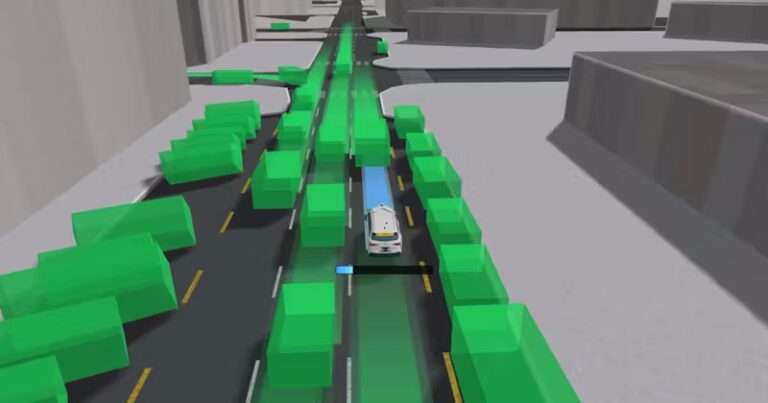
According to May Mobility, the system performs hundreds of simulated “what if” driving scenarios every 200 milliseconds, projecting potential traffic and vehicle interactions up to 10 seconds into the future before selecting a driving action.
The company said the updated system is being deployed across its existing autonomous vehicle fleet and will support an upcoming deployment on the Uber platform in Arlington, Texas.
May Mobility said it has completed more than 525,000 commercial rides and over 1.1 million autonomous driving miles to date, including driverless deployments in three U.S. states.
The company described the new system as an alternative to both traditional modular autonomous driving stacks and fully end-to-end neural network approaches.
According to May Mobility, the architecture combines deep learning with reasoning-based decision-making to allow vehicles to adapt to unfamiliar situations and environments without relying solely on massive amounts of training data.
“Driving by memorization is bad—humans don’t need to see a billion miles of road to drive safely,” said Edwin Olson, chief executive officer of May Mobility.
“The brain instantly builds a mental model of the world and then reasons through it. Our new system approaches driving the same way, and it dramatically changes how autonomy can safely scale,” Olson said.
The company said the world model incorporates physics, traffic rules and driving behavior patterns to generate predictive simulations of how road users may interact in different scenarios.
Its reasoning and planning engine then evaluates multiple driving strategies against those simulations, selecting only strategies that meet safety requirements.
May Mobility said the system’s decisions remain traceable to their source logic, which the company contrasted with some end-to-end neural network systems where decision-making can be more difficult to interpret.
The company also said the new architecture is intended to reduce autonomous vehicle hardware costs by using smaller models that require less computational power than systems trained on extremely large driving datasets.
May Mobility said the system supports its broader “Autonomy as a Service” business model and future deployments with partners including Toyota Motor, NTT, Lyft, Uber and Grab.
The company’s earlier driverless deployments have operated in Sun City, Ann Arbor and Peachtree Corners.


