
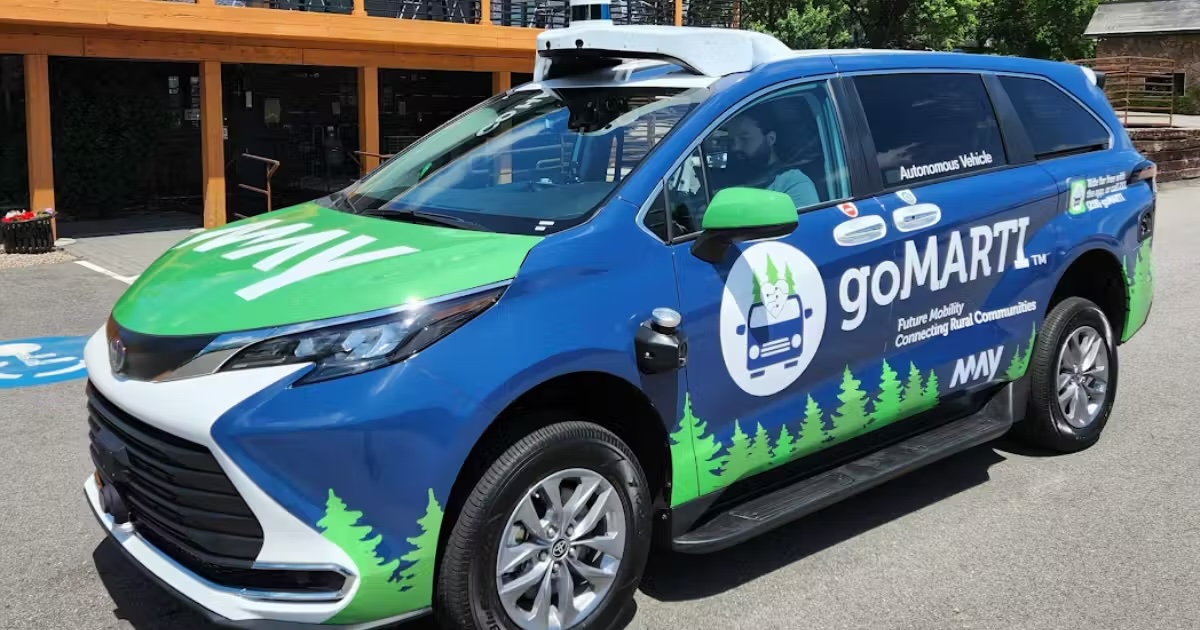
May Mobility said it has expanded its autonomous transit project in northern Minnesota, adding new stops, extended service hours and accessible vehicles to its goMARTI 2.0 program in Itasca County. The initiative, backed by U.S. federal and state funding, aims to showcase how autonomous technology can strengthen rural transit networks.
The expanded service in Grand Rapids, Minnesota – the northernmost U.S. city with active AV service – now includes key destinations such as Itasca Community College, Second Harvest Northland Foodshelf, Walmart and the Judy Garland Museum. Operating hours have been extended to run Monday through Saturday from 10 a.m. to 9 p.m., and Sundays from 8 a.m. to 3 p.m. Residents can request free, on-demand rides using the new goMARTI mobile app, powered by ride-hailing platform Via, or by calling a dedicated phone line.
May Mobility, which has deployed AVs in several U.S. cities, said its fleet in Grand Rapids is equipped with its proprietary Multi-Policy Decision Making (MPDM) system, which processes real-time data every 200 milliseconds to improve safety and navigation. The company emphasized its vehicles’ ability to operate in snowy climates, adding that performance in Minnesota winters provides valuable data for scaling its systems across other challenging environments.
The service has also introduced three non-autonomous vehicles, including a Volkswagen ID.Buzz and two wheelchair-accessible vans, to extend connections to surrounding communities such as Cohasset, Deer River and Ball Club. The vans, supplied by Cummings Mobility, include accessibility features such as the BraunAbility Turny Evo Swivel Car Seat and Q’Straint’s INQLINE system.
Funding for the expansion includes $9.3 million from the U.S. Department of Transportation’s Advanced Transportation Technology and Innovation program, supplemented by a $2.3 million state match from the Minnesota Department of Transportation (MnDOT). Additional MnDOT funding through its Moving Greater Minnesota Forward program supports extended service in Deer River and Ball Club, in partnership with the Leech Lake Band of Ojibwe.
Ida Rukavina, commissioner of Minnesota’s Iron Range Resources & Rehabilitation (IRRR), said the project demonstrates how rural regions can drive innovation in transportation. “This initiative is connecting people to jobs, education, healthcare and essential services,” she said. Tom Tang, May Mobility’s Chief People and Customer Operations Officer, added that autonomous services can help address driver shortages while delivering consistent, reliable transportation in underserved communities.