
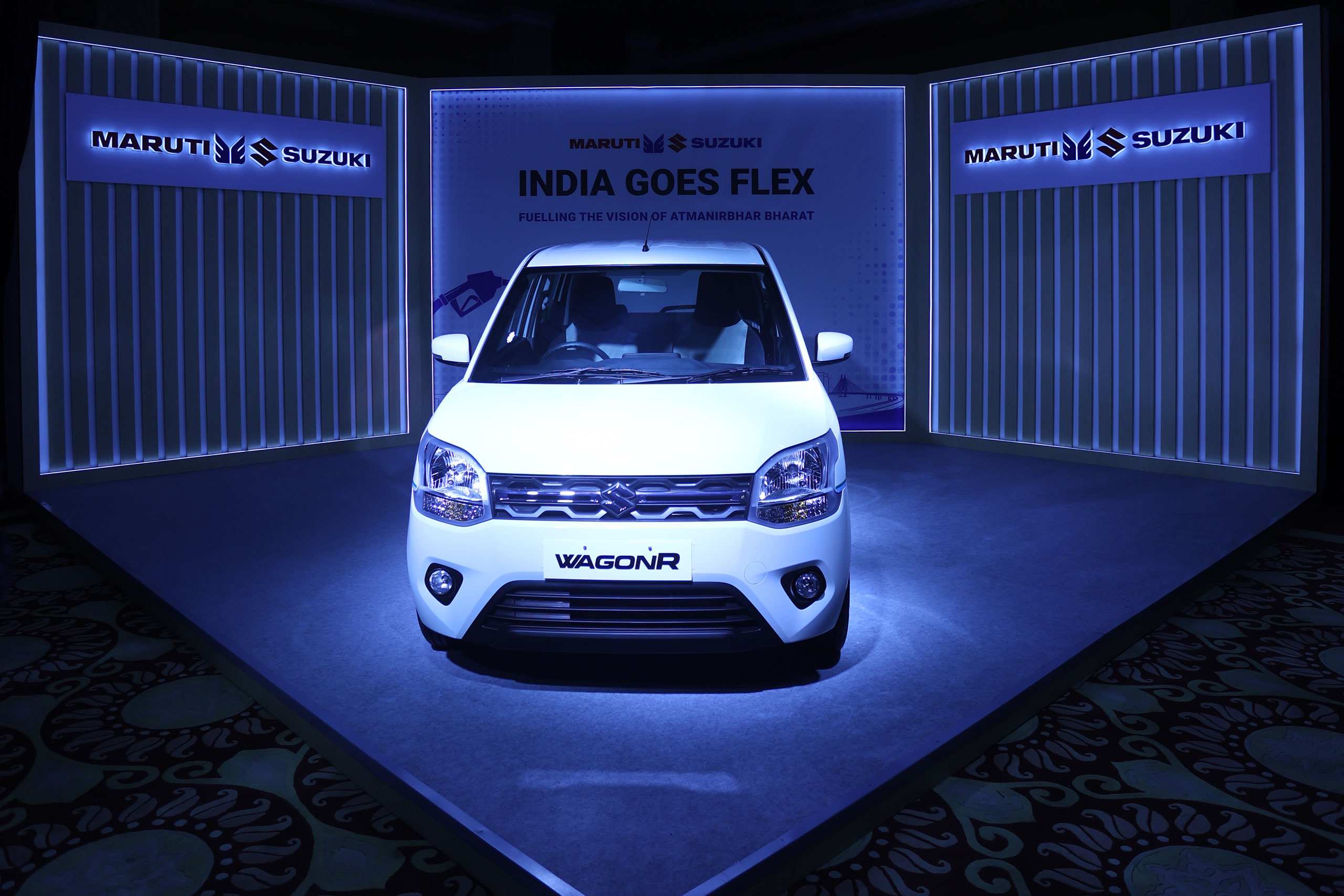
Maruti Suzuki India has launched the country’s first flex-fuel passenger car, introducing a version of the Wagon R capable of running on any ethanol-petrol blend from E20 to E100. The vehicle was unveiled ahead of World Environment Day in the presence of India’s Minister of Road Transport and Highways, Nitin Gadkari, and Minister of Petroleum and Natural Gas, Hardeep Singh Puri.
The launch marks a significant step in India’s efforts to diversify transportation fuels, reduce dependence on imported crude oil, and strengthen the country’s ethanol production ecosystem.
Wagon R Becomes Maruti Suzuki’s First Flex-Fuel Model
The Wagon R is the first vehicle in Maruti Suzuki’s lineup to receive flex-fuel technology, allowing drivers to use a wide range of ethanol-petrol blends without requiring modifications. The system supports fuels ranging from E20, containing 20% ethanol, to E100, which consists entirely of ethanol.
The introduction builds on the Wagon R’s established role in alternative-fuel mobility in India, where the model has been one of the company’s most popular compressed natural gas (CNG) offerings.
According to Maruti Suzuki, flex-fuel technology offers an additional pathway toward lowering transportation emissions while utilizing domestically produced biofuels.
Part of a Broader Multi-Fuel Strategy
The automaker said the launch forms part of a broader strategy that includes battery-electric vehicles, hybrid powertrains, CNG and compressed biogas (CBG) models, alongside ethanol-compatible vehicles.
“At Maruti Suzuki, we are committed to offer cars with multiple technologies and fuels. The Company is introducing BEVs, Hybrids, CNG/CBG and ethanol flex-fuel vehicles to meet India’s twin goals of reducing oil import and carbon emissions,” said Hisashi Takeuchi, Managing Director and Chief Executive of Maruti Suzuki India.
“The ecosystem for ethanol as a fuel in India is in its early stages, and as a market leader, we think it is our responsibility to contribute to make ‘India Go Flex’. Once it reaches mainstream adoption, Flex-Fuel Vehicles have the potential to cut oil imports, carbon emissions, and local air pollution while enhancing domestic value addition and farmer incomes.”
Supporting India’s Ethanol Ambitions
The flex-fuel Wagon R aligns with Indian government policies aimed at increasing ethanol blending in transportation fuels and reducing reliance on imported petroleum products.
India has been steadily expanding its ethanol production capacity through agricultural feedstocks such as sugarcane and grain-based sources. Policymakers view the fuel as a way to improve energy security while creating additional revenue opportunities for farmers and rural industries.
The launch also comes as India accelerates efforts to diversify its automotive energy mix through electric vehicles, alternative fuels, and biofuels as part of broader emissions-reduction and energy-independence objectives.
Early Stage Market Development
While ethanol-blended fuels are already available in many parts of India, infrastructure and fuel availability for higher ethanol concentrations remain under development. Maruti Suzuki acknowledged that the flex-fuel ecosystem is still in its early stages but expects broader adoption as fuel supply networks expand and policy support continues.
The company believes flex-fuel vehicles could play a complementary role alongside electric, hybrid, and gaseous-fuel vehicles in India’s evolving mobility landscape, particularly in regions where biofuel production is readily available and charging infrastructure remains limited.