

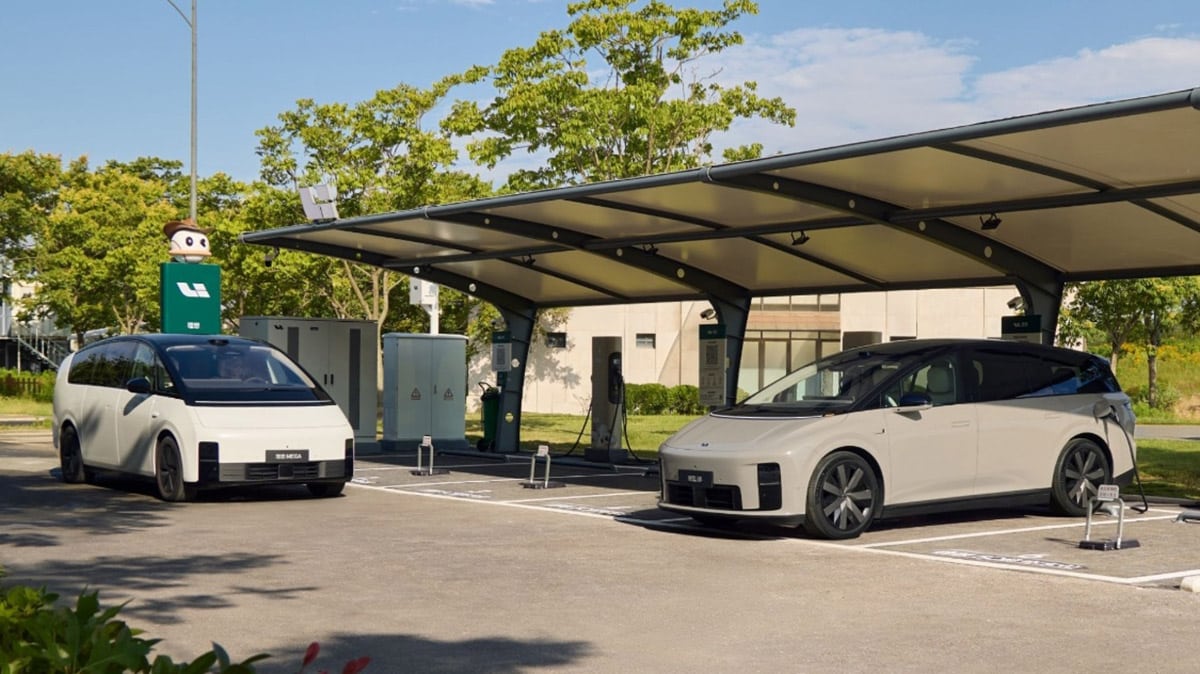
Li Auto has expanded its self-operated charging network to more than 4,000 supercharging stations in China, marking a key infrastructure milestone roughly six months after completing its 3,000th station, company data showed.
The automaker now operates 4,001 supercharging stations nationwide, according to its in-vehicle and mobile charging map, positioning Li Auto among China’s leading carmakers in terms of proprietary high-power charging infrastructure. The expansion underscores the company’s continued investment in charging capacity as it navigates a challenging transition in its product strategy.
See also: Li Auto CEO Highlights AI Push in Internal Meeting Amid Employee Concerns Over Sales Slowdown
Beyond its own network, Li Auto’s charging platform integrates 3,419 third-party premium supercharging stations with peak power above 200 kilowatts, as well as 76,937 third-generation fast-charging stations operated by external providers. The broader ecosystem is intended to support users across both battery electric vehicle (BEV) and extended-range electric vehicle (EREV) models.
Domestic rival Nio Inc operates a larger overall charging footprint, with 4,898 charging stations in China, covering both fast- and slow-charging facilities, in addition to 3,729 battery swap stations that underpin its alternative energy replenishment model.
See also: Li Auto Reshuffles R&D Leadership to Deepen Focus on Robotics and AI
Li Auto began trial operations of its first ultra-fast charging stations in April 2023, laying the groundwork for its entry into the BEV segment. The company launched its first BEV, the Li Mega MPV, in March 2024, followed by the Li i8 six-seat SUV in July 2025 and the Li i6 five-seat SUV in September, marking a gradual expansion beyond its previously EREV-only lineup.
The shift has coincided with operational and market headwinds. Over the past year, Li Auto’s EREV models have faced intensifying competition, while the ramp-up of its pure-electric models has been constrained by production challenges. Late last month, the company notified some Li i6 customers of delivery delays due to insufficient battery supply, six months after the model’s launch.
Against this backdrop, Li Auto has signaled adjustments to its strategy, seeking to refocus on its core EREV segment. Earlier this month, the automaker filed regulatory details for the Livis variant of its flagship Li L9 SUV, revealing a larger body, higher curb weight, and a bigger battery pack ahead of the updated model’s planned launch in the second quarter.
See also: Li Auto Rolls Out OTA 8.2 Update, Expanding Urban NOA And Smart Cockpit Features
The infrastructure milestone comes as Li Auto’s sales momentum remains under pressure. The company delivered 27,668 vehicles in January, down 7.55% from a year earlier and 37.47% lower than December, extending its streak of year-on-year monthly declines to eight consecutive months. January was its weakest monthly delivery performance since March 2025, according to company data. As of Jan. 31, 2026, Li Auto’s cumulative deliveries totaled 1,567,883 vehicles.