



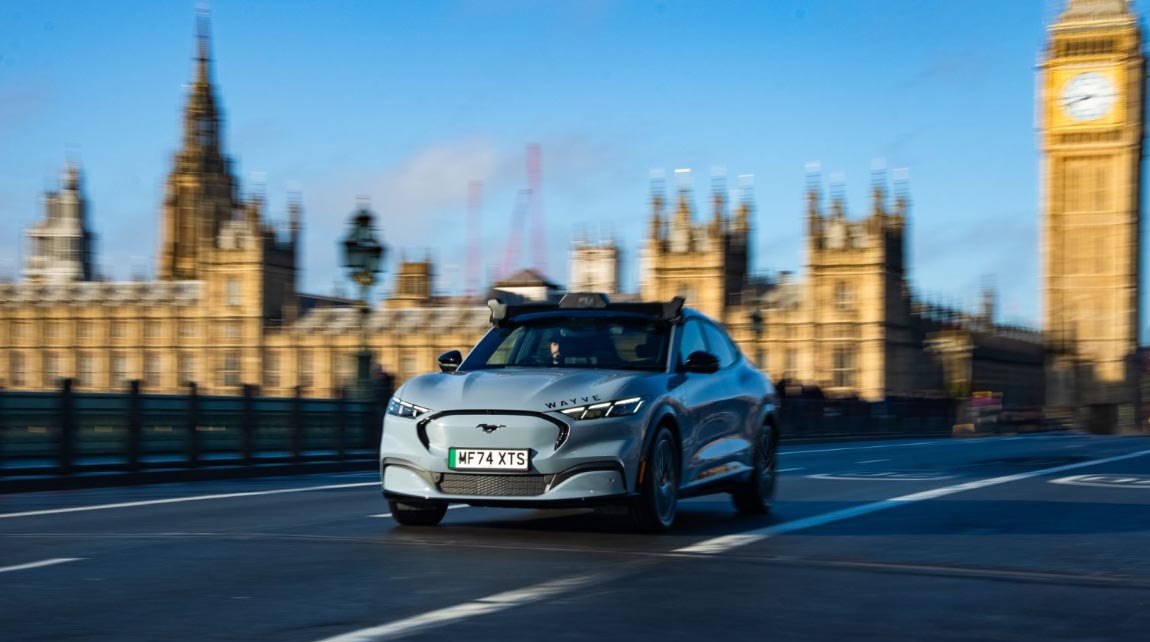
Uber and Wayve have cleared a key regulatory hurdle for their planned robotaxi service in London after Transport for London (TfL) issued Private Hire Vehicle licences for a number of Wayve’s autonomous electric vehicles.
The licensed fleet consists of fully electric Ford Mustang Mach-E models modified with Wayve’s AI Driver autonomous driving system, surround-view cameras and radar. TfL has inspected the vehicles to verify that they meet its required standards.
Licensing Moves Robotaxi Service Closer To London Launch
The vehicle licences satisfy one part of the “triple lock” requirement for private hire journeys in London, under which the operator, driver and vehicle must all hold licences from the same regulatory authority.
The planned robotaxi journeys will operate under the UK’s AV Trialling Code of Practice and Uber’s existing TfL licence. However, the vehicles will not initially operate without human supervision.
A trained safety driver who holds a TfL licence will remain inside each vehicle during the early trials. The driver will monitor the autonomous system and can intervene or take control whenever necessary.
Wayve’s vehicles are designed to perform driving tasks autonomously, but the continued presence of a safety driver reflects the regulatory requirements for the current testing phase.
Strong Interest From London Passengers
The partnership has attracted significant interest from potential passengers. Uber said more than 100,000 people have joined its waiting list for the London robotaxi programme over the past eight weeks.
Selected users are expected to take part in initial test rides during the summer, giving passengers an opportunity to experience Wayve’s autonomous driving technology before the service moves towards a broader launch.
“This licence is an important step towards giving Londoners the chance to experience autonomous driving technology,” said Sarah Gates, vice president of Global Affairs Assurance at Wayve.
Gates said Wayve would continue working with regulators, communities and the public as it moves towards deploying autonomous rides in London.
Annie Duvnjak, Global Head of Autonomous Mobility Operations at Uber, described the licence as an important milestone for bringing autonomous rides to London through the ride-hailing platform.
More Regulatory Approvals Still Required
Despite the latest approval, the licensing of the vehicles does not mean that a fully driverless commercial robotaxi service can begin immediately.
Wayve and Uber still face additional regulatory requirements covering autonomous vehicle testing, safety demonstrations and operating permissions. The UK has also established an application process for operating licences for robotaxi pilot projects.
For now, the London programme therefore remains a supervised autonomous driving trial rather than a fully driverless public service.
The partnership forms part of Uber’s wider strategy to introduce autonomous mobility services in multiple markets. Uber participated in a $1 billion funding round for Wayve in February and said the companies were targeting more than 10 global markets for robotaxi deployments, including London.
The two companies are also pursuing autonomous mobility opportunities in other cities. In Tokyo, Uber and Wayve are working with Nissan as an additional partner.
The London project could provide an important test for the commercial deployment of AI-powered autonomous vehicles in a densely populated European city, while also giving regulators further experience in overseeing robotaxi operations.