
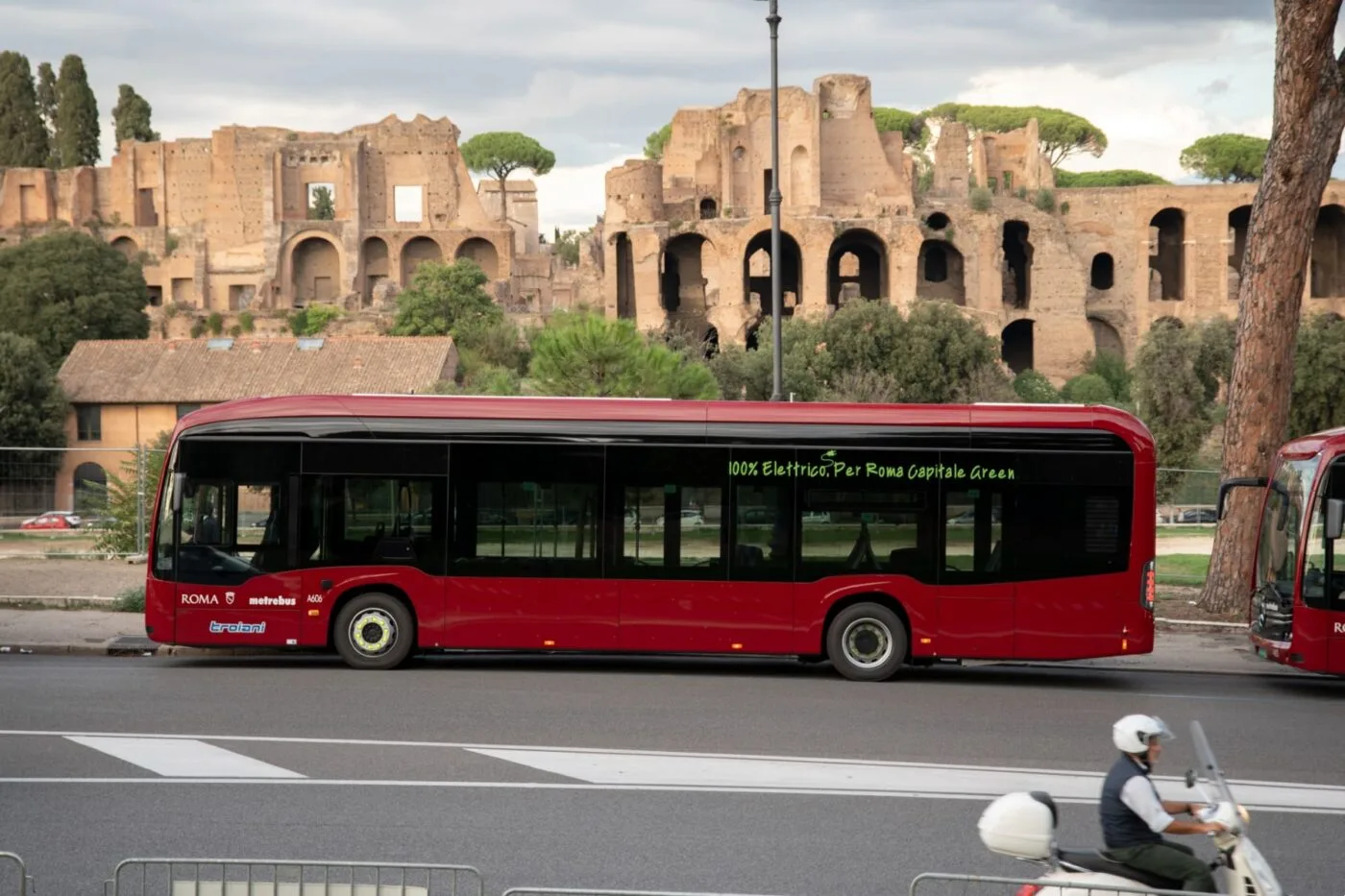
Italy’s central purchasing agency Consip has issued a €650 million tender for the procurement of 600 electric buses, marking another significant step in the country’s ongoing push to decarbonise public transport. The new tender, which spans urban, intercity, and regional applications, is part of Italy’s broader National Recovery and Resilience Plan and aligns with European Union climate targets.
Organised into five vehicle categories, the tender includes 70 minibuses (30 five-metre and 40 six-metre models), all specified with plug-in battery electric systems. In the midibus range, Consip is seeking 90 eight-metre and 50 nine-metre plug-in buses, along with 90 ten-metre midibuses, collectively valued at over €240 million.
The largest segment in terms of volume covers standard 12-metre buses, with 190 allocated for urban use (€223.6 million) and an additional 60 Class II interurban models (€67.8 million) for longer-distance routes. The procurement also includes 50 articulated 18-metre buses—35 with plug-in charging (€51.1 million) and 15 equipped with pantograph systems (€22.8 million) to enable rapid, high-power charging via overhead infrastructure.
“With this procurement, Consip continues its commitment to supporting fleet renewal and energy transition in Italy’s public transport sector,” the agency said in a statement. “The framework is designed to serve a wide variety of operational needs while accelerating the rollout of zero-emission vehicles across the country.”
Italy has emerged as a fast-growing market for electric buses in Europe. In 2024 alone, the country added approximately 1,000 electric buses to its fleet. According to sector data, electric drivetrains accounted for 20 per cent of new bus registrations in Italy last year, rising to 40 per cent for city buses.
This is not Consip’s first large-scale electric bus procurement. In 2022, it issued a tender for 1,000 zero-emission buses, and in 2023, followed up with a 500-unit tender that also included hydrogen fuel cell vehicles. The latest initiative further underscores Italy’s strategy to modernise public transport while reducing emissions across municipalities and regional transit networks.