



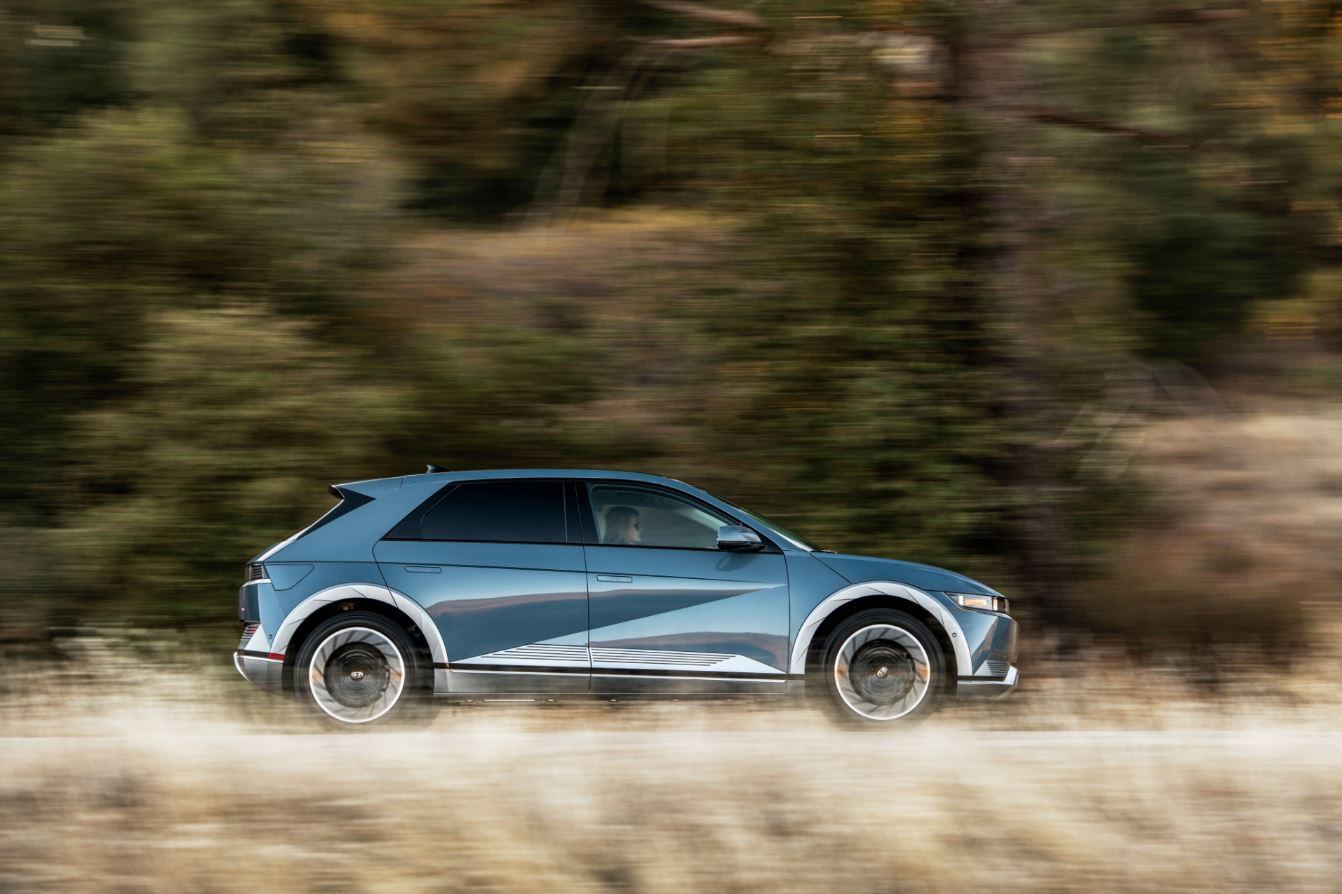
Hyundai has started local assembly of the Ioniq 5 in Thailand, allowing the automaker to reduce the electric SUV’s selling price as it expands its presence in one of Southeast Asia’s fastest-growing electric vehicle markets.
The locally assembled Ioniq 5 is priced at 1.699 million baht, compared with 1.988 million baht for the previously imported model from South Korea. The reduction of 289,000 baht, or about 15%, reflects the cost savings achieved through domestic production.
Local Production Reduces Purchase Price
To support the launch, Hyundai is offering an introductory discount of 300,000 baht for the first 400 customers purchasing the locally assembled model. The promotion lowers the effective purchase price to 1.399 million baht, representing total savings of 589,000 baht, or roughly 30%, compared with the imported version.
Hyundai previously announced plans to assemble electric vehicles in Thailand through a partnership with Thonburi Automotive Assembly Plant (TAAP). The Thailand Board of Investment approved Hyundai’s investment of approximately 1 billion baht to support local production of electric vehicles and battery systems.
TAAP already manufactures vehicles for Mercedes-Benz in Thailand and is expected to assemble the Ioniq 5 under the partnership.
Thailand Becomes Seventh Global Production Hub
With the start of local assembly, Thailand becomes the seventh country where Hyundai produces the Ioniq 5, joining South Korea, the United States, Singapore, Vietnam, Indonesia, and India.
Hyundai said the Thai-built model is offered exclusively in the N Line variant, making Thailand the only overseas production base for that configuration.
The vehicle is powered by a rear-mounted permanent magnet synchronous motor producing 168 kilowatts of power and 350 Newton-meters of torque. Energy is supplied by an 84-kilowatt-hour nickel manganese cobalt (NMC) battery pack.
According to Hyundai, the Thai-specification Ioniq 5 N Line accelerates from 0 to 100 km/h in 7.5 seconds, reaches a top speed of 185 km/h, and offers a WLTP driving range of up to 530 kilometers.
The battery can be charged from 10% to 100% in about 7.35 hours using a 10.5-kilowatt AC charger. When connected to a 350-kilowatt DC fast charger, charging from 10% to 80% takes approximately 18 minutes.
Hyundai’s latest investment aligns with Thailand’s strategy to expand domestic electric vehicle manufacturing and strengthen its role as a regional production hub for battery-powered vehicles.


