
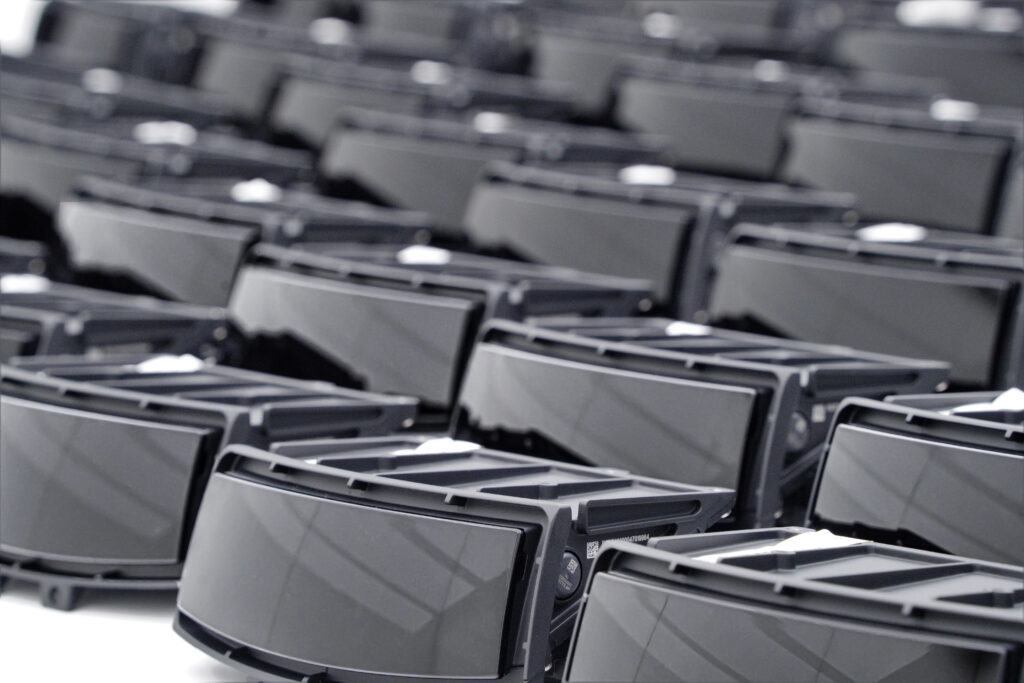
Hesai Group reported higher first-quarter profit and revenue as strong demand for automotive and robotics LiDAR systems drove a sharp increase in shipments.
The company posted net income of 18.3 million yuan ($2.7 million) for the three months ended March 31, marking its fourth consecutive quarter of profitability under U.S. GAAP accounting standards.
That compared with a net loss of 17.5 million yuan during the same period a year earlier.
First-quarter revenue rose 29.6% year-on-year to 680.6 million yuan.
Hesai said the results were supported by a 140.9% increase in total LiDAR shipments, which reached 471,723 units during the quarter.
ADAS LiDAR shipments increased 141.9% to 353,441 units, while robotics LiDAR deliveries rose 137.8% to 118,282 units.
Chief executive Li Yifan also announced that Hesai had become a strategic LiDAR supplier for Mercedes-Benz models supporting Level 3 autonomous driving capabilities.
According to the company, the agreement covers vehicle programmes in Europe and China, with production supported by Hesai’s Galileo manufacturing facility in Thailand.
Hesai said it is broadening its corporate strategy beyond “spatial perception” into what it describes as “spatial intelligence.”
As part of the transition, the company reorganized its reporting structure into two divisions: LiDAR Business and Strategic Growth Initiatives.
In April, Hesai introduced its first spatial intelligence product, called Kosmo, during the company’s Tech Day 2026 event.
The device is designed to support development of real-world three-dimensional data infrastructure for artificial intelligence applications.
The company expects Strategic Growth Initiatives to generate approximately 100 million yuan in revenue this year, with initial contributions beginning in the second quarter.
Despite revenue growth, Hesai’s gross margin declined to 39.1% from 41.7% a year earlier due to a higher contribution from lower-margin products.
The company also unveiled a new chip technology called Picasso, which it described as the world’s first six-dimensional full-colour ultra-sensitive chip.
The chip will be integrated into Hesai’s high-end ETX LiDAR system, with mass production expected to begin in the second half of 2026.
Looking ahead, Hesai forecast second-quarter revenue between 850 million yuan and 900 million yuan, representing projected annual growth of 20% to 27%.