


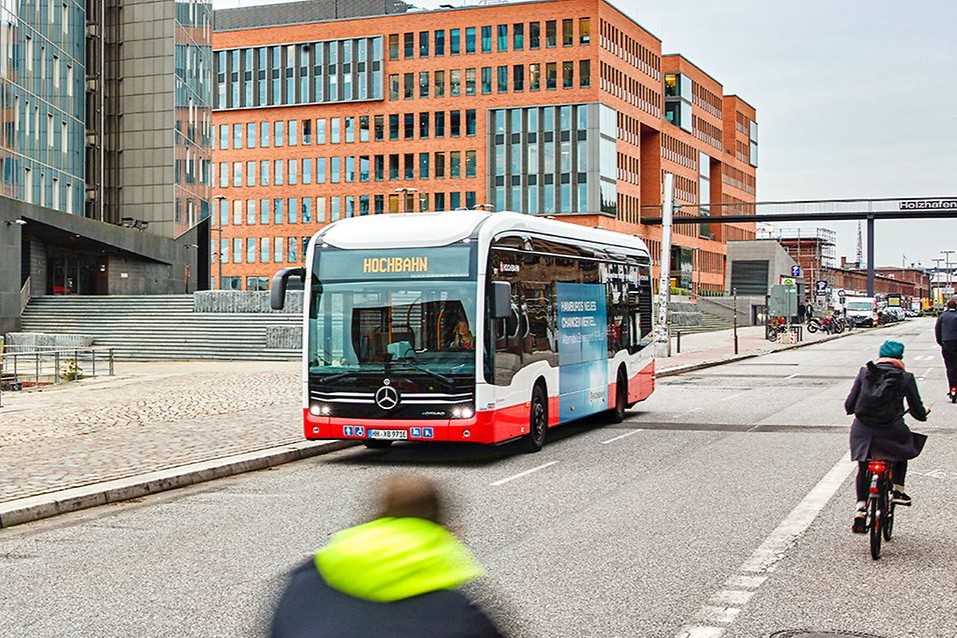
Hamburger Hochbahn plans to procure up to 240 additional battery-electric buses by 2031 as the German transit operator continues expanding its zero-emission fleet, although its earlier goal of operating a fully emission-free bus fleet by 2032 has been pushed further into the future.
The company also intends to add up to 150 additional buses powered by hydrotreated vegetable oil (HVO), reflecting a broader strategy focused on both fleet electrification and operational resilience.
See also: EUROGATE and Embotech Launch Autonomous Terminal Tractor Pilot in Hamburg
Hamburger Hochbahn has long been regarded as one of Germany’s leading public transport operators in electric bus deployment. Alongside Verkehrsbetriebe Hamburg-Holstein, the company had originally targeted a complete phase-out of diesel buses by 2030 before revising the timeline nearly two years ago to the “early 2030s,” with 2032 later identified as the revised target.
However, a spokesperson for Hochbahn told electrive that the transition to a fully locally emission-free fleet now depends heavily on federal support measures.
“A successful transition of entire bus fleets to Electric drives requires support from the federal government,” the spokesperson said, without providing a revised completion date.
See also: Hamburg Port Authority Lifts Time Slot Limits for Electric Trucks in Pilot Through 2026
Since 2020, Hochbahn has procured only zero-emission buses for regular fleet additions. The operator currently runs 432 fully battery-electric buses, accounting for approximately 39% of its fleet. Including hybrid vehicles, nearly 500 of the company’s roughly 1,200 buses are now electrified.
Hendryk Münster, head of department at Hochbahn, recently told electrive that the planned procurement programme could increase the share of fully electric buses to around 60% by 2031.
The additional electric buses are expected to come under a framework agreement signed with Daimler Buses at the end of 2024. Under the agreement, Daimler Buses was selected as the sole supplier for up to 350 electric buses, including the Mercedes-Benz eCitaro and Mercedes-Benz eCitaro G models.
See also: Hamburg Votes to Accelerate Climate Neutrality to 2040, Paving Way for Combustion Engine Phase-Out
Despite the planned expansion, around 40% of the fleet would still not be fully electric by 2031.
At the same time, Hochbahn said it would expand its use of HVO fuel for a limited number of conventionally powered buses. Existing diesel-powered vehicles have gradually been converted to HVO operation since January 2026 to reduce calculated carbon dioxide emissions from the non-electric portion of the fleet.
The company said maintaining multiple propulsion technologies would improve the resilience of public transport operations in scenarios including energy supply disruptions, spikes in transportation demand during emergencies, and interruptions affecting charging infrastructure availability.
“Our direction remains clear: we are consistently advancing the electrification of our bus fleet. At the same time, we bear the responsibility of ensuring that public transport remains stable, flexible, and reliable even in exceptional situations,” said Robert Henrich, chief executive of Hochbahn.
See also: Hamburg Begins Testing Autonomous Holon Minibus For Public Transport
Saskia Heidenberger, board member for bus operations, said sustainability and operational resilience needed to be addressed simultaneously.
“A high-performance public transport system must achieve two things today: become more sustainable while also being resilient to crises and disruptions. These two goals are not contradictory but must be considered together,” Heidenberger said.