
Researchers at the Fritz Haber Institute of the Max Planck Society in Berlin have gained new insights into how catalysts function inside hydrogen fuel cells, findings that could help guide future improvements in efficiency, durability and material use in the technology.
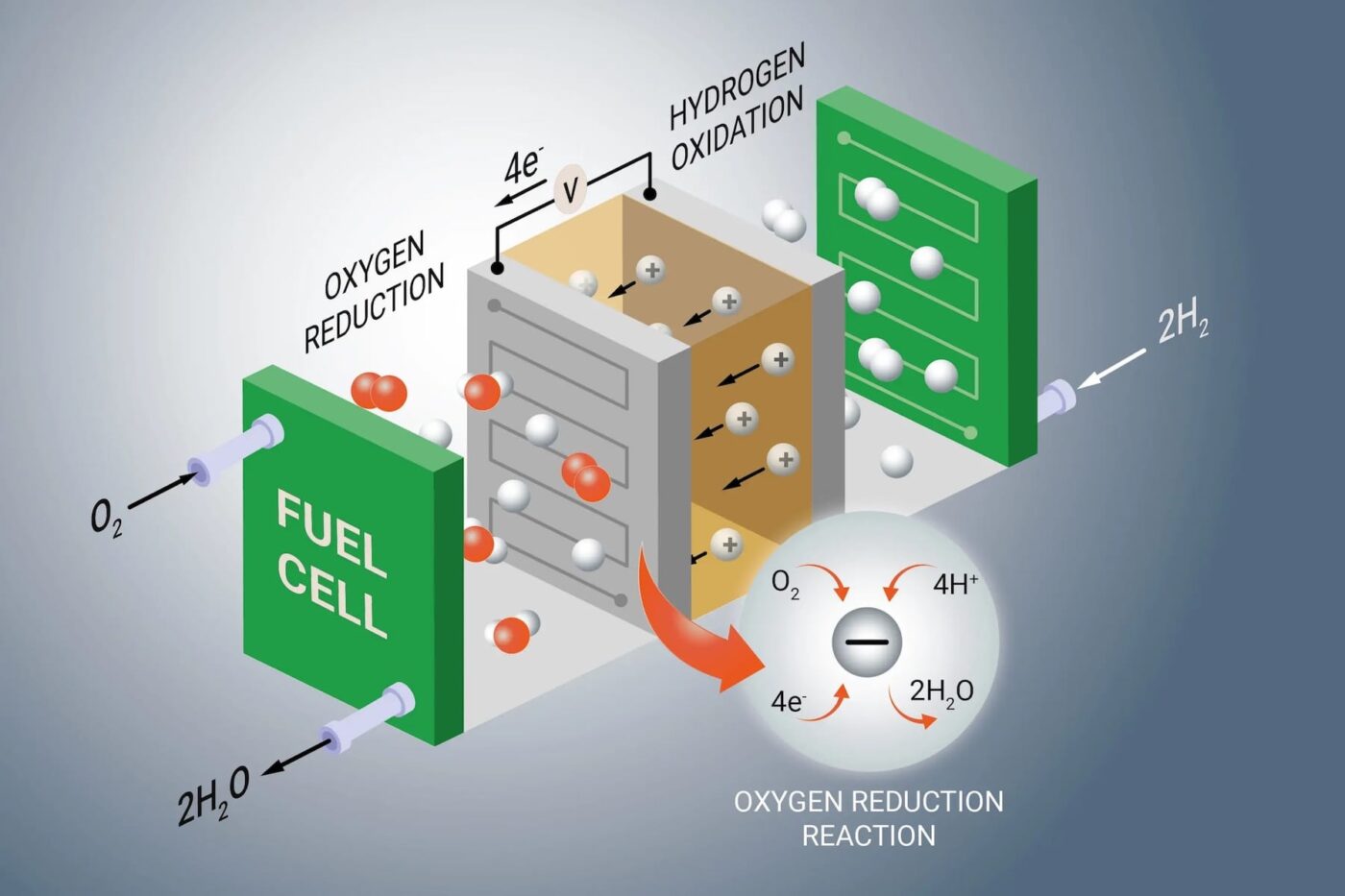
Unlike catalysts in internal combustion engines, which are used to reduce harmful exhaust emissions, fuel cell catalysts play a direct role in generating electricity. In hydrogen fuel cells, hydrogen is not burned but electrochemically converted into electrical power. Catalysts accelerate the otherwise slow reactions at the anode, where hydrogen is split into protons and electrons, and at the cathode, where oxygen reacts with protons and electrons to form water. Without catalysts, these reactions would proceed too slowly to produce meaningful amounts of electricity.
See also: Toyota Announces 2026 Mirai Fuel Cell Sedan With 402-Mile Range and $51,795 Starting Price
Despite their central role, the electrochemical processes governing fuel cell catalysts have remained relatively under-explored. The Fritz Haber Institute addressed this gap by systematically studying how the activity of four different fuel cell catalysts changes under varying voltages and pressures. The results showed that catalyst performance cannot be explained by a single rate-limiting reaction step, a simplifying assumption that has dominated the field for decades.
“For decades, researchers have frequently applied analyses and theories based on the assumption that there is a single rate-determining reaction step,” said Sebastian Öner, head of the research team. “Our work breaks with this tradition. We provide a kinetic framework for analysing operando spectroscopy and microscopy, which have been used for decades to study voltage-dependent structural and chemical changes.”
See also: BMW CEO Warns Europe Risks Falling Behind in Hydrogen Technology Race
Öner added that the team focused on understanding how voltage- and pressure-dependent microscopic dynamics collectively influence catalyst behaviour. “A central question is how overpotential- and pressure-dependent dynamic, microscopic properties influence the entire ensemble, ultimately defining the activation parameters. Our results provide new impetus for future research,” he said.
While the findings do not translate directly into a commercial product, researchers say they reshape the fundamental understanding of fuel cell reactions. The new framework could support more realistic modelling of operating conditions, guide the development of more efficient catalysts with lower platinum content, and help improve the robustness and longevity of fuel cell systems used in transport and stationary energy applications.