
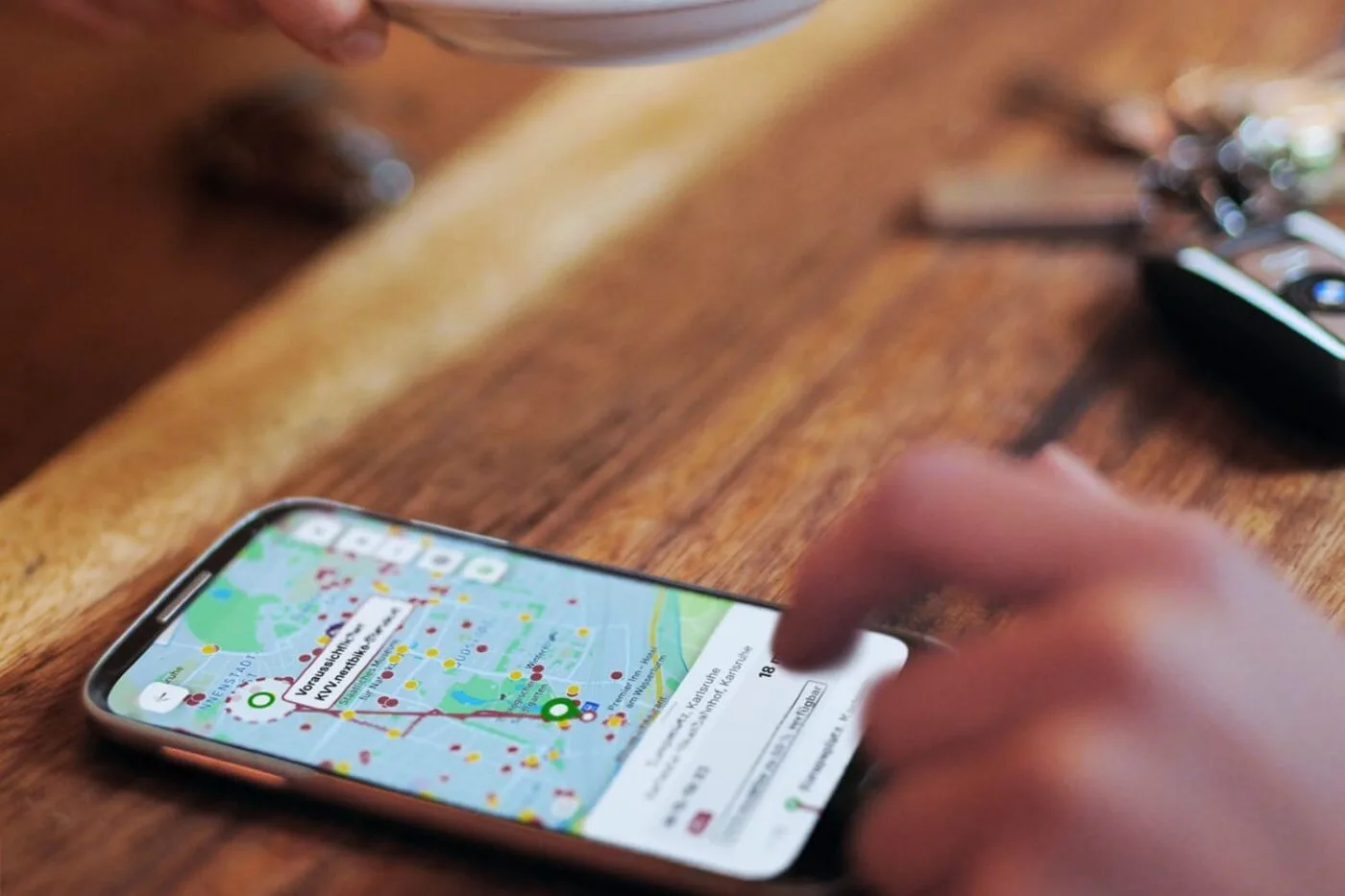
Researchers at Germany’s Fraunhofer IOSB in Karlsruhe have developed an artificial intelligence (AI) system designed to predict the availability of shared transport vehicles, such as e-scooters and hire bikes, in urban areas. The project, called DAKIMO, seeks to make public transport and shared mobility more reliable and encourage people to leave their private cars at home.
DAKIMO, which stands for ‘Data and AI as enablers for sustainable, intermodal mobility’, is supported by the German Federal Ministry of Research with funding of 3.5 million euros. Fraunhofer IOSB is collaborating with Karlsruhe-based transport companies Raumobil GmbH, INIT GmbH, Inovaplan GmbH, as well as the Karlsruhe Institute of Technology and the Karlsruhe Transport Association.
“Our AI forecasting feature recommends the optimal means of transportation to reach the destination in each individual case, including for the different segments of the route, without overcomplicating things. Bookable vehicles, including car-sharing cars, are displayed at both the start and end of the trip,” said Jens Ziehn, project manager at Fraunhofer IOSB.
The AI system calculates short- and long-term probabilities for the availability of shared vehicles using live traffic data, historical usage patterns, and open data sources. Reinhard Herzog, head of Fraunhofer IOSB’s Modelling and Networking group, explained: “Forecasting is possible because the AI uses small geographical cells and short time intervals to calculate expected availability based on public transit and historical data on aspects like the position of shared bikes.”
The forecast is already integrated into a test version of the Karlsruhe Regiomove app and is set for broader deployment across Baden-Württemberg. Researchers also plan to incorporate the system into the international General Bikeshare Feed Specification (GBFS), enabling real-time predictions of vehicle availability.
A study of over 1,500 people commissioned as part of the project showed nearly 90% of participants found the AI forecast helpful, with around 20% indicating they might occasionally leave their cars at home in favor of public transport. “Our research findings confirm that AI-based methods can effectively support the mobility transition and contribute to climate action,” Ziehn said.