
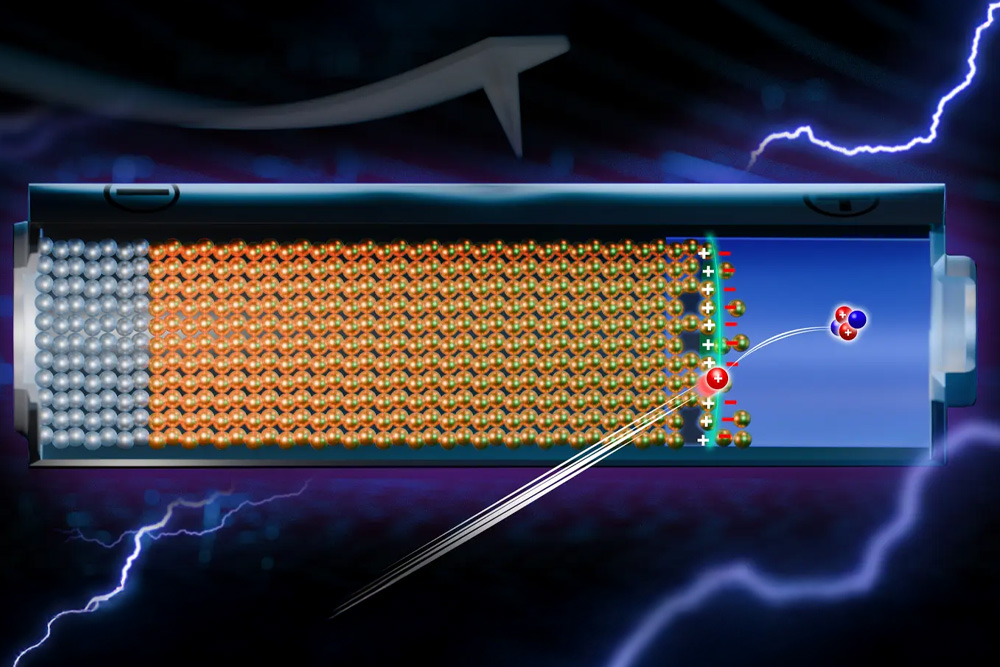
Researchers from Germany’s Max Planck Institute for Polymer Research (MPI-P) and several Japanese universities have identified how so-called space charge effects create resistance inside solid-state batteries, a finding that could help improve the performance of next-generation energy storage technologies, the institutes said.
The team investigated how space charge layers form at internal battery interfaces and how they impede the flow of ions during charging and discharging. Using advanced microscopic techniques, the researchers said they were able to determine, for the first time, the spatial extent of the space charge zone and quantify its contribution to overall battery resistance. Their findings were recently published in the journal ACS Nano.
See also: LG Chem Develops Uniform Solid-Electrolyte Technology for All-Solid-State Batteries
The researchers found that the space charge effect is most pronounced at the positive electrode, where a layer thinner than 50 nanometres forms — comparable to the thinnest part of a soap bubble. The charge layer repels migrating ions and adds resistance inside the battery. “A battery is a kind of pump,” said Rüdiger Berger, a group leader at MPI-P. “Ions, or charged atoms, move inside the battery, which must be balanced on the outside by a flow of electrons and thus a flow of current.” As ions accumulate, “this charge layer creates additional resistance and thus losses within the battery,” the team said. The layer accounts for roughly 7% of total battery resistance, though its impact varies depending on the electrolyte material.
Until now, the thickness and electrical impact of this charge layer had remained poorly understood, with previous studies producing widely differing estimates. To resolve this, the international team built a thin-film model battery and analysed it using Kelvin probe force microscopy and nuclear reaction analysis. These methods allowed the researchers to observe electrical potentials in near real time and detect lithium accumulation at the interface with the positive electrode. “Both techniques are new in battery research and can also be used for other questions in the future,” said Taro Hitosugi from the University of Tokyo.
See also: China Builds First Large-Capacity Solid-State Battery Line as GAC Targets 2027–2030 Mass Production
The researchers said the findings provide a scientific basis for reducing internal resistance and boosting solid-state battery performance by optimising electrode materials or structures. Further work will focus on identifying practical ways to suppress space charge formation and enhance power output and efficiency.