

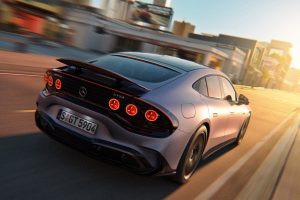



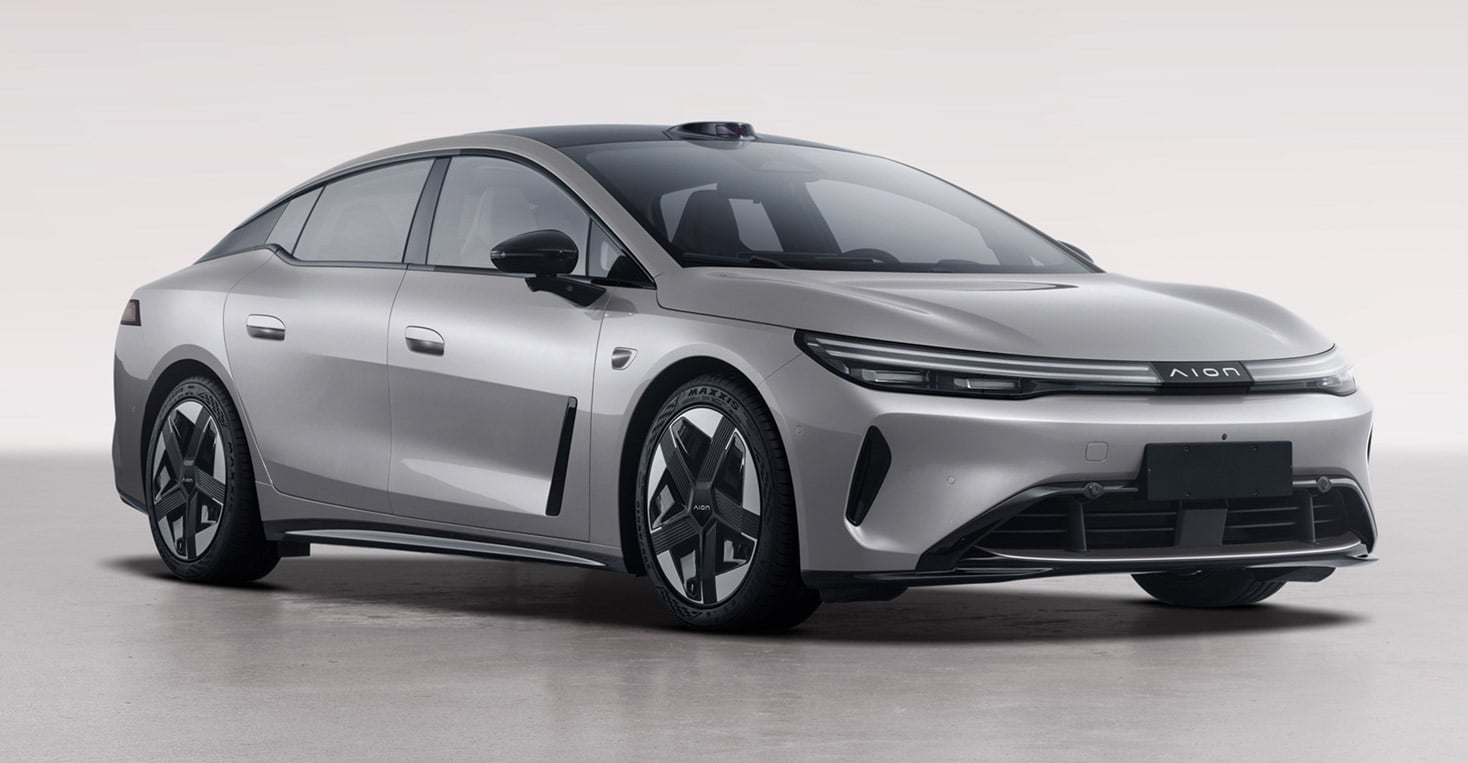
GAC Aion, the electric vehicle brand of GAC Group, has completed a regulatory filing for the Ray 7 in China, bringing the first model in its new Ray series closer to commercial launch.
China’s Ministry of Industry and Information Technology (MIIT) included the five-seat battery-electric sedan in its latest group of vehicle filings released on Friday. GAC Aion has yet to announce the model’s final price, driving range or launch date.
Fastback Sedan Introduces New Ray Series
The Ray 7 measures 4,960 mm long, 1,900 mm wide and 1,455 mm high, with a wheelbase of 2,920 mm.
Regulatory images show a low and wide stance, a fastback-style roofline and a closed front fascia typical of a battery-electric vehicle.
The filing lists two versions with curb weights of 1,720 kg and 1,855 kg. Both have a top speed of 180 km/h.
The Ray 7 is powered by a permanent-magnet synchronous motor supplied by Huawei, producing up to 180 kW, or about 241 horsepower.
Two LFP Battery Suppliers
The two variants use lithium iron phosphate batteries, but their battery suppliers differ.
One configuration uses cells from CATL, while the other is equipped with batteries supplied by Yinpai Battery, GAC Aion’s own battery business.
The regulatory filing does not disclose battery capacities or official driving ranges.
GAC Aion has also listed several optional equipment configurations, including roof-mounted LiDAR, fender cameras, different wheel designs and brake-caliper colours.
Some versions can be ordered without the roof-mounted LiDAR and fender cameras. A “Ray 01” badge is also shown among the vehicle’s exterior configurations.
New Architecture And Driver Assistance
GAC Aion introduced the Ray series on July 28, describing the Ray 7 as a “super electric sedan loved by young people.”
The Ray 7 will be the first model to carry GAC Aion’s new logo.
The company has also highlighted what it calls a “super chassis,” incorporating a chip-level integrated drive-and-control architecture that GAC Aion says is the first of its kind globally.
Driver assistance is another major focus. GAC Aion previously said the Ray 7 would use a LiDAR-based system and algorithms derived from technology developed for Level 4 autonomous driving.
The regulatory filing confirms that LiDAR will be available, although detailed specifications for the vehicle’s assisted-driving system have not yet been released.
Ray 7 Arrives As GAC Aion Sales Recover
The new Ray series comes as GAC Aion’s sales show signs of recovery following a weaker 2025.
The brand delivered 28,807 vehicles in July, up 36.37% from the same month a year earlier, according to data compiled by CnEVPost.
For the first seven months of the year, GAC Aion sold 210,386 vehicles, an increase of 62.08% year on year.
The growth contrasts with 2025, when the brand’s full-year sales declined 22.62%.
The Ray 7 will therefore enter the market as GAC Aion seeks to sustain its sales recovery while expanding its electric sedan portfolio with a new design identity, updated vehicle architecture and LiDAR-based driver-assistance technology.


