




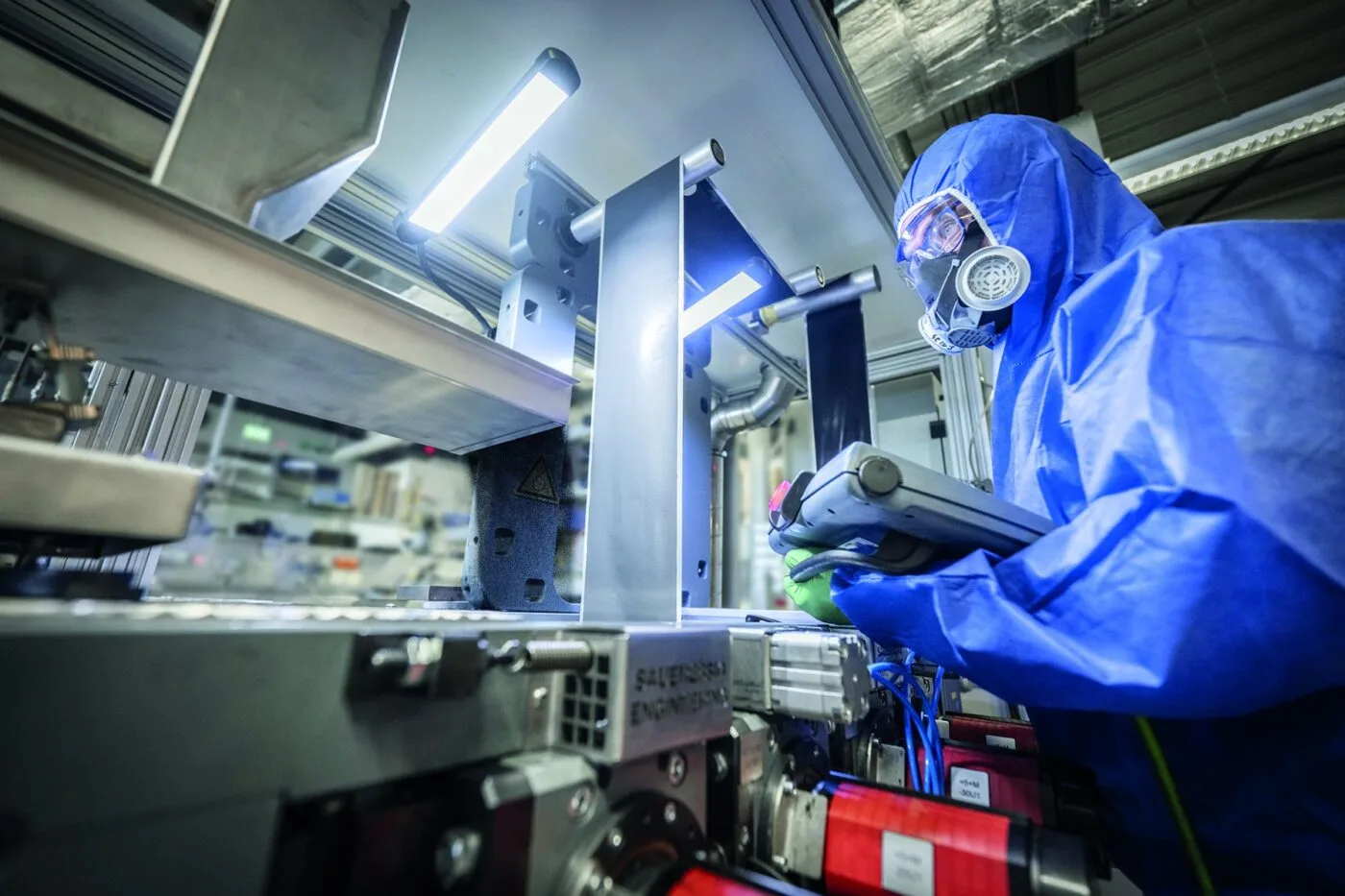
Fraunhofer IWS has inaugurated its DRYplatform, a facility designed to scale solvent-free battery electrode coating from laboratory experiments to near-industrial production, the institute said on Wednesday. The platform is intended as a “lighthouse” project to support the transfer of dry electrode-coating technology from research to industry.
At the center of the facility is Fraunhofer’s DRYtraec process, which replaces conventional wet coating methods by eliminating solvents and energy-intensive drying stages. The system features a flexible dry-air multi-chamber setup with precise humidity control, high-intensity mixers for powder preparation, and an interconnected data infrastructure linking inline and offline analysis for rapid process optimisation.
The institute said the DRYplatform will support partners across the battery value chain, including powder suppliers validating formulations, equipment manufacturers optimising systems, and cell producers testing performance under near-industrial conditions. The facility is designed to complement Fraunhofer’s Research Fabrication Battery Cell (FFB), which plans to commission a DRYtraec-based production line later this year.
Dry-coating technology is seen as a way to maintain industrial competitiveness while enabling early adoption by cell manufacturers. The platform is capable of evaluating methods for lithium-ion, solid-state, sodium-ion, and lithium–sulphur batteries, helping companies decide whether to supplement or replace wet-coating processes in future production.
The project received €3.7 million in funding from the German Federal Ministry of Education and Research (BMFTR).
See also: Fraunhofer ISE Unveils Flexible Platform to Accelerate Fuel Cell MEA Production
“DRYplatform integrates state-of-the-art dry-coating and analytics infrastructure, from powder preparation and cell testing to the digital interconnection of all process data,” said Prof. Christoph Leyens, Director of Fraunhofer IWS. “It accelerates the transfer from science to industry and provides our partners with a research environment unmatched anywhere in the world.”
Dr. Benjamin Schumm, Head of Particle Technology, added: “We systematically linked material development, plant engineering, and process analytics. That lets us deliver fast, reliable answers to complex questions – a capability only possible through the breadth of expertise at Fraunhofer IWS.”


