



Fraunhofer ITWM has joined 16 European partners in a new EU-funded project called “Stellar”, which seeks to develop a cost-effective and sustainable roll-to-roll test facility for producing lithium metal (LiM) battery anode foils. The project, officially launched in June 2025, will run for four years and is backed by €7.9 million in funding from the European Commission.
The initiative, formally titled “Safe, Sustainable, and High-throughput Production of Reliable Lithium Metal Anodes for Gen 4b/4c/5 Batteries”, aims to address key challenges in producing lithium metal anodes—materials known for their higher energy density compared to conventional lithium-ion batteries but limited by safety and manufacturing constraints.
See also: Fraunhofer ISE Unveils Flexible Platform to Accelerate Fuel Cell MEA Production
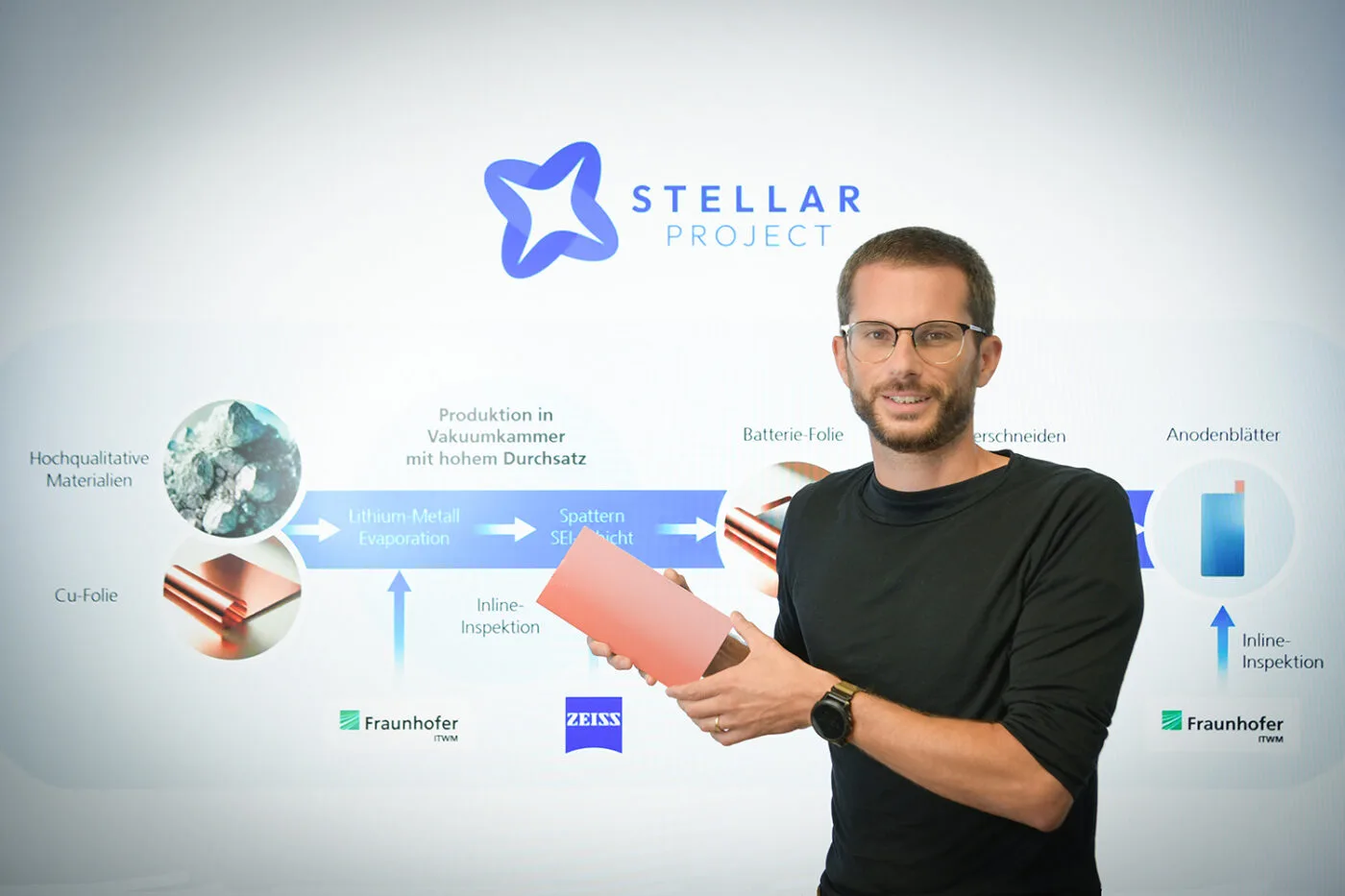
The pilot plant, hosted by Belgian battery developer Avesta Holding, will serve as the primary site for testing and developing the new production system. The process involves applying thin lithium layers onto copper foils inside a vacuum chamber using continuous roll-to-roll technology, enabling efficient production of large-area and flexible anodes. Researchers will closely monitor film properties such as thickness, surface texture, electrical conductivity, and cutting quality under complex vacuum conditions.
Fraunhofer ITWM will contribute to the project by developing optical measurement technologies to monitor and control the lithium coating process. “With our broad portfolio of measurement technology, we can individually adapt the most suitable methods to the very specific requirements,” said Dr. Stefan Duran, project manager at Fraunhofer ITWM.
See also: Fraunhofer IWU, EDAG to Build Automated Pilot Plant for EV Battery Disassembly in Chemnitz
The new facility is expected to reach an annual production capacity of around 60 kilometres of anode foil, maintaining lithium layer thicknesses between 5 and 15 micrometres. According to the European Commission’s funding portal, the Stellar project will also focus on integrating digital twin technologies for real-time process optimisation and designing LiM-based battery modules and packs for future large-scale industrial applications.
The project represents an important step in Europe’s efforts to strengthen its battery manufacturing ecosystem, supporting sustainable production methods and enhancing competitiveness in next-generation energy storage technologies.


