


Fraunhofer IAF and Ambibox have developed a gallium nitride (GaN)-based power electronics module for bidirectional electric vehicle charging as part of the GaN4EmoBiL research project, with a demonstrator set to be unveiled at the PCIM Expo & Conference in Germany next week.
The project aims to reduce the cost of bidirectional charging systems by replacing conventional power semiconductor technologies with GaN-based components designed for high-efficiency operation in 800-volt charging applications.
Targeting Lower-Cost Bidirectional Charging
Bidirectional charging enables electric vehicle batteries to both receive and supply electricity, allowing vehicles to function as energy storage systems for homes and electricity grids.
The technology supports applications such as Vehicle-to-Home (V2H) and Vehicle-to-Grid (V2G), where stored energy can be fed back into buildings or the grid when needed.
Current bidirectional charging systems typically use either silicon carbide (SiC) semiconductors, which offer high efficiency but come with higher costs, or conventional silicon-based components that are generally less efficient.
The GaN4EmoBiL project, launched in 2023, seeks to improve this balance by using gallium nitride technology to lower system costs while maintaining performance.
New 1,200-Volt GaN Power Module
Fraunhofer IAF and Ambibox have developed a new power electronics module using 1,200-volt-class gallium nitride semiconductors mounted on a specially designed insulating substrate.
The module is intended for use in bidirectional DC charging systems for 800-volt electric vehicles.
Researchers say the technology could support wider adoption of bidirectional charging by reducing equipment size, weight and cost.
Demonstrator to Debut at PCIM 2026
The project partners will showcase a prototype bidirectional charger at the PCIM Expo & Conference 2026, scheduled to take place in Nuremberg from June 9 to June 11.
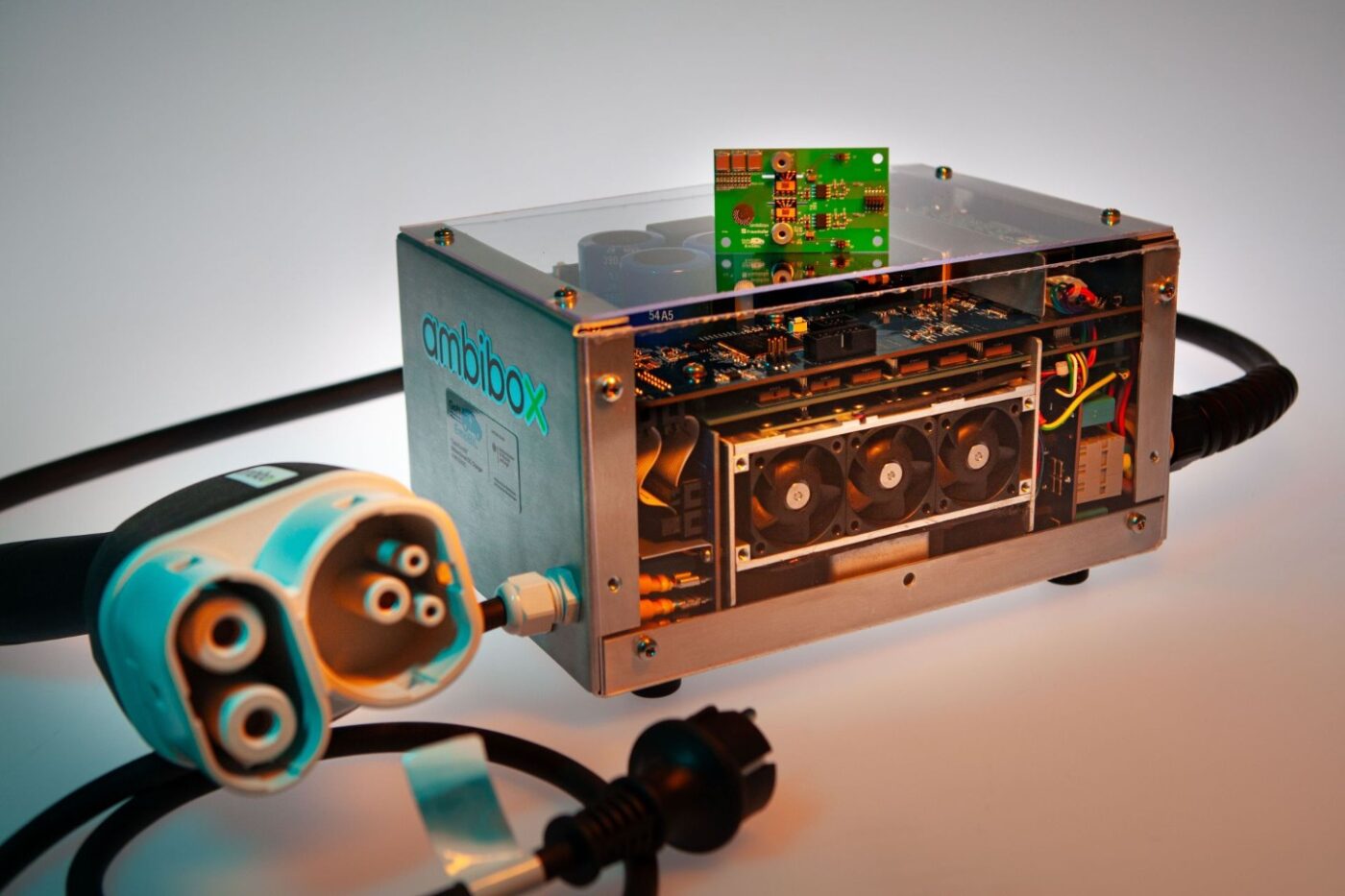
The demonstrator is a single-phase off-board DC charger capable of delivering up to 3 kW of bidirectional charging power.
“The single-phase demonstrator of an off-board EV charger with up to 3 kW of bidirectional power addresses an existing gap in the trade-off between cost, flexibility, efficiency, and compactness for bidirectional charging,” said Stefan Mönch, coordinator of the GaN4EmoBiL project.
Compact Off-Board Charging Design
Unlike traditional on-board chargers that are integrated into vehicles, the GaN4EmoBiL system places the power conversion hardware outside the vehicle.
Fraunhofer IAF said the design offers greater flexibility while reducing size and weight.
The demonstrator supports both CCS and Schuko connectors and has a total volume of 8.3 litres.
The complete system weighs 5.7 kilograms, including charging cables and plugs.
Although its charging capacity is lower than the 11 kW and 22 kW charging systems commonly installed in electric vehicles, the project partners say the mobility and compact design make it suitable for a range of bidirectional charging applications.
Supporting Future Energy Integration
The project reflects growing interest in integrating electric vehicles into energy systems as distributed storage assets.
Vehicle-to-grid and vehicle-to-home technologies are increasingly viewed as tools for balancing renewable energy generation, supporting grid stability and enabling consumers to participate in energy markets.
By developing a smaller and potentially lower-cost bidirectional charging solution, the GaN4EmoBiL partners aim to help accelerate broader adoption of these technologies in the future.