
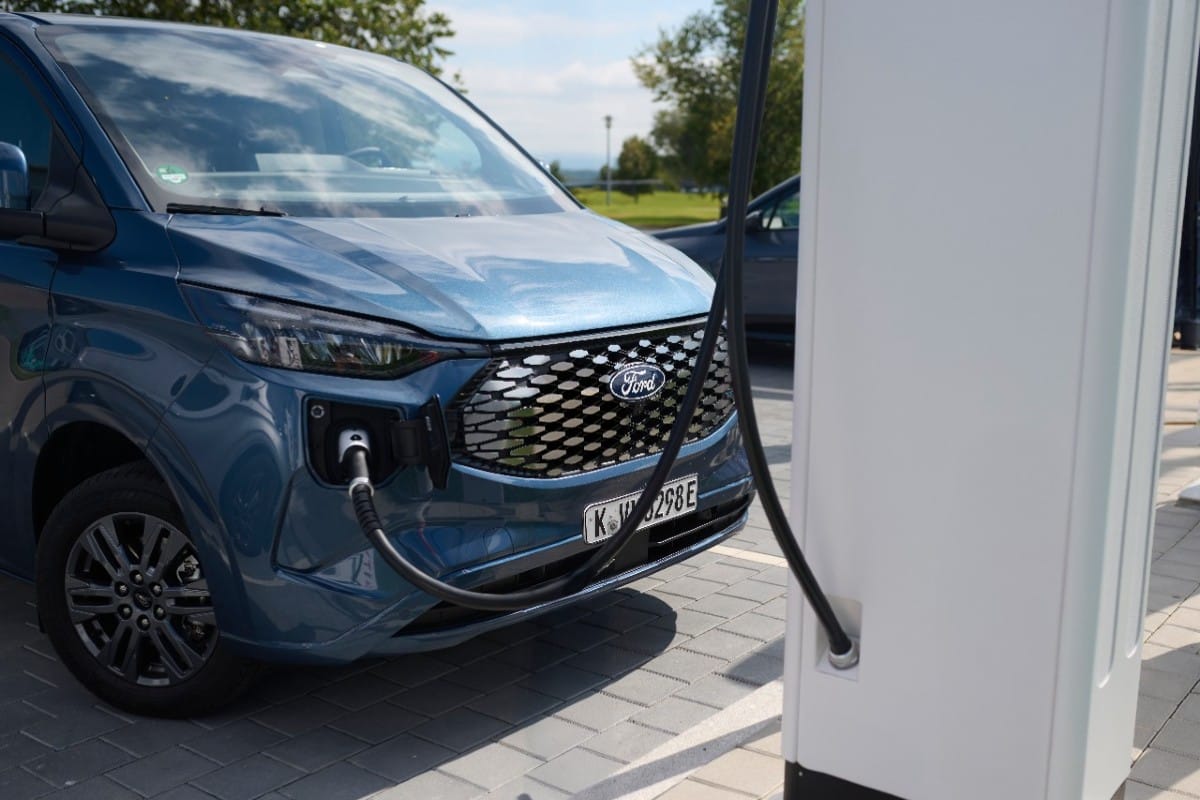
Ford Motor will increase the usable battery capacity of its E-Transit Custom van and E-Tourneo Custom passenger variant to 70 kilowatt-hours from early 2026, lifting the maximum WLTP driving range to up to 370 kilometres and cutting charging times, the company said. The update marks an improvement of about 13% in range compared with the current 64 kWh net battery, which is rated at up to 337 km under the WLTP test cycle.
Ford said the higher usable capacity will be achieved without changing the physical battery hardware. “We can now utilise a higher proportion of the energy content,” a company spokesperson said, adding that while the gross battery size remains the same, the unlocked net capacity will increase by 6 kWh. At a 125 kW DC fast charger, the updated models will be able to charge from 10% to 80% in around 29 minutes, about 10 minutes faster than before.
Existing E-Transit Custom vehicles will not receive additional usable battery capacity but will gain faster charging through an over-the-air software update. Ford said charging from 10% to 80% of usable capacity will drop from around 39 minutes to approximately 25 minutes. “We are committed to helping businesses maximise the potential of their company vehicles by continuously improving the product even after delivery,” said Hans Schep, general manager of Ford Pro Europe, pointing to software updates and connected services as part of Ford’s customer strategy.
From early 2026, Ford will also offer a new all-wheel-drive version of the E-Transit Custom, in which an additional electric motor on the front axle works alongside the rear drive unit. The AWD variant will be available with output levels of 100 kW, 160 kW and 210 kW, with the highest-power version offering up to 630 Nm of torque and a maximum towing capacity of 2.3 tonnes. Ford said the independently controlled dual-motor system is designed to improve traction on construction sites, mountainous roads and in winter conditions. The company has not yet disclosed the WLTP range for the all-wheel-drive version.
Ford has been offering the E-Transit Custom in Europe since mid-2024, with deliveries in the DACH region starting in the fourth quarter of last year. The one-tonne van is built at the Ford-Otosan plant in Yeniköy, Turkey, and is available as a battery-electric, plug-in hybrid and combustion model. The platform also underpins an electric Volkswagen derivative produced under a cooperation agreement between the two automakers.