
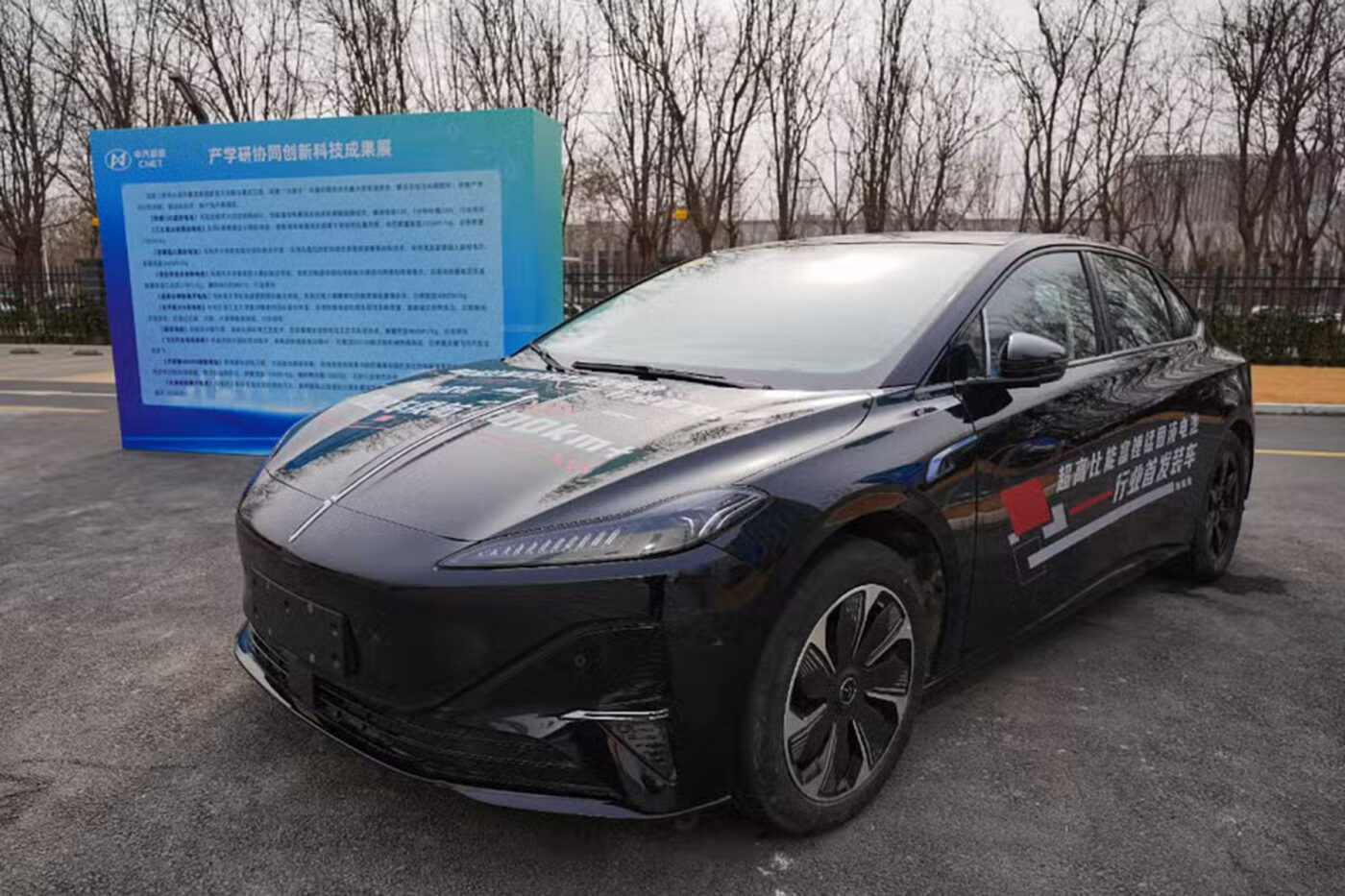
China’s FAW Group has begun testing prototype vehicles equipped with semi-solid-state batteries developed by its battery subsidiary China Automotive New Energy Battery (CANEB), marking another step toward commercialisation of advanced battery technologies.
The new battery pack, installed in a prototype from FAW’s premium Hongqi marque, has a capacity of 142 kWh and is claimed to deliver a driving range exceeding 1,000 kilometres under China’s CLTC testing cycle. While full specifications have not been disclosed, Chinese reports indicate cell energy density above 500 Wh/kg—significantly higher than current mainstream lithium-ion batteries.
At that density, the cells alone would weigh roughly 285 kilograms, though the complete pack would be heavier due to cooling systems, structural components, wiring and control electronics. Engineers are using vehicle trials to evaluate not only battery performance but also required adaptations to thermal management and power electronics.
Unlike many semi-solid-state designs that modify existing NMC or NCA chemistries by replacing liquid electrolyte with a hybrid version, CANEB’s battery reportedly uses a lithium-rich manganese-based chemistry. According to industry reports, the system employs an in-situ-cured composite electrolyte designed to provide high ionic conductivity, flame resistance and improved compatibility between components.
The battery also features an in-situ-formed lithium negative electrode, which aims to enhance safety and cycle life while avoiding the higher costs associated with metallic lithium anodes. The manufacturer cites a cathode capacity of about 300 mAh per gram.
Prototype testing follows earlier announcements by Hongqi that it had begun real-world trials of solid-state battery systems in the Hongqi Tiangong 06. The company previously described that programme as the first installation of a complete solid-state system in a production-type vehicle, though details suggest the technology may include semi-solid elements rather than a fully solid electrolyte.
Automakers worldwide are investing heavily in next-generation batteries, which promise higher energy density, improved safety and faster charging compared with conventional lithium-ion cells. However, large-scale commercial production remains challenging due to cost, durability and manufacturing hurdles.