
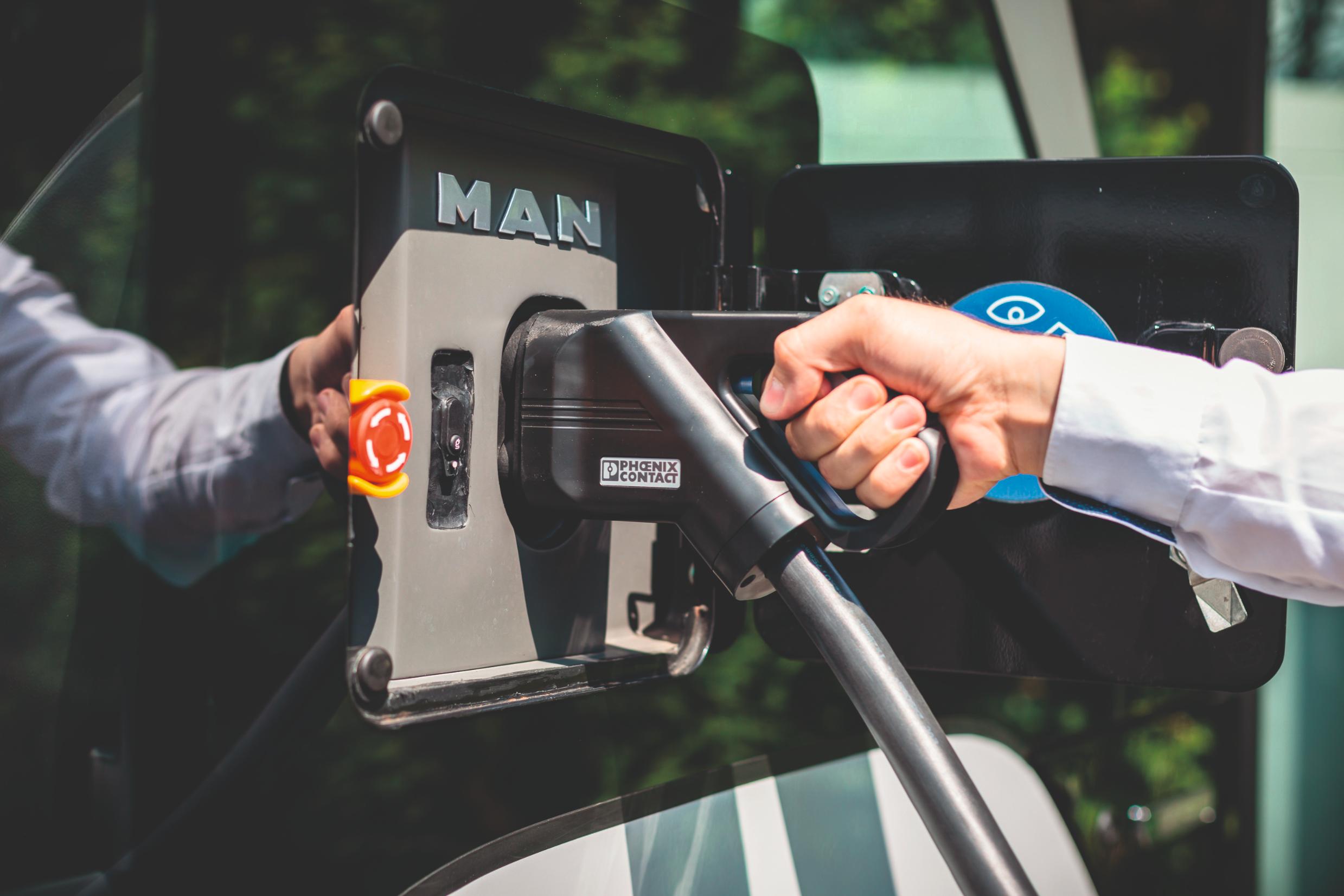
The European Commission has approved a German state aid scheme worth up to €1.6 billion to support the rollout of fast-charging infrastructure for battery-electric heavy-duty vehicles along the country’s motorways, clearing the way for large-scale public funding of e-truck chargers.
The approval allows Germany to proceed with subsidies for charging stations at unmanaged motorway rest areas, after Brussels assessed the plan under EU state aid rules designed to prevent market distortion and unfair competition.
See also: EU Plans to Ease 2035 Combustion Engine Restrictions, Allowing Hybrids Beyond Deadline
The scheme covers the deployment of up to around 1,410 charging points at more than 120 non-serviced rest sites across Germany, the Commission said. The German government launched a tender in September 2024 for charging hubs at 130 unmanaged rest areas, forming part of a broader plan to establish a nationwide e-truck charging network.
“The approved measure supports the development of a cross-border charging network, aligning with the Commission’s ‘Fit for 55’ ambitions and the Alternative Fuels Infrastructure Regulation,” the Commission said, adding that concerns raised by third parties over potential competition issues were assessed and dismissed.
See also: EU Approves Sweden’s Climate Social Plan To Support Electric Car Access
Brussels concluded that the aid is “necessary and appropriate” to accelerate the deployment of fast-charging infrastructure for electric heavy-duty vehicles, noting that the investments would not be made “to the same extent and within the same timeframe without the public support.” It said safeguards were included to limit the impact on competition and intra-EU trade.
Teresa Ribera, the Commission’s executive vice-president for a clean, just and competitive transition, said the scheme would support both climate and industrial objectives. “This scheme will contribute to the decarbonisation of the road transport sector in Germany by adding crucial charging infrastructure along the German motorways,” Ribera said. “It will help the automotive industry to ramp up the transition to sustainable and smart mobility.”
The funding is part of Germany’s initial e-truck fast-charging network programme launched in 2024, which foresees support for 350 sites in total — 220 at managed rest areas and 130 at unmanaged sites. So far, only the unmanaged locations have been tendered, with a second round for serviced rest areas still pending.
Under the plan, charging stations must offer at least 400 kW per CCS charging point and 1,000 kW per MCS charging point, meeting the requirements for long-haul electric freight transport.
Germany is among several EU member states seeking to accelerate heavy-duty vehicle electrification as part of the bloc’s wider climate strategy, while ensuring compliance with EU competition and state aid rules.