


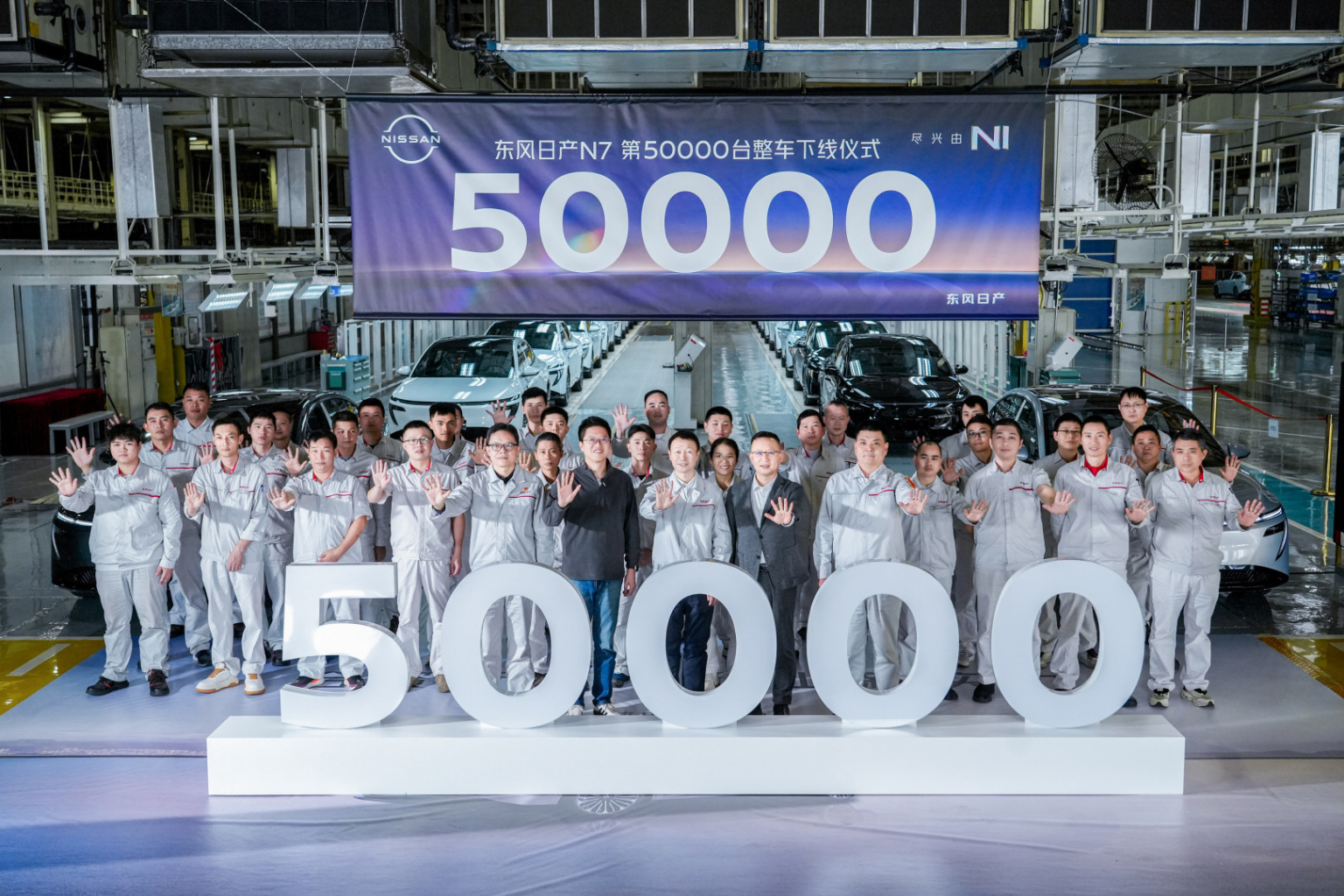
The 50,000th unit of the Dongfeng Nissan N7 rolled off the production line on Dec. 11, marking a key milestone for the Japanese automaker’s China joint venture as it accelerates its transition toward new energy vehicles.
Launched on April 27 with prices ranging from 119,900 yuan to 149,900 yuan ($16,900–$21,100), the mid-to-large-sized electric sedan reached the milestone in just eight months. The model has played a central role in reversing sales declines at Dongfeng Nissan, which has been under pressure amid intensifying competition in China’s car market.
See also: Dongfeng’s Voyah Launches Passion L Hybrid Sedan to Compete in China’s Luxury Market
The N7 was developed with a high degree of autonomy for the Chinese joint venture. Dongfeng Nissan said it had “decision-making authority over 99.9% of the content” during development, covering product definition, research and development, and supply chain selection. The car measures 4,930 mm in length with a wheelbase of 2,915 mm and is positioned in the competitive mid-to-large sedan segment.
Higher-end versions of the N7 are equipped with Qualcomm’s Snapdragon 8295P cockpit chip and a 15.6-inch central display, while advanced driver-assistance functions are powered by Nvidia’s Orin X chip and software from Chinese autonomous driving firm Momenta. Market response has been strong, with pre-orders exceeding 10,000 units within two weeks of launch and firm orders topping 20,000 units within 50 days, the company said.
See also: Dongfeng Nissan Files NX8 SUV With 800-Volt Platform and Dual EV Powertrains in China
Monthly deliveries surpassed 10,000 units in August, helping Dongfeng Nissan achieve consecutive month-on-month sales growth from June. Building on the N7’s momentum, the company launched the N6 plug-in hybrid sedan in December and plans to introduce the NX8 mid-to-large SUV in the first half of 2026, offering both extended-range and fully electric variants. Dongfeng Nissan said it aims to roll out at least five new energy models by the end of 2026 as part of its broader electrification strategy.


