



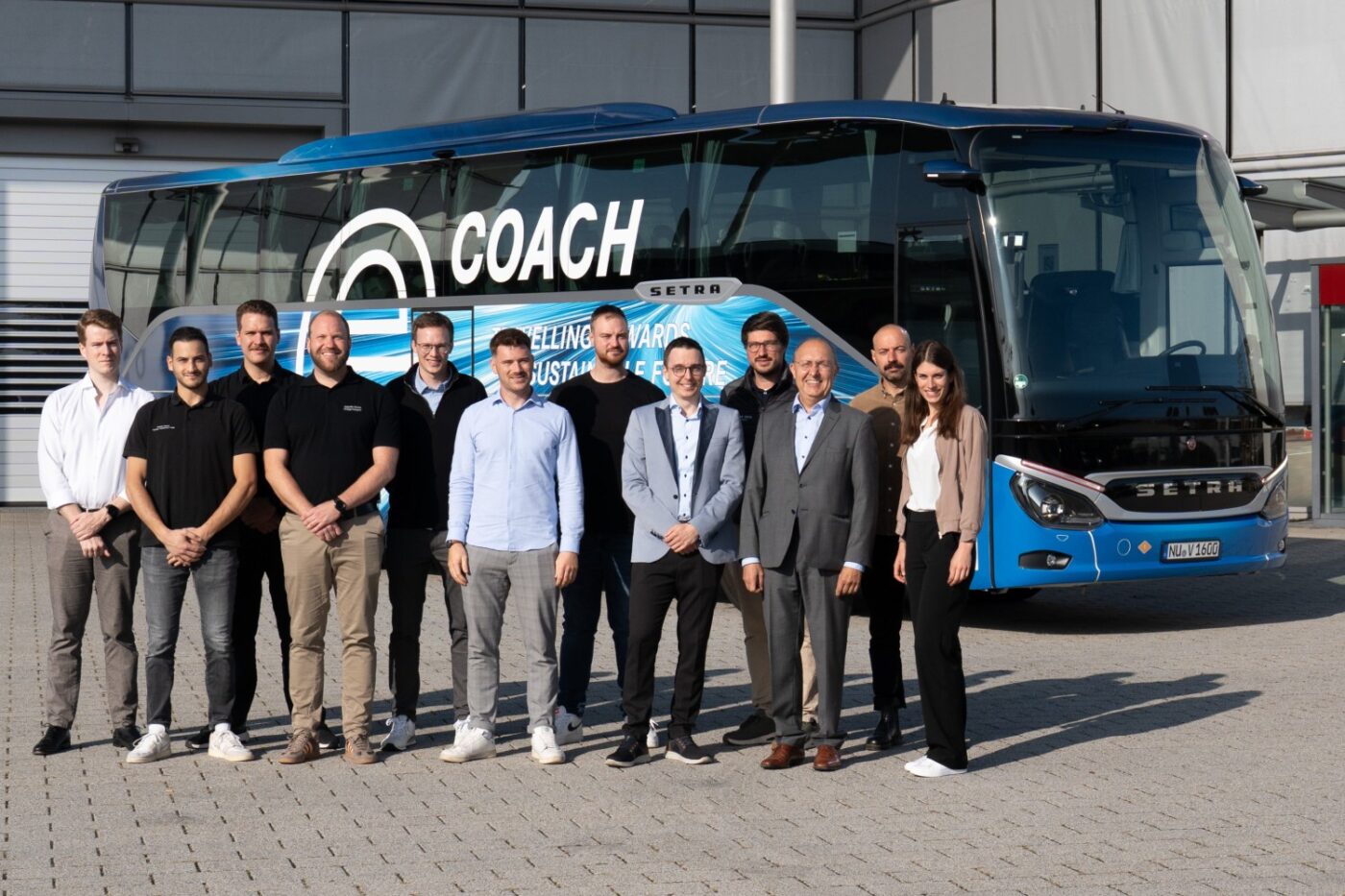
Daimler Buses and its partners in the government-funded Electrified Coach (ELCH) project have completed a joint test drive of a technology demonstrator capable of travelling more than 500 kilometres. The test took place in Neu-Ulm, Germany, marking a milestone in the development of battery-electric coaches.
The project, coordinated by Daimler Buses, began in 2022 and is scheduled to continue until the end of 2026. Its objective is to develop a modular electric powertrain and validate technologies that could support future series-production coaches under the Mercedes-Benz and Setra brands.
The demonstrator is being used to evaluate technical concepts and gather data to guide the development of electric coaches for long-distance travel.
Testing Electric Coach Technology
The test drive in Neu-Ulm allowed the project partners to assess the demonstrator under real-world conditions. The meeting also provided an opportunity to review progress and coordinate the remaining work ahead of the project’s scheduled conclusion.
Beyond the electric powertrain and battery, the project addresses energy consumption, aerodynamics, lightweight construction, economic viability and the practical requirements of long-distance coach operations.
Daimler Buses said the work is intended to advance the development and validation of a battery-electric coach concept suitable for the market.
The project’s findings provide an important basis for the further electrification of the coach segment at Daimler Buses.
Daimler Buses aims to offer battery-electric coaches by the end of the decade. The ELCH project is intended to provide technical and operational insights to support that objective.
Research and Industry Partners
Daimler Buses is coordinating the project with research institutions and industry partners, including the Karlsruhe Institute of Technology (KIT), the University of Mannheim’s Mannheim Institute for Sustainable Energy Studies (MISES), Rhineland-Palatinate Technical University of Kaiserslautern-Landau (RPTU) and Flix SE.
Each partner contributes expertise in a different area of electric coach development.
- Karlsruhe Institute of Technology: The Institute for Information Processing Technologies (ITIV) analyses and processes vehicle data, supporting the optimisation of the coach’s operating strategy.
- RPTU: Its iMAD and SAM institutes investigate lightweight construction and aerodynamic improvements intended to reduce energy consumption and increase range.
- University of Mannheim: MISES evaluates the economic viability of battery-electric coach concepts across different operating scenarios and analyses their competitiveness.
- Flix: The long-distance bus operator contributes real-world operating and usage data and supports the development of practical application profiles and driving cycles.
The combination of research and operational expertise is intended to help the partners assess how electric coaches could perform in real transport services, where range, energy use, operating costs and passenger requirements must be considered together.
Preparing for Battery-Electric Coaches
Daimler Buses views the ELCH project as part of its broader electrification strategy. The company plans to introduce battery-electric coaches under its Mercedes-Benz and Setra brands by the end of the decade.
The demonstrator’s reported range of more than 500 kilometres represents a development milestone, but the project continues to evaluate the technologies and operating conditions needed for commercial use.
With the project scheduled to conclude at the end of 2026, the findings are expected to inform further development of electric coach powertrains, vehicle design and operational concepts. The work will help establish a technical foundation for Daimler Buses as it prepares to extend electrification from urban buses into long-distance coach services.


