
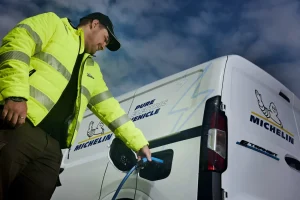


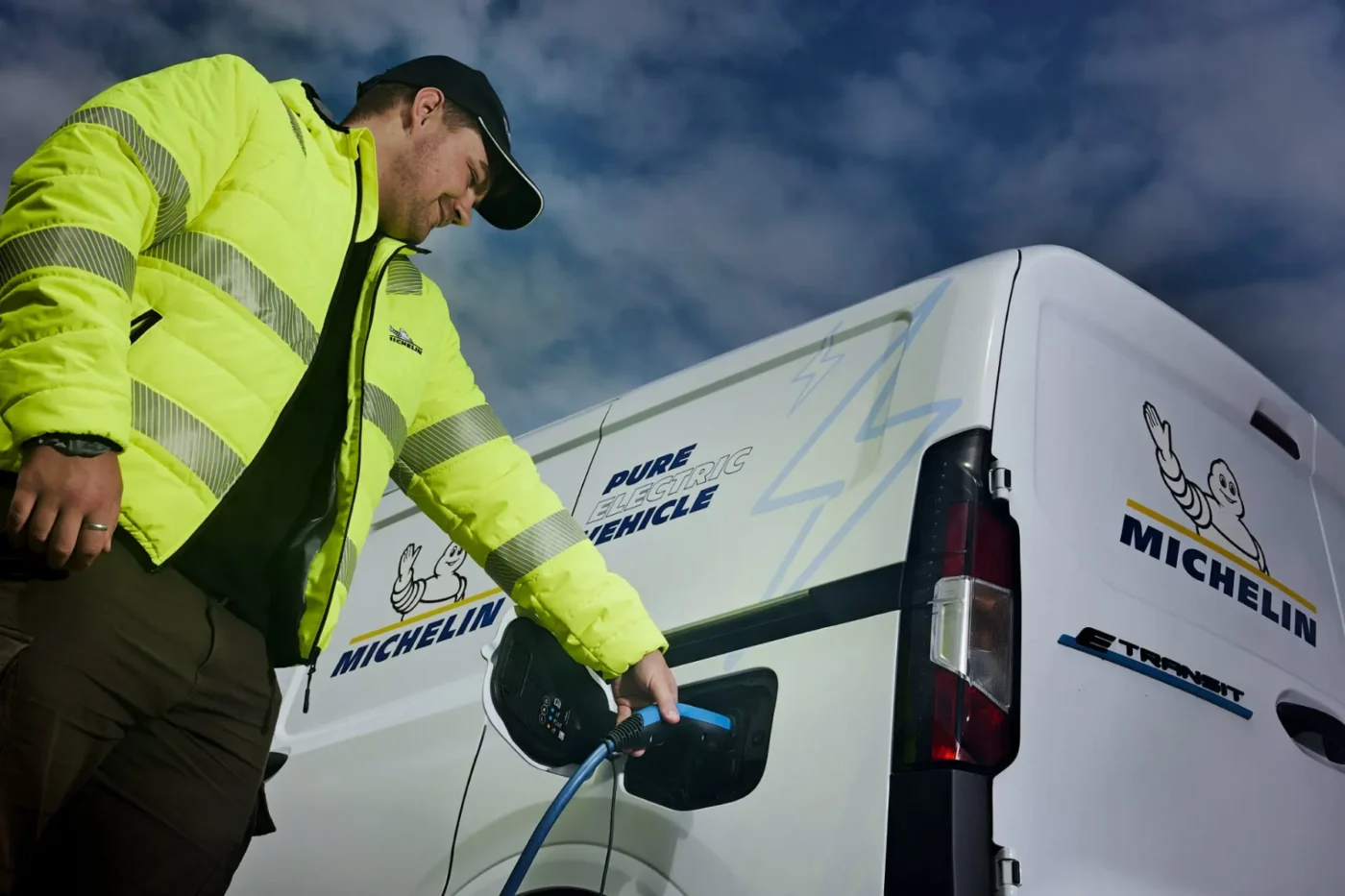
Michelin Connected Fleet has introduced Michelin EV Charge, a charging management solution designed to help corporate fleets manage public charging, monitor energy consumption and control operating costs. Developed in collaboration with Dutch technology provider Deftpower, the platform brings access to more than 1.2 million public charging points across Europe together with billing and vehicle telematics data.
The service allows drivers to locate available charging stations, plan journeys and select charging options through a dedicated application and charging card. For fleet operators, the platform provides centralized access to charging transactions and associated costs across multiple charging networks.
Charging Access and Cost Management
Michelin EV Charge is designed to simplify public charging for businesses operating electric vehicles across different networks. Michelin says the service offers transparent pricing without additional network fees and, in some cases, access to negotiated tariffs.
Centralized billing enables fleet managers to track public charging expenditure across their vehicles and identify differences in charging costs. The platform is intended to reduce the administrative complexity associated with managing multiple charging providers and payment systems.
Integration With Fleet Telematics
A key feature of Michelin EV Charge is its integration of charging information with vehicle and telematics data already collected through Michelin’s MyConnectedFleet platform.
The combined data provides fleet managers with an overview of vehicle journeys, energy consumption, charging status and charging behaviour. By comparing charging transactions with vehicle usage, operators can identify potentially expensive or inefficient charging patterns.
The platform can also recommend more cost-effective charging practices, with the aim of improving energy management and making the total cost of ownership (TCO) of electric fleets easier to monitor.
Sophie Foucque, CEO of Michelin Connected Fleet, said the integration is intended to give businesses more detailed information about how their vehicles are used.
By aggregating charging data with fleet vehicle data, we give companies a more detailed insight into vehicle usage and actionable solutions for bringing energy costs down.
She added:
This new solution gives us more leverage to support fleet managers at each step of their transition to a more sustainable form of mobility by reconciling operational performance and cost control.
Deftpower Provides the Technology Platform
Michelin EV Charge is built on Deftpower’s MSP-2.0 platform, which the Dutch company provides as a white-label solution for mobility service providers. The technology supports the initiation, billing and analysis of charging sessions.
Deftpower also develops managed charging capabilities designed to align charging with vehicle energy requirements and electricity market conditions. Depending on the vehicle, tariff and charging infrastructure, this approach can shift some charging activity to periods when electricity is cheaper or grid demand is lower.
In 2025, Deftpower said that up to two-thirds of the energy used during a charging session could potentially be shifted away from peak periods. The actual amount depends on charging conditions and the flexibility available to each vehicle.
In August 2025, Deftpower secured €12.5 million in investment to support further platform development and expansion. At the time, the company said it was working with more than 40 customers across 10 European countries.
Deftpower CEO Jacob van Zonneveld said the partnership addresses the operational demands associated with fleet electrification.
Fleet electrification should mean lower costs and less complexity, not more work for drivers and fleet managers.
Fleet Electrification Increases Charging Requirements
The launch comes as more commercial fleets adopt electric vehicles, creating additional requirements for charging access, cost tracking and operational planning.
According to the Arval Mobility Observatory Barometer 2026, 57% of surveyed fleets in Germany already had electric vehicles, while a further 19% planned to transition to electric vehicles within three years.
As fleets expand their electric vehicle use, operators must manage charging across different networks, tariffs and access systems. Michelin EV Charge is intended to bring these activities into a single management environment.
Extending Michelin’s Electrification Services
Michelin EV Charge adds public charging management to the existing capabilities of MyConnectedFleet. Companies can already use the platform to assess vehicle suitability for electrification based on real-world usage profiles and monitor metrics such as battery status and driving range.
Michelin also operates Watèa by Michelin, a service launched in 2021 to support the electrification of commercial cars and light commercial vehicles. Its offering initially focused on battery-electric vehicles and was later expanded to include hydrogen fuel-cell vehicles, along with related infrastructure and services.
With EV Charge, Michelin Connected Fleet is extending its fleet electrification activities through a data-driven approach to charging management. Deftpower, meanwhile, gains another fleet-sector partner for its charging technology platform.


