
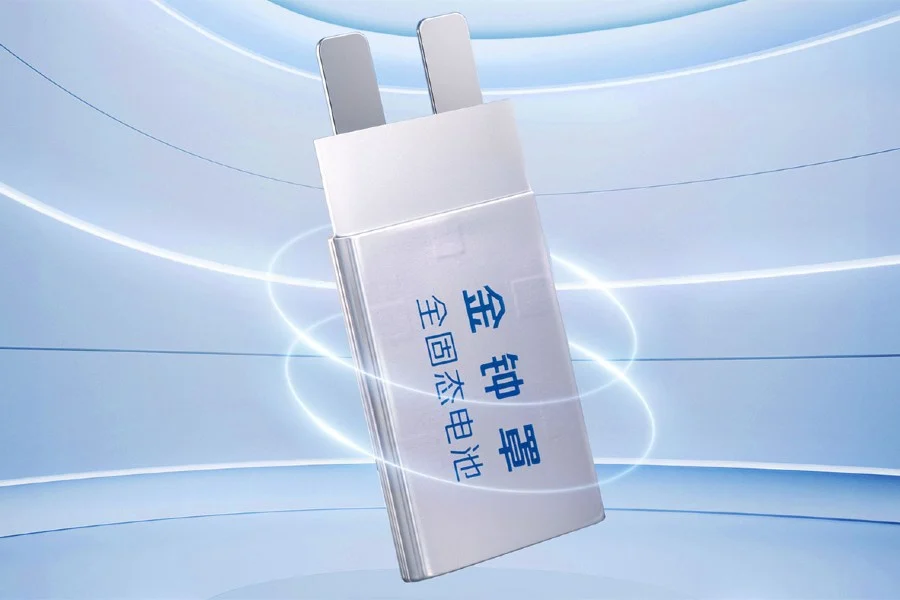
Chinese automaker Changan plans to begin installing solid-state batteries in vehicles for testing before the third quarter of 2026, with mass production scheduled to start in 2027, according to an update filed with the Shenzhen Stock Exchange.
The batteries, part of Changan’s “Golden Bell” lineup, are expected to deliver an energy density of about 400 Wh/kg and enable driving ranges of up to 1,500 kilometres in battery-electric vehicles, figures previously outlined to investors in 2025 and now described in more concrete deployment terms.
Changan said the cells will be introduced initially in robots and electric vehicles as part of validation efforts. The company has provided few technical details beyond performance targets, though it stated that safety could improve by 70% through remote diagnostics and artificial intelligence, without elaborating on the methodology.
The Golden Bell battery brand, launched in November 2023, includes multiple technologies, ranging from conventional lithium-ion cells to semi-solid and fully solid-state designs. Once fully scaled, production capacity could reach 150 GWh, although the allocation among battery types has not been disclosed.
Industry observers expect additional technical information to be released later in 2026 as development progresses.
Changan is pursuing multiple battery strategies simultaneously. In collaboration with battery giant CATL, the company has also begun testing sodium-ion batteries in prototype versions of the Nevo A06 sedan. Those packs, based on CATL’s Naxtra technology, have a lower energy density of about 175 Wh/kg but promise lower costs and reduced reliance on scarce materials such as lithium and nickel.
The Nevo A06 equipped with sodium-ion batteries is rated for around 400 kilometres of range under China’s CLTC testing cycle, highlighting the performance gap between cost-focused sodium-ion solutions and the higher-energy solid-state technology under development.
If successful, Changan’s solid-state batteries could significantly extend electric vehicle range and safety, though commercialization timelines remain uncertain across the industry.
Source: CarNewsChina