
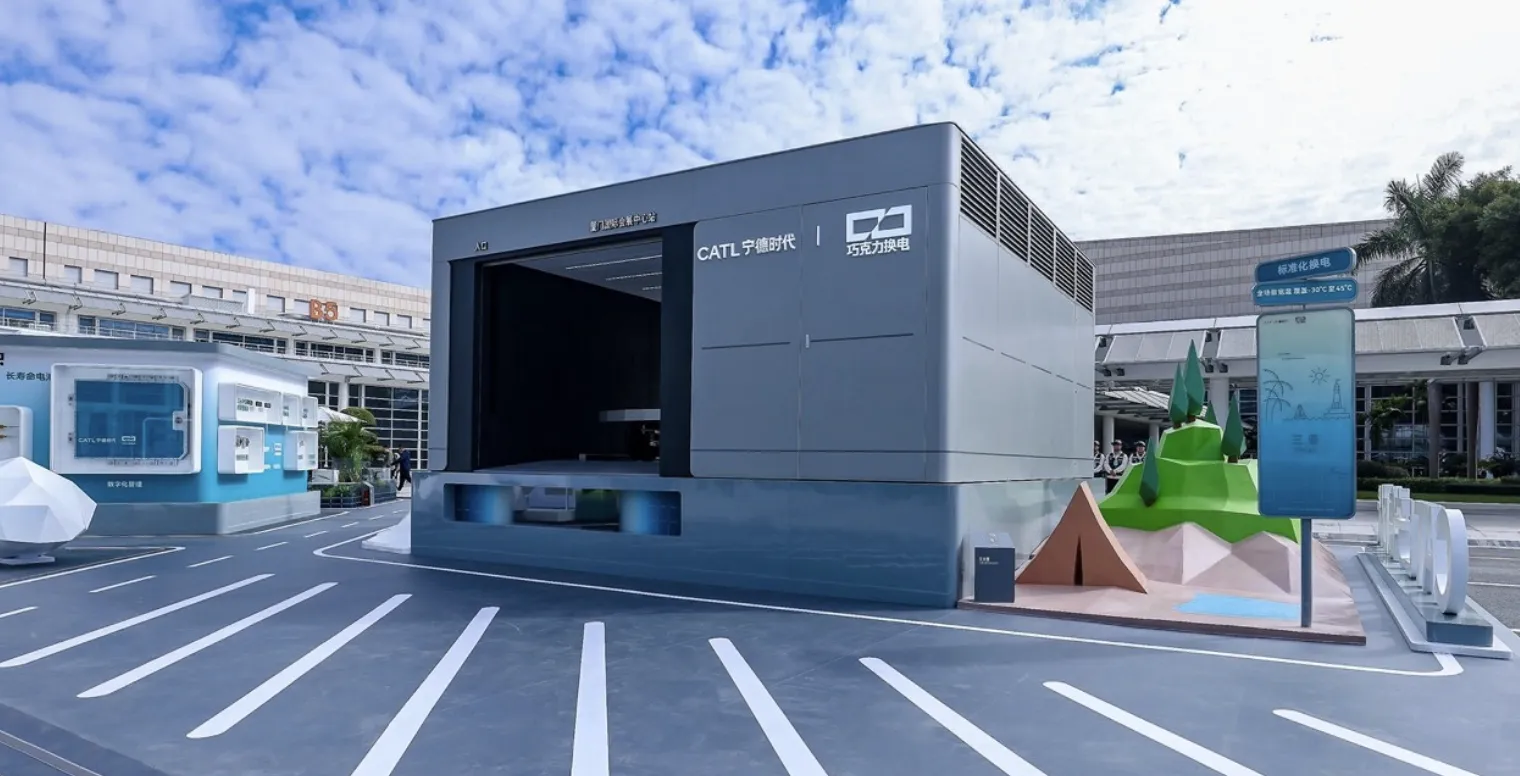
CATL’s Chocolate Swap battery-swapping network has expanded to 1,650 stations across China, underscoring the company’s ambition to transform from a battery manufacturer into a comprehensive energy services provider.
The company announced that its battery-swapping infrastructure now spans 127 cities nationwide, up significantly from its plan unveiled in June 2025 to build 1,020 stations across 45 cities by the end of that year.
According to CATL, the network has been growing at an average pace of more than 200 new stations per month over the past six months.
Building a Nationwide Swapping Network
CATL said it aims to expand the Chocolate Swap network to more than 3,000 stations by the end of 2026, covering nearly 190 cities across China.
The company is also developing an “11 vertical, 9 horizontal” highway battery-swapping network that is scheduled for completion by 2027.
The expressway grid is designed to support both daily urban commuting and long-distance travel by providing wider access to rapid battery-swapping services.
Major metropolitan markets including Beijing, Guangzhou and Chongqing each now host more than 50 swapping stations.
The network has also expanded into more remote regions, stretching from Lhasa in western China to Hulunbuir in Inner Mongolia.
Strategic Shift Beyond Batteries
The rapid deployment reflects CATL’s broader strategy to move beyond battery manufacturing and establish a nationwide energy service ecosystem.
CATL first introduced the Chocolate Swap concept in 2022, promoting standardized and modular battery packs designed to support multiple vehicle brands through a common battery-swapping infrastructure.
The approach seeks to address one of the industry’s long-standing challenges, where battery-swapping systems have traditionally been limited to individual automakers and proprietary vehicle platforms.
Partnership With NIO and Automakers
In March 2025, CATL and NIO announced a strategic partnership to jointly develop a unified battery-swapping network for passenger vehicles.
The collaboration aims to improve interoperability and expand battery-swapping accessibility across a wider range of electric vehicle models.
Two months later, CATL partnered with FAW, Changan Automobile, BAIC Group, Chery Automobile and GAC Group to introduce 10 new vehicle models compatible with the Chocolate Swap system.
The growing list of participating automakers is expected to strengthen adoption of the standardized swapping platform.
Arcfox Beta S3 Swap Edition Launch
One of the latest vehicles to support the system is the Arcfox Beta S3 Swap Edition, developed through cooperation between CATL’s Chocolate Swap business and BAIC’s Arcfox brand.
Launched on May 22, 2026, the vehicle utilizes CATL’s Chocolate No. 25 battery pack and adopts a battery rental model intended to reduce upfront vehicle costs.
The model starts at 59,800 yuan excluding battery ownership costs.
According to CATL, the vehicle offers a driving range of up to 535 kilometers and can complete a battery swap in approximately 99 seconds without requiring drivers to leave the vehicle.
In major cities, users can access what the company describes as a “10-minute swap circle,” allowing convenient access to nearby swapping facilities.
Growing Competition in Energy Services
As China’s electric vehicle market matures, battery swapping is increasingly viewed as a complementary solution to conventional charging infrastructure.
Through its rapidly expanding Chocolate Swap network, CATL is positioning itself not only as the world’s largest battery manufacturer but also as a major provider of energy replenishment services for electric vehicle owners.
The company’s success in attracting automakers and expanding network coverage could play a key role in determining the future adoption of battery-swapping technology in China’s new energy vehicle market.
Source: Gasgoo