



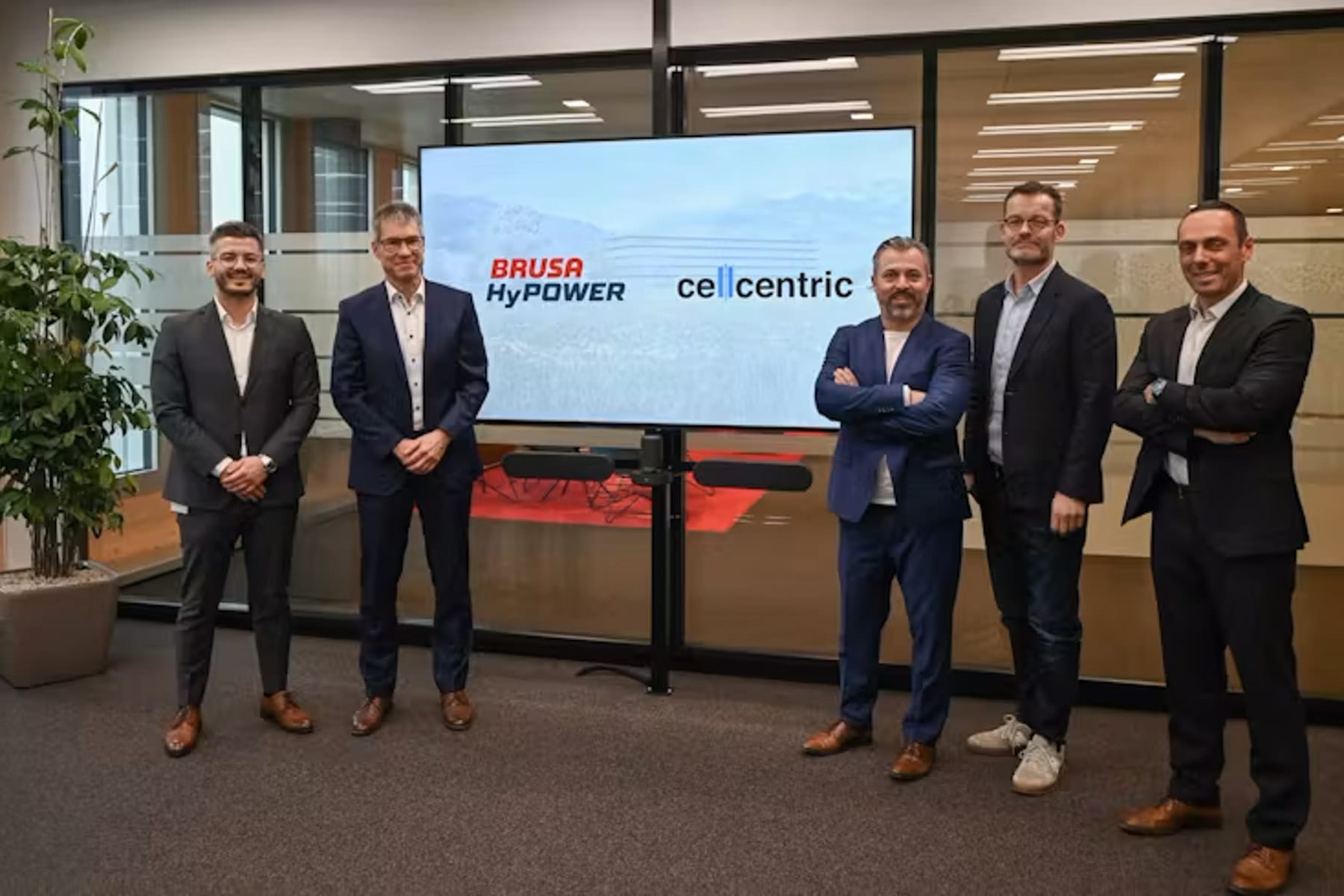
Swiss power electronics manufacturer Brusa HyPower will take over development of a key power electronics component for Cellcentric, the fuel cell joint venture between Daimler Truck and Volvo Group, as the partners prepare for series production later this decade.
Cellcentric said Brusa HyPower will be responsible for developing the Fuel Cell Interface (FCI), a central element of its next-generation fuel cell system. The FCI acts as a DC/DC converter, transforming fuel cell voltage to the vehicle’s high-voltage network, monitoring the fuel cell, isolating it safely when required and supplying power to high-voltage components within the system.
See also: Honda to End Fuel Cell Production at GM Joint Venture by 2026
Founded in 2021, Cellcentric develops and manufactures fuel cell systems primarily for heavy-duty commercial vehicles, as well as selected non-automotive applications. The company is building a dedicated production facility in Weilheim an der Teck, in Germany’s Baden-Württemberg region, though completion has been delayed. Pilot production is already underway at another site in the same region.
Cellcentric said the collaboration strengthens its global supply chain, including access to Asian markets, which it described as a driver of growth and innovation. Brusa HyPower operates facilities in Europe, the United States and Asia, making it a suitable strategic partner, the company added.
See also: Cellcentric Names Kai Wörner as COO as Fuel Cell Venture Adjusts Industrial Plans
Brusa HyPower is part of the Swiss Brusa Group, which also includes Brusa Technology and Brusa Elektronik. Brusa HyPower was founded in 2021 as a spin-off focused on the mass production of power electronics.
“With our new generation of high-performance DC/DC converters, we are contributing our many years of expertise in power electronics to significantly advance the further development of cellcentric’s fuel cell technology,” said Holger Fink, adding that the collaboration would help “shape the future of climate-neutral mobility.”
See also: German Research Project Targets Hydrogen Refuelling Reliability for Truck Operators
Cellcentric said the partnership aligns with its plans to industrialise fuel cell technology at scale. “We are delighted to have gained a partner with an international presence, decades of expertise, and a high level of innovation for this project,” said Markus Siegel, global head of procurement and aftersales at Cellcentric.


