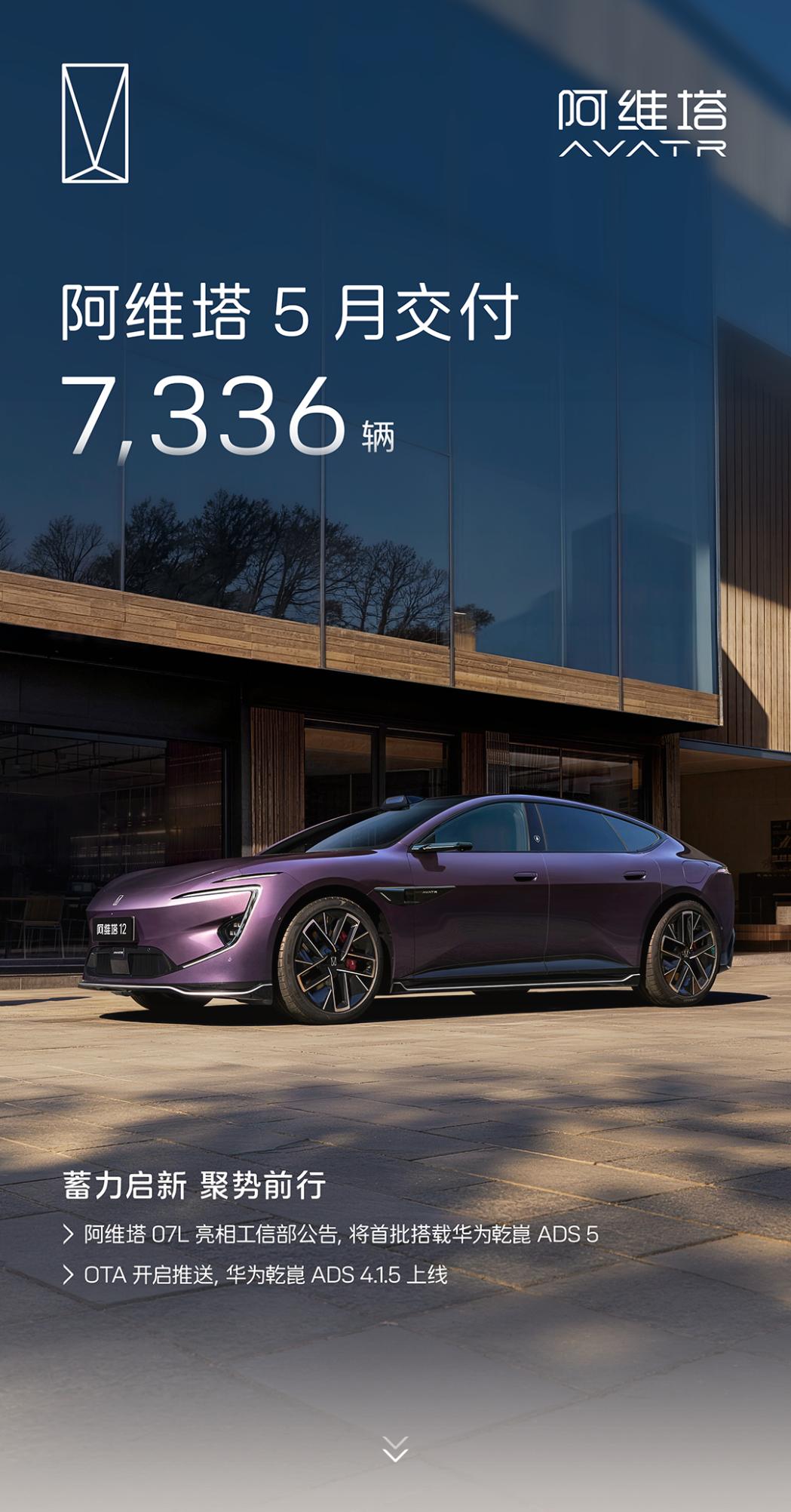
Avatr delivered 7,336 vehicles in May as the premium electric vehicle brand continued to expand its intelligent driving capabilities through its partnership with Huawei.
The company is preparing to introduce the Avatr 07L, which recently appeared in filings with China’s Ministry of Industry and Information Technology (MIIT). According to Avatr, the model will be among the first vehicles equipped with Huawei’s next-generation Qiankun Smart Driving ADS 5 system.
Avatr 07L to Debut ADS 5 Technology
The upcoming Avatr 07L represents the latest step in the company’s strategy to differentiate itself through advanced intelligent driving technologies.
Huawei’s Qiankun ADS platform has become a key selling point for several Chinese premium new energy vehicle brands, with the ADS 5 system expected to deliver enhanced autonomous driving and safety capabilities.
The new model is expected to strengthen Avatr’s position in China’s increasingly competitive premium electric vehicle segment.
Software Upgrade Expands Driver Assistance Features
Alongside preparations for the new model, Avatr has started rolling out the AVATR.OS 5.1.2 software update to existing vehicles.
The update is centered on Huawei’s Qiankun Smart Driving ADS 4.1.5 platform and introduces a range of new intelligent driving functions.
Among the additions are defensive driving capabilities designed to improve vehicle behavior when navigating sharp corners, as well as earlier detection and warning functions for vulnerable road users approaching from behind.
The software upgrade reflects the growing importance of over-the-air updates and intelligent driving features as automakers seek to enhance vehicle functionality after delivery.
Industry Faces Intensifying Competition
Speaking at the Future Mobility Conference on May 29, Avatr Technology Chairman Wang Hui said China’s automotive industry has entered a new phase where intelligence is becoming the primary competitive battleground.
According to Wang, electrification represented the first stage of transformation for the automotive sector, while intelligent technologies now define the industry’s next phase of development.
However, he warned that increasingly intense competition is placing pressure on manufacturers’ financial performance.
China’s domestic vehicle sales exceeded 34.4 million units in 2025, but industry profit margins fell to 4.1%, according to Wang. During the first two months of 2026, margins declined further to 2.9%.
“The consensus in the auto world is that over the past three to five years, everyone has been moving in lockstep,” Wang said.
“That made cutthroat competition the easiest path forward. It’s not just about prices, but also specs and services. Ultimately, though, we aren’t squeezing our rivals—we’re squeezing our own profits.”
Focus on Sustainable Growth
Wang argued that manufacturers should prioritize sustainable profitability rather than pursuing market share through aggressive pricing strategies.
“Sales without profit are essentially hollow,” Wang said.
“Scale built on price wars is a false prosperity.”
His comments come as Chinese automakers continue to compete aggressively through vehicle pricing, intelligent driving technology, software capabilities and ecosystem services.