
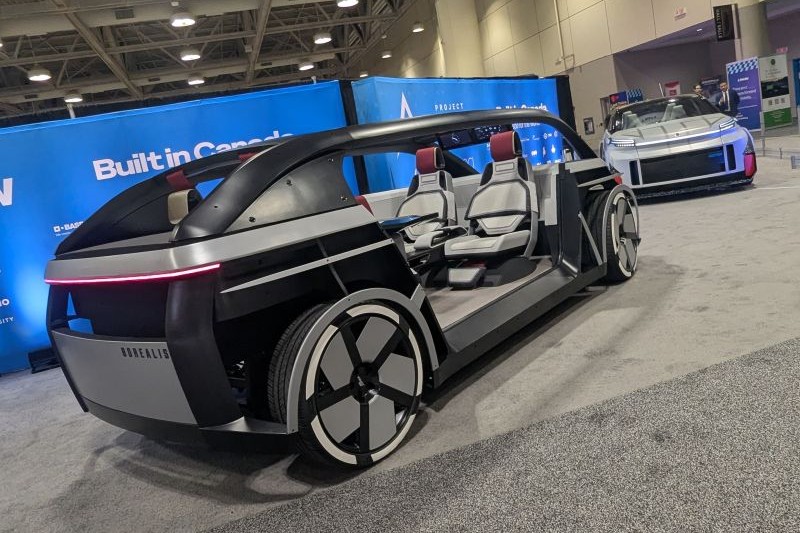
Canada’s Automotive Parts Manufacturers’ Association (APMA) has presented two new electric vehicle prototypes at the 2026 Canadian International Auto Show, showcasing domestic supplier expertise and innovative production techniques aimed at future mobility.
The prototypes form part of Project Arrow, an initiative launched in 2021 to demonstrate Canada’s ability to design and manufacture a complete electric vehicle despite lacking a globally recognized domestic automaker brand. The program brings together industry partners, universities and technology companies to highlight the country’s automotive supply chain.
In the project’s second phase, the original battery-electric SUV concept has been joined by a van concept. The SUV is now designated Project Arrow Vector, while the van is called Project Arrow Borealis. The two vehicles target different timelines, with the crossover potentially feasible by 2030 and the van envisioned for around 2040.
The Vector crossover is designed as a high-performance battery-electric vehicle with peak output of about 480 kilowatts, a driving range of up to 550 kilometers and Level 3 automated driving capability. The Borealis van concept, by contrast, aims for a range of up to 1,500 kilometers and Level 5 full autonomy, reflected in a cabin layout with seats arranged face-to-face to support driverless operation.
Project developers are using advanced additive manufacturing techniques, including large-scale 3D printing, to reduce vehicle weight and component count. While such methods are already employed in motorsport and limited production runs, large-scale commercial adoption remains challenging due to cost and industrial readiness.
Earlier plans for mass production by the mid-2020s have become less defined. According to German publication Auto Motor und Sport, the transition to series production will depend heavily on whether the underlying technologies can be industrialized at scale.