

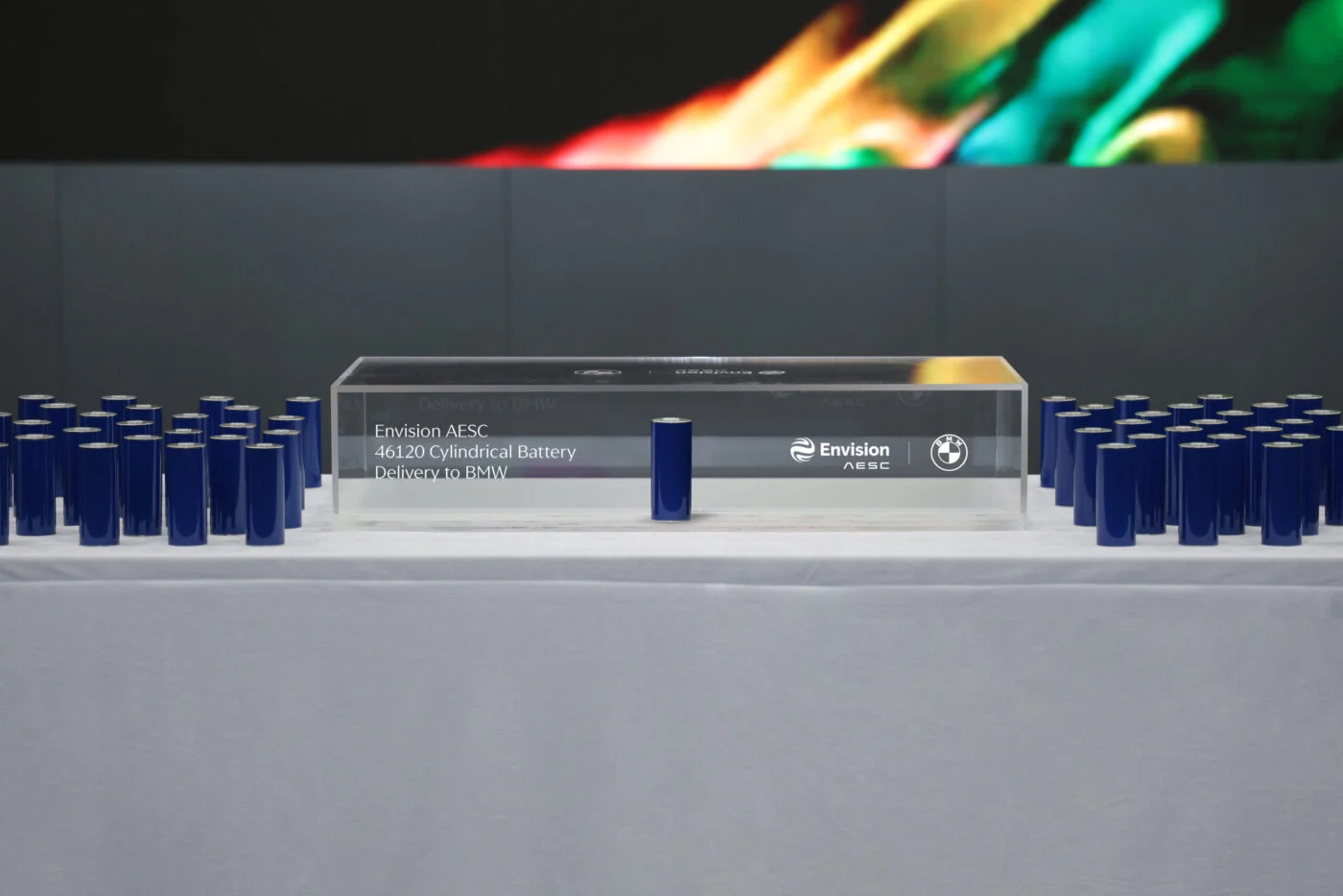
AESC has begun mass production of its new 46120 cylindrical battery cells, marking a step forward in the company’s battery manufacturing strategy as it prepares to supply future electric vehicles for BMW Group.
The first announced model to adopt the new battery technology is the all-electric BMW iX5, which is expected to enter the market in late 2026 or early 2027.
The new battery cell measures 46 millimetres in diameter and 120 millimetres in height. According to AESC, the design increases usable energy per cell by nearly 30% compared with previous cylindrical formats while reducing the number of cells and components required in a battery pack, helping simplify vehicle integration.
The company said the cells use a nickel-rich cathode and a silicon-doped anode, delivering an energy density of up to 310Wh/kg. AESC added that improvements to thermal management and structural design are intended to enhance battery safety and long-term durability.
Advanced Manufacturing Process
AESC said its production facilities incorporate more than 1,000 camera-based inspection stations throughout the manufacturing line, while every battery cell undergoes full X-ray inspection before leaving the factory.
The manufacturing process also uses magnetic levitation technology to transport materials, enabling production precision of up to 0.01 millimetres.
“Years of R&D and manufacturing expertise have enabled the mass production and global rollout of our 46120 cells,” said David Wan, Global CEO of AESC.
Supporting BMW’s Next-Generation EVs
The new cylindrical cells will form part of BMW’s sixth-generation eDrive battery technology.
BMW has announced that the all-electric iX5 will be the first model equipped with the new cells. Although the SUV will continue to use the company’s CLAR vehicle platform rather than the Neue Klasse architecture, it will feature the latest battery system, including an 800-volt electrical architecture and a net battery capacity of 141kWh.
BMW expects the new battery technology to provide higher energy density, faster charging and longer driving range than its previous generation of prismatic battery cells.
Production Location Not Disclosed
AESC has not identified which manufacturing facility is currently producing the 46120 battery cells, stating only that mass production has begun at its advanced manufacturing sites.
The company operates or is developing battery production facilities in China, Japan, the United States, the United Kingdom, France and Spain.
AESC previously announced plans to build a battery plant in Florence County, South Carolina, to supply BMW following a major supply agreement signed in 2022. However, work on that project was paused in mid-2025, and the company has not confirmed whether the new cells for the BMW iX5 will be produced there or at another facility.