
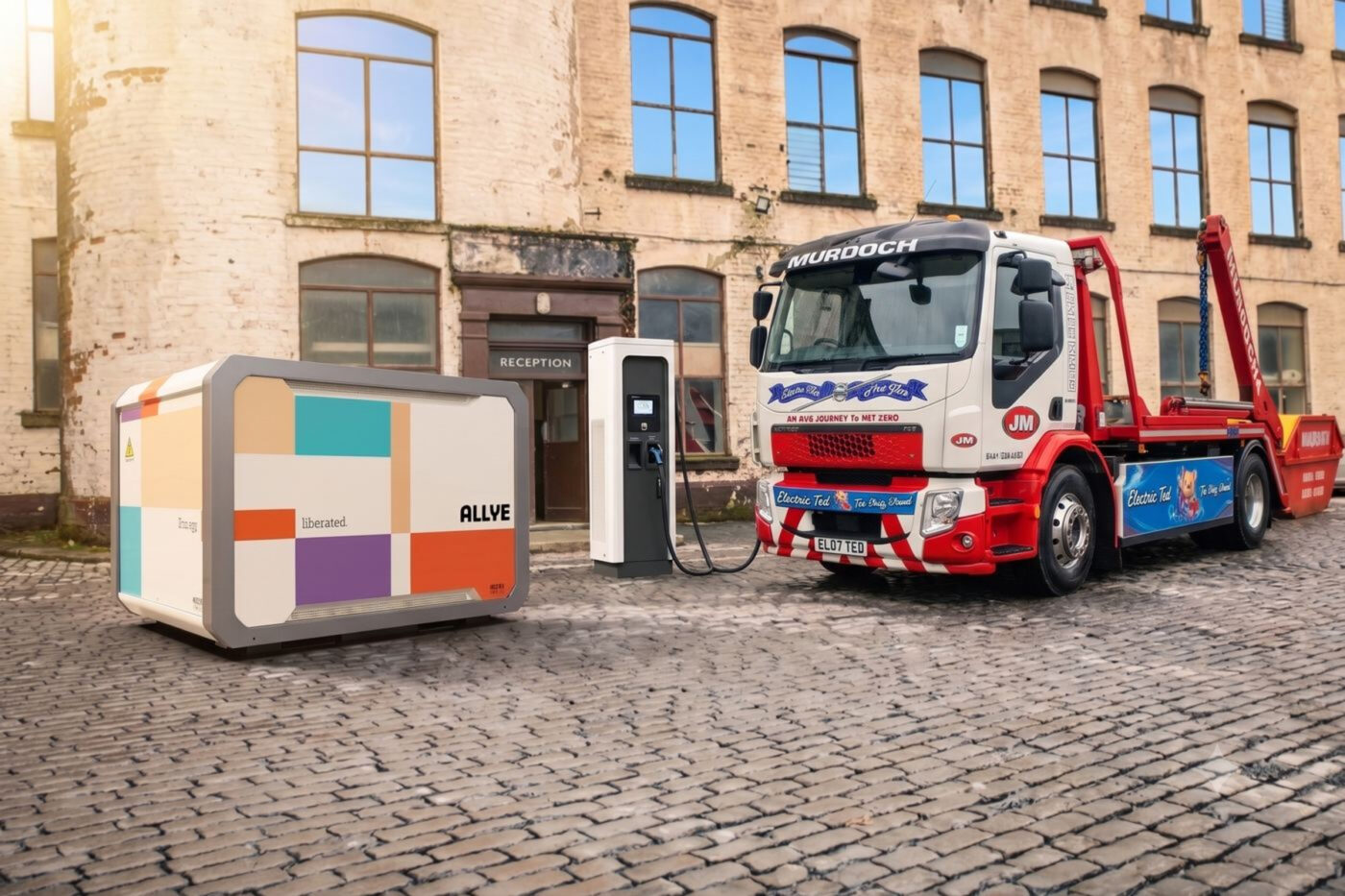
British energy storage company Allye Energy has introduced the Mobile Energy Vault (MEV), a battery-buffered fast-charging system designed to help commercial fleet operators install high-power EV charging without necessarily upgrading their existing grid connections.
The system uses complete battery packs recovered from decommissioned electric vehicles to store electricity drawn from a depot’s existing power supply. It can then release that energy at charging power levels of up to 400 kW, addressing sites where grid capacity is insufficient for conventional fast-charging infrastructure.
Allye is targeting fleet depots that need higher charging capacity but face high grid reinforcement costs or lengthy connection upgrade delays.
Two MEV Versions Offer Up to 232 kWh of Storage
Allye plans to offer the MEV in two configurations. The MEV200 has 155 kWh of storage capacity, while the MEV300 provides 232 kWh. Both versions can charge two vehicles simultaneously and support maximum DC charging power of up to 400 kW.
The system is based on the 800-volt architecture of Allye’s Max300 mobile battery storage platform. According to the company, it supports vehicles operating on both 400-volt and 800-volt electrical systems.
Its PackFlex technology allows battery packs with different capacities, ages and cell chemistries to operate within a single storage system.
Rather than using newly manufactured battery cells, Allye integrates complete battery packs from retired electric vehicles. The company estimates that this approach saves approximately 15 to 24 tonnes of CO₂ equivalent emissions per unit compared with a system built using new batteries. This figure is based on Allye’s own calculations.
Battery Storage Reduces Dependence on Grid Capacity
The MEV separates the power available from the grid from the power delivered to vehicles. Electricity can be accumulated gradually through an existing connection and subsequently discharged at much higher power levels during charging sessions.
This approach is particularly relevant for fleet operators that require rapid vehicle charging but cannot obtain sufficient grid capacity at their depots.
Allye points to a project at J&M Murdoch, a waste management company in Glasgow, as an example of the technology in operation.
The company said a proposed grid upgrade for the depot was estimated to cost approximately £300,000. Instead, Allye worked with charging provider Chargepoly to install a Max300 storage system using an existing 32 A connection with a capacity of 22 kW.
The installation supplies a separate DC fast charger serving two electric vehicles and delivers approximately 200 kWh of energy per day, according to Allye.
However, battery buffering does not increase the total amount of electricity available to a site. Although the system can provide high charging power for shorter periods, its daily energy output remains constrained by the electricity that can be drawn from the grid and stored over time.
Consequently, the number of vehicles a depot can charge depends on its available grid connection, storage capacity, operating schedule and charging requirements.
Faster Deployment and Flexible Installation
Allye says the MEV can help fleet operators avoid lengthy waits for grid connection upgrades. The company cites UK lead times of 18 to 36 months for new depot connections.
The system can be connected through industrial sockets or a fixed electrical installation and commissioned within a few hours. Its modular deployment approach also allows operators to dismantle and relocate the equipment if a depot changes location.
These characteristics could make battery-buffered charging an option for fleet operators that need additional charging capacity before permanent grid infrastructure becomes available.
Safety Features and Commercial Options
The MEV incorporates several safety and monitoring systems. Its charging cables include cut monitoring, forensic markings and quick-release mechanisms intended to simplify the replacement of damaged cables. Cameras are also used to monitor charging stations and cables.
Inside the storage unit, safety measures include pyrotechnic fuses, gas detection and fire barriers separating individual battery packs.
Unlike the technically related Max300, which is designed as a mobile energy storage system and can also replace diesel generators or supply temporary charging points, the MEV is intended for stationary depot installations.
Allye has set a starting price of £70,000 for the MEV. Customers can also access the system through its EV Charging as a Service offering, with the MEV200 available from £1,900 per month.
The first deliveries are scheduled for the second quarter of 2027.
Battery-Buffered Charging Targets Fleet Electrification Challenges
The MEV addresses a key infrastructure constraint facing commercial fleet electrification: the difference between the total electricity available at a site and the power that can be delivered at any given moment.
By storing electricity during periods of lower demand and releasing it at higher power during vehicle charging, battery-buffered systems can reduce the need for immediate grid reinforcement.
AMG Lithium Opens Frankfurt Lab to Test Sulfide Solid-State Battery Materials
Their economic viability, however, depends on several factors, including existing connection capacity, daily energy requirements, vehicle charging schedules, storage utilisation and the cost of upgrading the local grid.
For fleet operators facing expensive infrastructure upgrades or extended connection delays, Allye’s MEV offers an alternative route to deploying high-power charging at existing depots.