
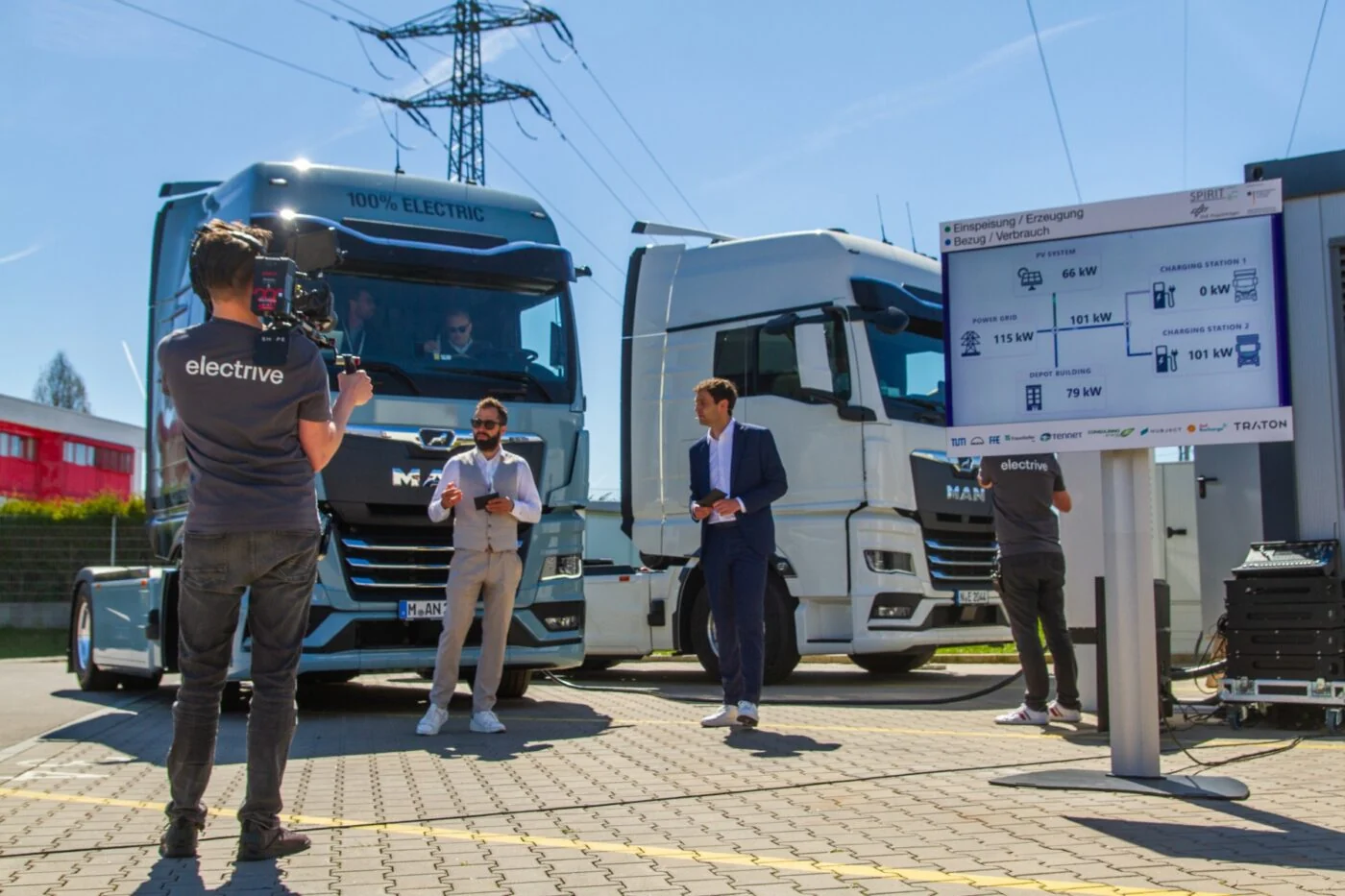
Electric trucks could play a broader role in the energy system by storing electricity and supplying it back to depots, other vehicles or the public grid, according to the findings of Germany’s SPIRIT-E research project. After three years of work, the consortium has presented results demonstrating the technical potential and economic benefits of bidirectional charging for heavy-duty electric vehicles.
The project ran from August 2023 to October 2026, with funding from the German federal government and leadership from the German Aerospace Center (DLR). Its research focused on identifying barriers to electrifying heavy-duty transport and developing practical solutions for integrating electric trucks into existing energy systems.
SPIRIT-E investigated two main approaches: opening private charging infrastructure at logistics sites to third parties, supported by reservation systems, and combining reservable charging facilities with bidirectional charging to strengthen connections between the transport and energy sectors.
Shell Business Recharge Solutions (SBRS), part of the Shell Group, developed the project’s bidirectional DC charging infrastructure. Other consortium members included the Technical University of Munich (TUM), which served as lead partner, Fraunhofer IEE, the Research Centre for Energy Economics, TenneT, Hubject, Consolinno Energy and MAN Truck & Bus.
MAN eTGX Demonstrates 350 kW Bidirectional Charging
The project solutions were tested at a real-world research facility operated by logistics company Schmid in Obertraublingen, near Regensburg.
In spring 2026, the consortium conducted what it described as the world’s first live demonstration of bidirectional charging for an electric truck. The demonstration took place on 24 April and featured a MAN eTGX equipped with 480 kWh of usable battery capacity.
Using SBRS’s bidirectional DC charging station, the truck was able to feed electricity back into the grid at a power output of up to 350 kW.
MAN Truck & Bus, TIP Group Agree Framework Deal for Up to 1,800 Trucks Across Europe
The project examined three bidirectional applications: Vehicle-to-Vehicle (V2V), in which a truck supplies electricity to other vehicles; Vehicle-to-Site (V2S), which allows the vehicle to support the energy supply of a company facility; and Vehicle-to-Grid (V2G), through which stored electricity is returned to the public power grid.
Communication between vehicles and charging infrastructure was based on the international ISO 15118-20 standard.
Electric Trucks Could Reduce Fleet Energy Costs
TUM’s accompanying research examined how logistics companies could operate electric fleets reliably and make the transition economically viable. The university’s analysis included real-world driving data from six German heavy-duty vehicle fleets, covering a combined 2.15 million kilometres.
The findings highlighted several opportunities to improve fleet operations and reduce costs.
Reserving charging points along long-distance routes could improve planning reliability for electric trucks. Depending on the scenario, the median time loss compared with diesel trucks could be reduced to approximately 1–4%.
MAN Truck & Bus Commits One Billion Euros to Germany Under MAN2030+ Plan
Coordinating fleet operations with depot charging infrastructure also proved important. Companies with private charging facilities at their depots could operate a larger proportion of their fleets reliably on electricity than those relying exclusively on public charging. Adding photovoltaic systems and battery storage could deliver 25–44% greater savings compared with simply switching to electric trucks.
The research also found that incorporating charging flexibility into dispatch and route planning could allow vehicles to charge during periods of lower electricity prices, reducing overall fleet costs depending on the structure of transport orders.
Integrating depots more intelligently into the electricity system produced further savings. According to TUM, grid and electricity market integration reduced total costs for the fleets studied by an average of 1.7 cents per kilometre. With bidirectional charging, the savings increased to 6.1 cents per kilometre.
Depot Energy Management Offers Significant Potential
The researchers identified using stored electricity at a company’s own premises as one of the most promising applications.
“For example, electric trucks can charge using surplus electricity from a photovoltaic system during the day and supply that electricity again later. This can increase the amount of a company’s electricity demand that it meets from its own generation. The vehicles can also cover short-term spikes in electricity demand, helping to avoid costly peak loads,” the researchers stated.
The project team considers energy cost savings of approximately 10% achievable under suitable operating conditions. For a truck covering 100,000 kilometres annually, this would represent savings equivalent to the energy costs of driving 10,000 kilometres.
The actual benefits depend on factors including annual mileage, vehicle downtime and electricity prices. Regional transport operations are considered particularly suitable because their vehicles regularly return to their depots, providing opportunities to charge and discharge batteries according to energy demand and market conditions.
SPIRIT-E also explored how mobile batteries could participate in electricity markets. In a dedicated test environment, the consortium simulated vehicles charging when electricity prices were low and selling stored energy when prices increased. TUM said this could provide freight operators with an additional revenue stream in the future.
MAN Truck & Bus Launches Battery Production at Nuremberg Plant, Plans €150 Million Expansion
To support these applications, the project partners developed and tested interfaces connecting trucks, charging stations, energy management systems, electricity marketers and grid operators. The work also included a reservation system for charging infrastructure.
Grid Capacity and Market Standards Remain Challenges
Despite demonstrating the technical feasibility of bidirectional charging, the project team identified grid integration and commercial conditions as major obstacles to wider deployment.
Many logistics sites lack sufficient grid connection capacity to support the charging requirements of larger electric truck fleets. The consortium identified flexible grid connection agreements, stationary battery storage and shared charging infrastructure as potential ways to address these limitations.
The development of common standards for electricity marketing is another outstanding issue. Proprietary technical systems used by different providers can limit interoperability, making it harder to coordinate energy flows between vehicles, charging infrastructure and electricity markets.
The distribution of responsibilities and revenues among logistics companies, vehicle manufacturers and electricity marketers also requires further clarification.
MAN Trucks Expands EV Consultation Services to Support Fleet Electrification in Europe
Prof. Markus Lienkamp, Head of the Chair of Automotive Technology at TUM’s School of Engineering and Design, said the project had demonstrated how electric trucks could become active components of the energy system rather than simply additional electricity consumers.
“SPIRIT-E has shown that heavy-duty electric trucks can be much more than just new electricity consumers. Technically, they can be integrated into the energy system as flexible storage systems. The task now is to standardize and scale the solutions that have been tested and turn them into viable business models. This will require researchers, grid operators, industry, the logistics sector, and policymakers to work together,” summarised Prof. Markus Lienkamp.
The findings suggest that bidirectional charging could create additional economic value for electric truck operators while supporting the integration of renewable electricity. However, wider adoption will depend on improvements to grid infrastructure, compatible technical standards and commercially viable arrangements for managing stored energy.