
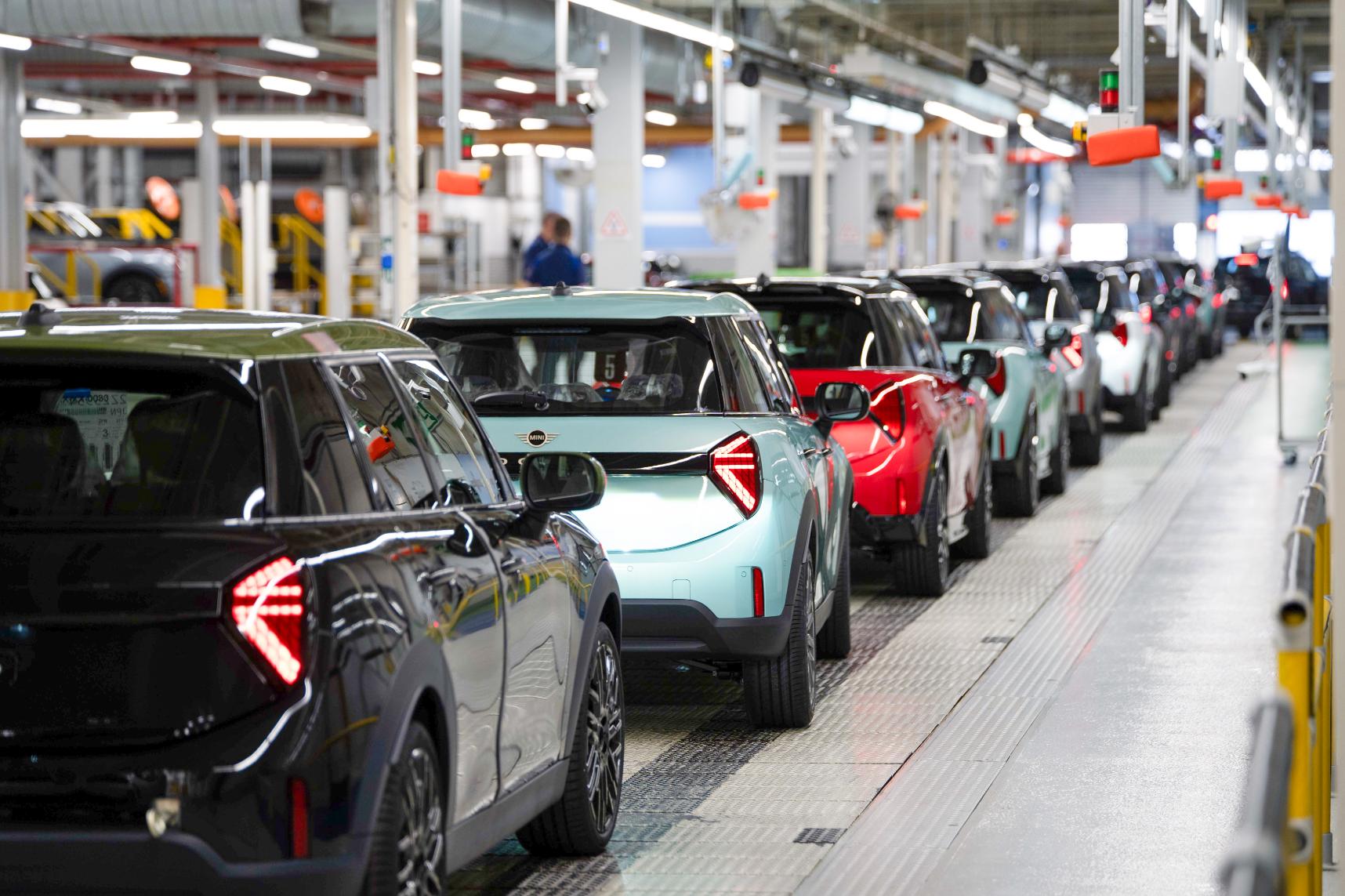
BMW Group has completed one million automated vehicle movements using its Automated Driving In-Plant (AFW) system, which moves newly manufactured vehicles through designated production and logistics areas without a driver. The company announced the milestone on October 27, as MINI Plant Oxford became the fourth facility to adopt the technology.
The system was developed with Swiss technology company Embotech and is currently operating at BMW Group plants in Dingolfing, Leipzig and Regensburg, as well as MINI Plant Oxford. BMW plans to introduce the system at Plant Spartanburg in the United States, with series operation scheduled to begin in 2027.
BMW said its production network now records approximately 3,500 automated vehicle movements per day. MINI Plant Oxford completed more than 53,000 movements during the past year.
Driverless Vehicle Movement Across Production Sites
AFW automates vehicle movement within defined areas of a factory, reducing the need for drivers to move cars between production stages and logistics locations.
BMW iX5 Demonstrates 464 kW Fast Charging, Adding 170 Miles in 10 Minutes
The system uses LiDAR sensors installed in the plant infrastructure, alongside cloud-based architecture and motion-planning software. Because the sensors are positioned outside the vehicles, the technology can operate across different vehicle models and equipment specifications without requiring dedicated onboard hardware.
The system monitors its surroundings and responds to people, other vehicles, driverless transport equipment, logistics traffic and temporary obstacles. LiDAR sensors along the designated routes provide environmental data for navigation.
BMW said the technology is CE-certified for use in its production environment and can be adapted to different factory layouts, vehicle architectures and manufacturing processes.
MINI Plant Oxford Connects AFW With Factory Control Systems
MINI Plant Oxford is the first BMW Group facility to connect automated vehicle movements directly with existing control systems, according to the company.
At the UK plant, AFW positions vehicles alongside lifting equipment used for specific production operations. A cloud-based solution coordinates the interaction between the vehicles and the equipment.
BMW also said its Dingolfing facility has what the company describes as Europe’s largest LiDAR infrastructure for this application. Artificial intelligence is used in the development, simulation and operation of the technology.
“We recognised the potential of Automated Driving In-Plant early, tested it in a pilot phase and systematically developed it to series maturity. We are now rolling out this technology worldwide,” said Raymond Wittmann, BMW AG’s Board of Management member responsible for Production.
BMW began testing AFW at Dingolfing in 2022 before expanding it to Leipzig, Regensburg and Oxford. The company plans to introduce the technology in stages across its global production network.
Embotech Develops Software and Safety Architecture
Embotech worked with BMW to develop and scale AFW through multiple stages. The collaboration followed a multi-year relationship with BMW Startup Garage, while BMW i Ventures acquired a financial interest in Embotech in December 2024.
According to Embotech, its contribution includes AI-based software for perception, prediction and planning, alongside a separate deterministic safety architecture independently certified by TÜV SÜD. This architecture defines and enforces the system’s safety boundaries.
Embotech reported that AFW operates around the clock across the four facilities, with availability exceeding 99.5%. The companies have also developed tools and processes for system deployment, monitoring, diagnosis and recovery.
“With BMW Group, we completed the first 500,000 automated vehicle movements in 15 months and the next 500,000 in just seven. For Embotech, the next phase is about taking what we have learned into more use cases, sites, customers and industrial environments,” said Andreas Kyrtatos, CEO of Embotech.
BMW’s latest milestone reflects the expansion of automated vehicle handling from a pilot project into regular production operations. The planned deployment at Spartanburg will extend the technology to another major manufacturing site, while the companies aim to apply the system to additional locations and industrial uses.