
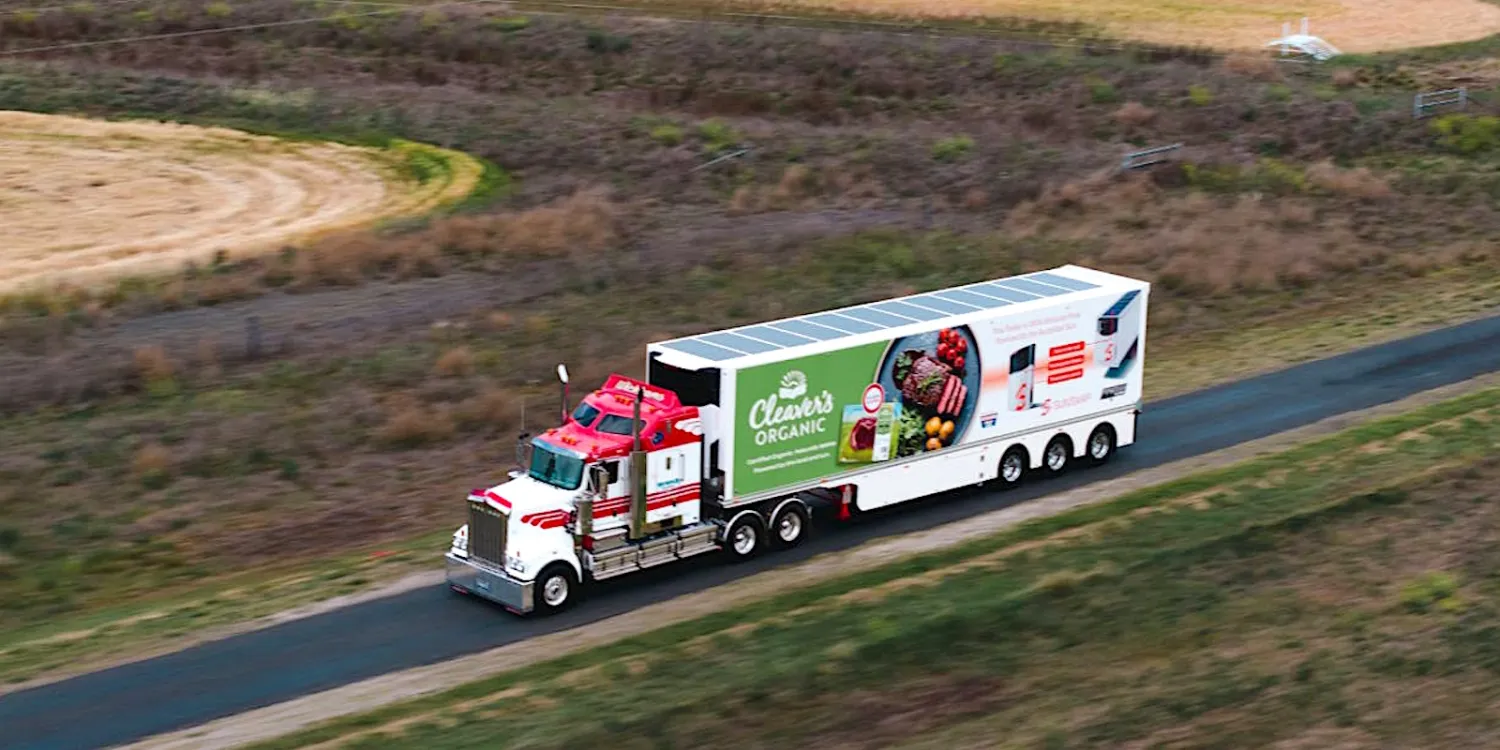
Australian transport operator Wickham Freight Lines has taken delivery of Sunswap Endurance, a solar-powered electric trailer refrigeration unit designed to reduce diesel consumption in refrigerated freight operations. The delivery marks the deployment of what has been described as Australia’s first regular-production solar-powered electric trailer refrigeration unit (TRU) with a customer.
The family-owned company purchased the units after testing the technology on a long-distance route between Sydney and Brisbane. The move introduces an alternative to conventional diesel-powered refrigeration systems, which can continue running throughout a journey even when the truck towing the trailer uses an electric drivetrain.
Long-Distance Trial Supports Fleet Purchase
Wickham Freight Lines tested the Sunswap Endurance unit on a return journey between Sydney and Brisbane during the Australian summer. The route covered approximately 1,670 kilometers (1,040 miles) over more than 30 hours of driving.
According to the company, the refrigeration unit completed the trip with more than 65% of its battery capacity remaining. The result helped convince Wickham to purchase the technology for its refrigerated transport operations.
Graham Keogh, director at Wickham Freight Lines, said the trial demonstrated the unit’s operational performance and potential cost benefits.
“I put the Sunswap Endurance into the fleet and told the team to stretch it — treat it as a normal unit,” explains Graham Keogh, director at Wickham Freight Lines. “We were genuinely impressed. I’m a true believer. I love the technology and I’m not a true tech person whatsoever. You can just see that it’s a winner … the performance, reliability and operational savings were beyond what we expected. For a business like ours, running a large fleet across the east coast, with a heavy focus on refrigerated and cold chain freight, this technology makes real commercial sense.”
The company operates across Australia’s eastern states, transporting refrigerated goods that require temperature-controlled conditions throughout the journey.
Replacing Diesel-Powered Trailer Refrigeration
Conventional trailer refrigeration units often rely on dedicated diesel engines to maintain cargo temperatures. These systems can operate for extended periods while trucks are stationary, loading or unloading, as well as during transit.
Their fuel consumption contributes to fleet emissions and can produce nitrogen oxides, carbon dioxide and engine noise. These impacts have become an increasing consideration for transport operators seeking to reduce their environmental footprint, particularly in urban freight corridors and distribution areas.
Sunswap Endurance uses an electric refrigeration system supported by solar power and onboard battery storage. The approach is designed to maintain temperature-controlled conditions for cargo such as fresh food, flowers and pharmaceutical products without relying on diesel combustion for refrigeration.
By separating refrigeration energy from diesel fuel, the system could also help operators reduce exposure to fuel costs and simplify emissions-reduction efforts across refrigerated fleets.
Actual savings will depend on operating conditions, refrigeration demand, solar generation, charging requirements and the performance of the equipment over time.
Technology Moves Beyond Demonstration
Sunswap first showcased the Endurance solar-powered refrigeration unit at HVIA TruckShowX in the Hunter Valley in May 2026. Wickham’s purchase represents a step beyond demonstration, providing a real-world application with a commercial transport operator.
Customer deployments will help establish how the technology performs across different routes, weather conditions and cargo requirements. For refrigerated freight businesses, reliability is particularly important because temperature deviations can compromise perishable goods and create financial losses.
The Sydney–Brisbane trial provides an initial indication of the unit’s potential for long-distance operations, although broader fleet experience will be needed to establish performance across a wider range of conditions.
Electrification Extends Beyond the Truck
The deployment highlights a remaining challenge in commercial vehicle electrification: switching the tractor to electric power does not automatically eliminate diesel consumption across the entire vehicle combination.
Refrigeration equipment can operate independently of the truck’s propulsion system, creating a separate source of fuel use and emissions. Electrifying these auxiliary systems offers another way for transport companies to reduce the environmental impact of their operations.
For Wickham Freight Lines, the purchase of Sunswap Endurance units follows a trial that the company says delivered encouraging results in battery performance, reliability and operating costs. Further deployment and long-term operational data will help determine how widely solar-powered electric refrigeration can be adopted across Australia’s refrigerated transport sector.