
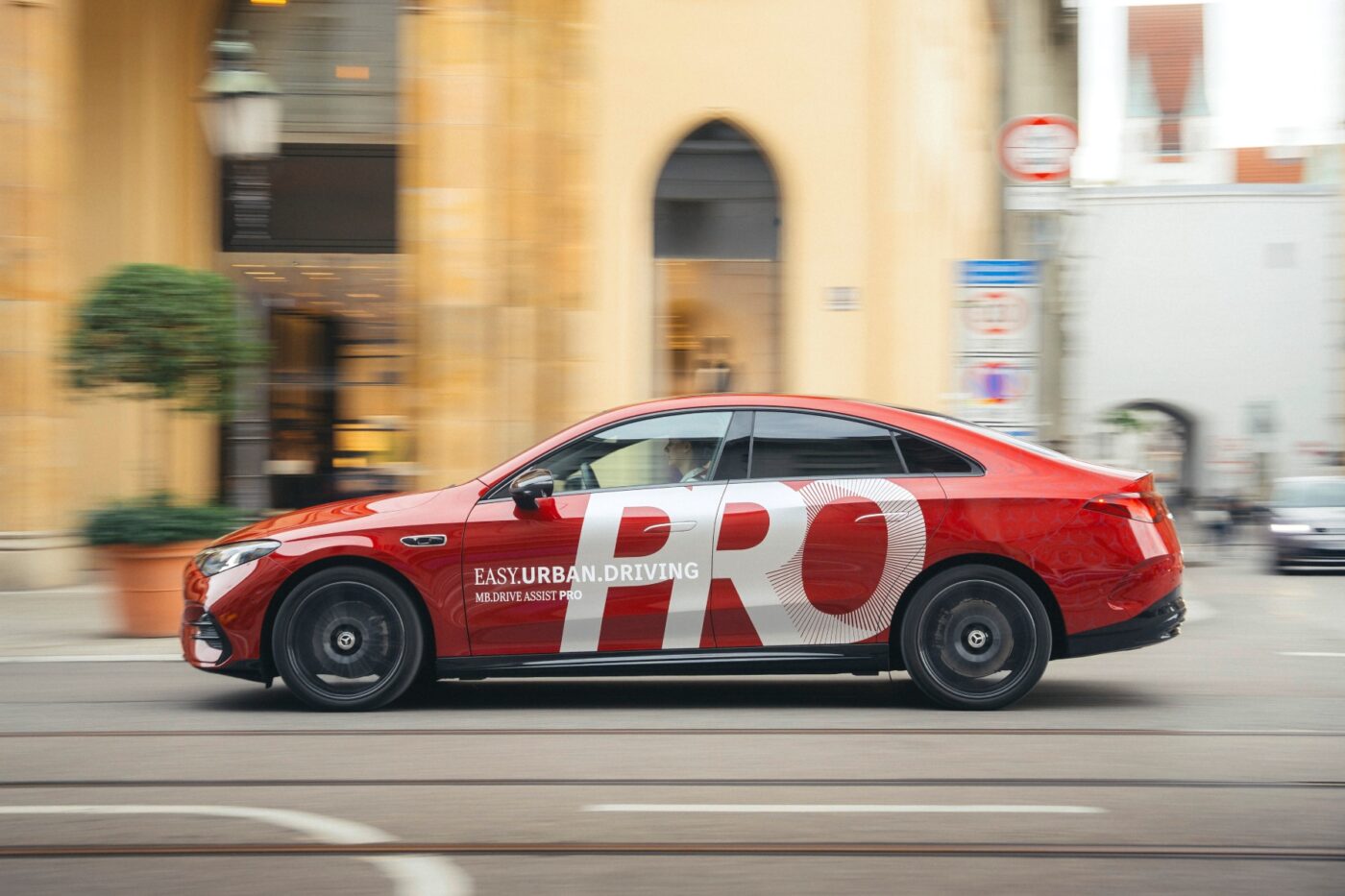
Mercedes-Benz is preparing to introduce its MB.Drive Assist Pro system in Germany, expanding its advanced driver assistance technology beyond motorway driving to more complex urban environments. The SAE Level 2 system is already being introduced in China and the United States, making Germany the latest market to receive the technology.
Unveiled at CES in Las Vegas in early 2026, MB.Drive Assist Pro is designed to assist drivers with a range of tasks during city journeys. These include merging into traffic, changing lanes, turning, braking and moving off at traffic lights. Despite these capabilities, the system remains a Level 2 driver assistance feature, meaning drivers must continuously monitor the road and remain responsible for vehicle control.
Mercedes-Benz plans to offer existing customers access to the functions through an over-the-air software update, provided their vehicles have the required technical equipment. Pricing for the German market has not yet been disclosed. Customers will be able to try the system free of charge for one month.
In the United States, Mercedes-Benz offers MB.Drive Assist Pro through a three-year subscription priced at US$3,950, equivalent to approximately €3,520.
Pilot Launch Planned for Late 2026
Mercedes-Benz expects to begin a pilot rollout with selected customers in Stuttgart and Munich in late 2026. Eligible customers will be contacted directly and receive the software update for their compatible vehicles.
The company plans to use feedback from these initial users to refine and improve the system as its deployment progresses.
Germany’s regulatory framework is another factor enabling the launch. The UNECE’s UN Regulation No. 171 establishes requirements for driver assistance systems, including relevant safety provisions. Mercedes-Benz intends to use this framework as a basis for a potential wider rollout across the European Union, without requiring separate individual approvals for each market where the regulation applies.
Sensors and Computing Hardware
MB.Drive Assist Pro combines a network of sensors with substantial onboard computing capacity to support its urban driving functions.
The system’s hardware comprises 27 sensors: ten cameras, five radar sensors and 12 ultrasonic sensors. A dedicated computer provides computing performance of up to 254 tera operations per second (TOPS).
Its software architecture integrates Mercedes-Benz’s MB.OS operating system with NVIDIA Hyperion, the Halos security system and Alpamayo software.
The combination is designed to support the system’s advanced assistance functions in urban traffic. However, Mercedes-Benz continues to classify the technology as SAE Level 2, under which the driver remains responsible for supervising the vehicle throughout the journey.