
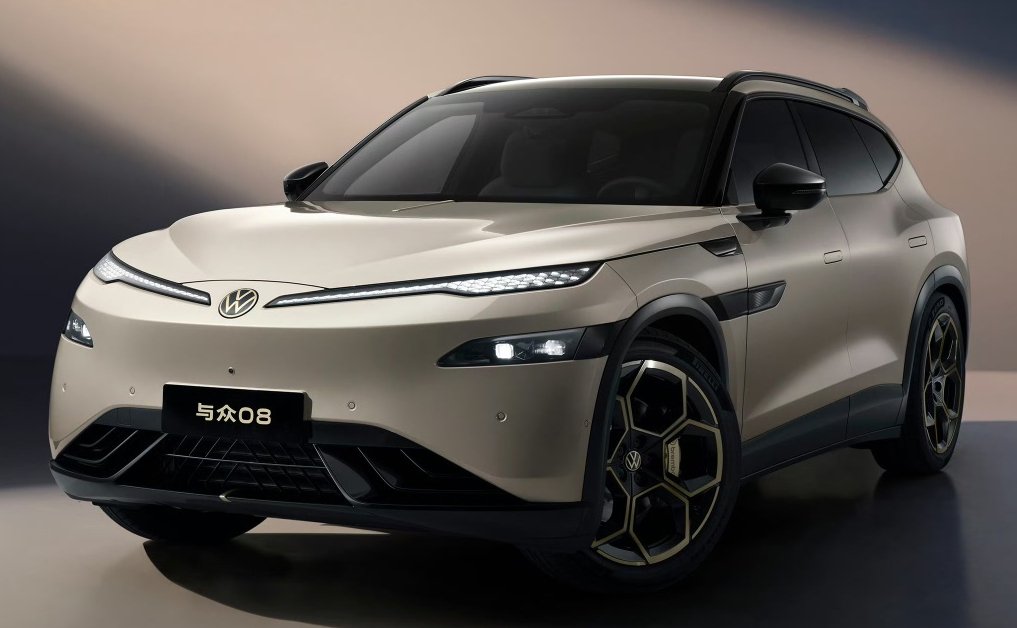
Volkswagen’s efforts to revive its electric vehicle business in China using technology from local partner Xpeng are facing an early sales challenge, with the jointly developed ID.UNYX 08 reportedly achieving only a small fraction of its planned monthly volume.
According to Reuters, citing data from consulting firm ThinkerCar, the electric SUV averaged 267 units in monthly sales between April and August. Volkswagen had reportedly targeted monthly sales of 3,622 units for the model this year, meaning its average sales reached approximately 7.4% of that target.
The figures highlight the challenges facing Volkswagen as it adapts its products and sales strategy to China’s increasingly competitive electric vehicle market.
Limited Dealership Coverage Restricts Reach
One factor cited in the Reuters report is the ID.UNYX 08’s limited distribution network. The model is primarily sold through Volkswagen Anhui, which operates a separate dealer network rather than relying on the more than 3,000 outlets associated with Volkswagen’s established partnerships with FAW and SAIC.
Volkswagen Anhui reportedly has 166 dealerships. The company plans to expand the model’s availability through additional sales locations in cooperation with long-standing partner FAW.
Limited dealership coverage may be affecting customer awareness and access to the vehicle, according to people familiar with the matter cited by Reuters.
Pricing and equipment are also reportedly contributing to the model’s weak sales. When the ID.UNYX 08 launched in April, its starting price was 229,900 yuan, or less than €29,000. Reuters reported that Volkswagen had subsequently offered discounts of around 17% for several weeks.
Chinese Rivals Offer Strong Competition
The ID.UNYX 08 competes in a segment where domestic manufacturers are offering increasingly sophisticated technology and charging capabilities.
According to ThinkerCar data cited by Reuters, Xiaomi sold nearly 57,000 YU7 SUVs between April and August, while Zeekr sold more than 21,000 units of the 7X. The ID.UNYX 08 recorded approximately 1,300 sales over the same period.
The Xiaomi YU7 offers an advanced sensor package, while the Zeekr 7X is positioned around fast-charging capabilities. These offerings add to the pressure on Volkswagen to align its technology, pricing and product appeal with local expectations.
Pedro Pacheco, vice president of research at Gartner, described the challenge facing foreign automakers in China:
Chinese customers ask: Why buy an expensive German car if they can get the technology much cheaper?
Xpeng Technology Underpins Volkswagen’s New EVs
Volkswagen and Xpeng entered a partnership in July 2023, with Volkswagen also investing in the Chinese automaker. The collaboration is intended to help Volkswagen develop vehicles better suited to China’s market.
The ID.UNYX 08, launched in April, uses Xpeng’s Edward platform alongside its cockpit systems, intelligent driving technologies and AI chips. A related electric sedan, the ID.UNYX 09, followed in September.
Volkswagen is also preparing to introduce its first Chinese electric vehicles based on the China Electronic Architecture (CEA), which was jointly developed with Xpeng. The architecture forms part of the company’s wider effort to accelerate vehicle development and improve its technological competitiveness in China.
Earlier Partnership Talks With BYD and Leapmotor
The Reuters report also describes Volkswagen’s earlier efforts to secure additional Chinese technology partnerships before reaching its agreement with Xpeng.
According to the report, Volkswagen approached BYD in 2022 about using the Chinese manufacturer’s Dolphin platform for vehicles under its Jetta sub-brand. Reuters said it could not establish why the proposed arrangement did not proceed.
Volkswagen also held talks with Leapmotor before its agreement with Xpeng. Leapmotor ultimately entered a partnership with Stellantis.
The reported discussions illustrate Volkswagen’s search for local technology and development expertise as competition in China’s electric vehicle sector intensified.
Volkswagen’s China Sales Come Under Pressure
Volkswagen’s wider business in China has also experienced a significant decline. In the first half of 2026, sales across all powertrain types fell 25.9% year-on-year to 973,000 vehicles. Electric vehicle sales dropped 47.9% to 30,900 units, according to the figures provided in the report.
In response, Volkswagen has also introduced updates and substantial price reductions for the older ID.UNYX 06 and ID.UNYX 07, which do not use Xpeng-based platforms.
The performance of the ID.UNYX 08 highlights the difficulty of translating new technology partnerships into sales growth. Volkswagen’s next steps include expanding distribution, adjusting product pricing and bringing additional locally developed electric vehicles to market. Whether these measures can improve its position will depend on customer demand and its ability to compete with domestic brands on technology, value and availability.