
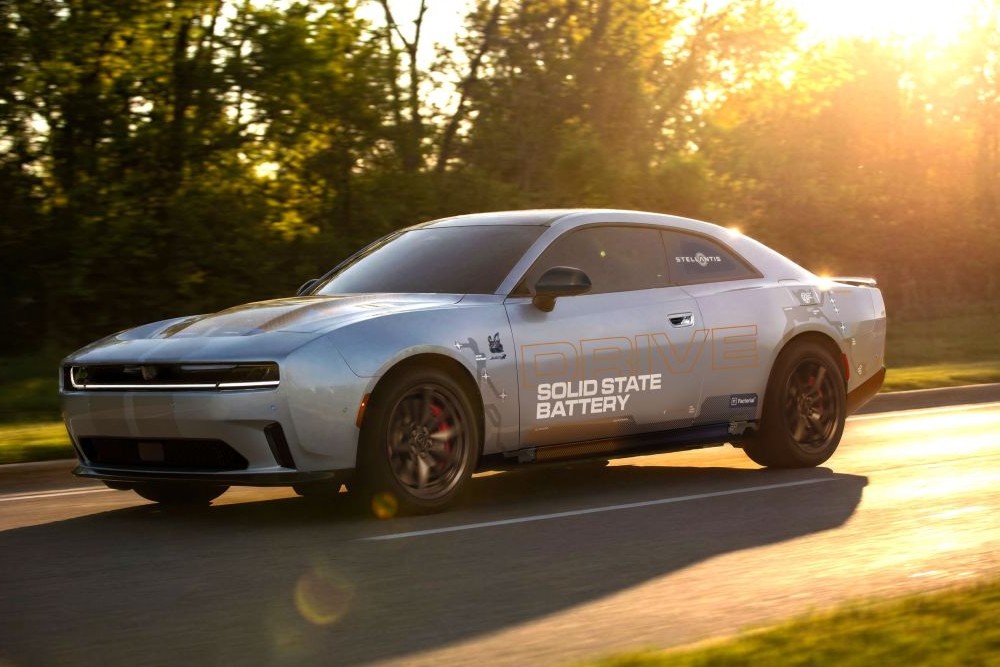
Stellantis has integrated solid-state battery cells into a Dodge Charger Daytona development vehicle and has begun a real-world testing programme aimed at evaluating the technology’s performance, safety and reliability under everyday operating conditions.
According to Stellantis and battery developer Factorial Energy, the project represents the first integration of solid-state battery cells into a Stellantis vehicle, marking a significant milestone in the automaker’s next-generation battery development efforts.
Moving From Laboratory Testing to Road Trials
The development vehicle is equipped with Factorial Energy’s FEST (Factorial Electrolyte System Technology) solid-state battery cells, which combine a lithium-metal anode with a proprietary polymer separator.
The road-testing programme follows several years of development and validation work between the two companies.
Factorial began supplying B-sample FEST cells in 2024, with the cells offering capacities exceeding 106 ampere-hours. In 2025, the partners demonstrated fast-charging capabilities, showing the batteries could charge from 15% to 90% state of charge in approximately 18 minutes while delivering an energy density of 375 Wh/kg.
Stellantis subsequently completed validation testing of the FEST technology before advancing to vehicle integration.
New Battery Architecture Developed
To accommodate the solid-state cells, engineers from Stellantis and Factorial jointly developed a new battery pack architecture.
Stellantis said it created a patented mechanical design that enabled the FEST cells to be integrated into an existing battery pack structure.
The companies also modified battery management systems and vehicle control software to optimize the performance of the solid-state technology under varying operating conditions.
According to the partners, these engineering adaptations are critical to ensuring that the cells perform reliably during real-world driving.
Dodge Charger Daytona Chosen as Demonstration Vehicle
The test programme will use a development version of the all-electric Dodge Charger Daytona, which is built on Stellantis’ STLA Large platform.
The electric muscle car was selected shortly after its market introduction in 2024 as the platform for Stellantis’ solid-state battery demonstration programme.
The road-testing campaign is expected to focus on battery performance, charging characteristics, durability and operational safety across a range of driving environments.
Factorial Advances Solid-State Development
Factorial Energy is one of the leading developers of solid-state battery technology and is backed by several major automotive manufacturers, including Stellantis, Mercedes-Benz and Hyundai-Kia.
Alongside FEST, the company is developing another solid-state platform known as Solstice.
Factorial has stated that Solstice cells could potentially achieve energy densities of up to 450 Wh/kg, although it has not specified whether that figure applies at the cell or battery pack level.
The company believes the technology could eventually increase electric vehicle range by as much as 80% compared with current battery systems.
Path Toward Commercialisation
Stellantis Chief Engineering and Technology Officer Ned Curic said the objective is to bring solid-state battery technology closer to commercial deployment.
“Battery development is a balancing act. It’s not enough to optimise a single metric. We need a system that delivers real benefits in a real vehicle.”
He added that solid-state batteries could offer customers longer driving range, faster charging and lower costs while remaining compatible with existing lithium-ion battery manufacturing processes.
Factorial Chief Executive Officer Siyu Huang said the project demonstrates the importance of collaboration across the entire battery development chain.
“We are deeply honoured to work alongside Stellantis, one of the world’s great mass-market automakers, on this STLA Large-based development car.”
“What we have built together, from cell chemistry to pack architecture to enable real-world road testing, is exactly the kind of deep, full-stack collaboration that solid-state has always required.”
The start of road testing marks an important step toward validating solid-state battery technology outside laboratory environments and could help accelerate the path toward future commercial electric vehicles equipped with next-generation battery systems.