
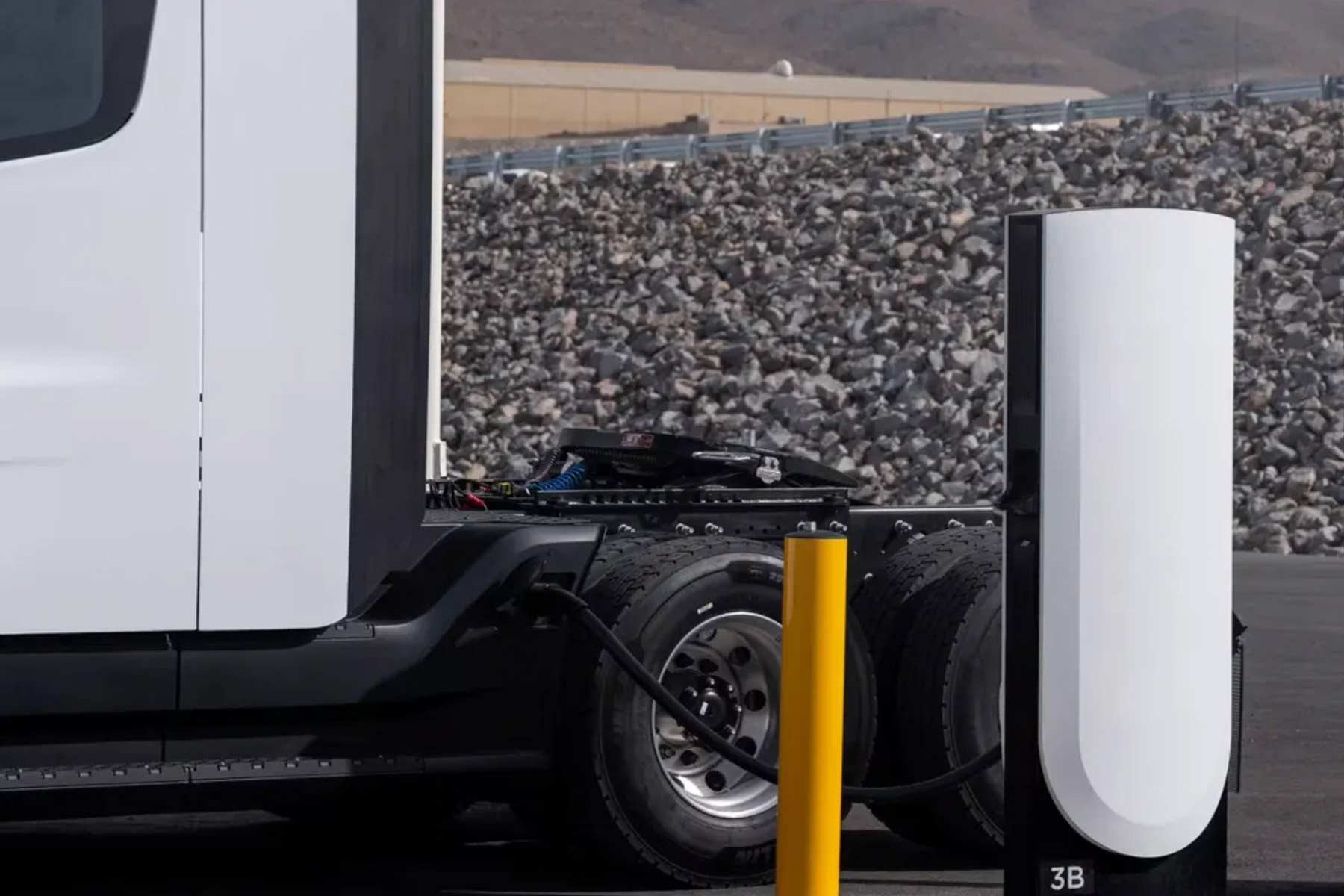
Tesla has launched a new “Semi Charging for Business” programme that allows fleet operators and commercial customers to install proprietary charging systems for the Tesla Semi, alongside a lower-power depot charging product called the Basecharger.
The programme mirrors Tesla’s Supercharger for Business model used in the passenger vehicle market, enabling third-party customers in the United States to deploy Tesla-branded charging infrastructure at their own facilities.
See also: Tesla Deploys New AI Model to Predict Supercharger Demand and Reduce Wait Times
Tesla said its high-power Megacharger system, designed for fast charging electric heavy-duty trucks, is available starting at $188,000 through the company’s online configurator. The package includes a 1.2MW power cabinet and two charging dispensers that share the available charging capacity. Installation costs and taxes are not included.
The company added that operators opening their charging sites to external users can generate revenue, though Tesla charges an additional fee of $0.08 per kilowatt-hour for third-party charging access.
Tesla said the Semi can recharge up to 60% of its battery capacity within 30 minutes using a Megacharger, allowing drivers to recover several hundred kilometers of driving range during mandatory rest periods or loading operations.
See also: Tesla Begins Rollout of FSD v14.3 With Faster AI and Improved Driving Behavior
In addition to fast-charging infrastructure, Tesla also introduced the Basecharger, a 125kW charging solution intended primarily for overnight depot charging. According to the company, the unit can recharge approximately 60% of a Tesla Semi battery in around four hours.
The Basecharger is priced at approximately $40,000, with deliveries expected to begin in early 2027.
Industry publication Electrek described the pricing as highly competitive and noted that Tesla’s lower third-party charging fee for commercial truck charging—$0.08 per kWh compared with $0.10 per kWh under the passenger vehicle Supercharger for Business programme—suggests the company is seeking to accelerate deployment of Semi charging infrastructure.
Both charging systems visually resemble Tesla’s V4 Supercharger hardware, although they feature different cable mounting systems adapted for heavy-duty vehicles.
See also: Tesla Regains Global BEV Lead in Q1 2026 Amid Inventory Build
Tesla said the products support open industry standards including ISO 15118-2 and OCPI, allowing interoperability beyond Tesla’s own ecosystem. Optional payment terminals are also available.
The systems are designed to integrate with Tesla’s management platform, enabling customers to monitor charger utilization, adjust operational settings, and manage pricing through the Tesla Portal.
The announcement comes as Tesla continues expanding production of the Semi truck and building charging infrastructure to support commercial fleet electrification.