
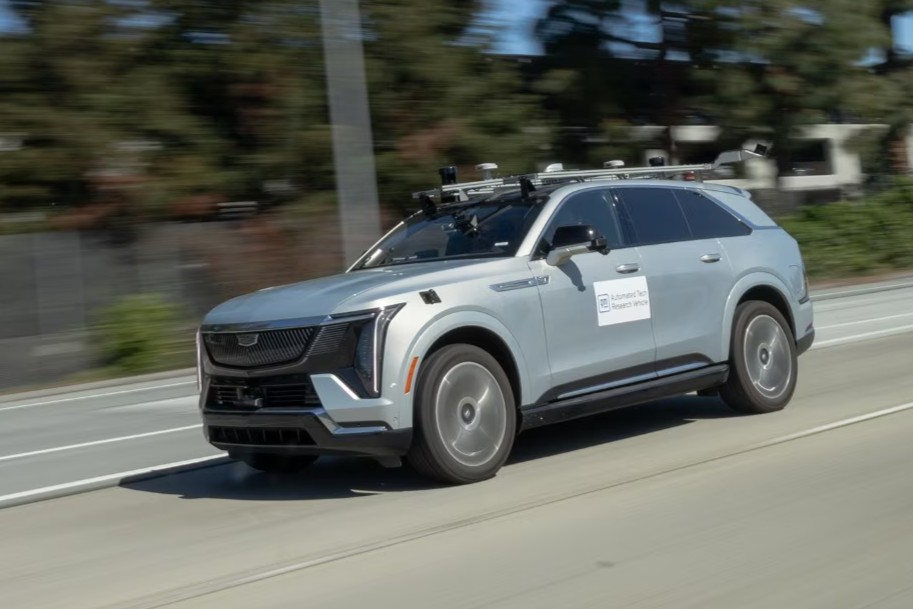
General Motors is moving forward with the development of Level 3 automated driving technology, announcing plans to begin road testing in the United States using its flagship electric SUV, the Cadillac Escalade IQ, even as European rivals BMW and Mercedes-Benz pull back from similar systems.
The Detroit-based automaker said it will deploy a fleet of around 200 test vehicles equipped with the new system, each accompanied by a human safety driver. The trials mark a shift from earlier data-gathering efforts to active testing in real-world traffic conditions.
Unlike GM’s existing Super Cruise, which operates at SAE Level 2 and requires drivers to keep their eyes on the road, the new system will enable “hands-free, eyes-off” driving in certain conditions. Under SAE Level 3 automation, drivers may engage in activities such as reading emails or watching videos but must remain ready to take control when prompted.
“Each vehicle will be accompanied by a human safety driver,” General Motors said, describing the transition as a move toward “active testing of automated technology in real-world traffic conditions.”
The company had previously outlined plans to introduce Level 3 capability in the Escalade IQ by 2028. The system is also expected to expand to other premium models under General Motors and eventually to higher-volume vehicles from Chevrolet, without requiring full redevelopment for each model.
GM said its development builds on more than one million miles of data collected across 34 U.S. states, forming the basis for the next generation of automated driving technology.
In contrast, BMW and Mercedes-Benz have stepped back from their Level 3 offerings, citing practical and regulatory constraints. Both companies had introduced systems—Drive Pilot from Mercedes and Personal Pilot L3 from BMW—on select flagship models but found their use limited to specific scenarios.
These systems were primarily restricted to motorway driving at low speeds, such as in traffic congestion. BMW’s version was capped at 60 km/h, while Mercedes later extended functionality to speeds of up to 95 km/h. However, neither system could operate in urban environments or on rural roads.
The technology also requires costly hardware, including lidar sensors, pushing prices above £6,000 and limiting broader adoption.
As a result, Mercedes-Benz has shifted focus to its Level 2++ system, MB.Drive Assist Pro, offered in updated versions of the S-Class. The system allows highly automated driving across a wider range of scenarios, including urban routes, but still requires drivers to maintain visual attention at all times. BMW has similarly prioritized advanced Level 2 systems.