
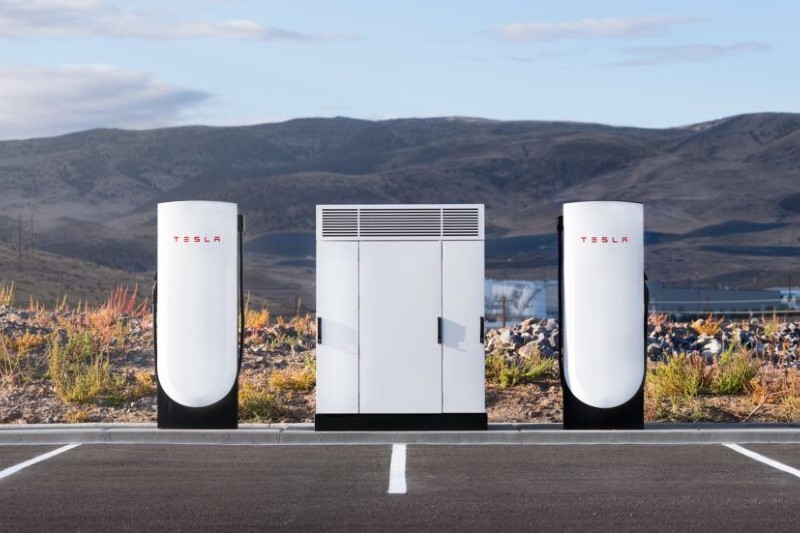
Tesla has added more than 60 planned Megacharger locations to its ‘Find Us’ online map, offering its most detailed view yet of the charging infrastructure intended to support the Tesla Semi across the United States.
The update, first highlighted in a LinkedIn post by Jason Gies, a member of the Tesla Semi business development team, brings the total number of listed truck charging sites to 66. Of these, two are currently operational, while the remaining 64 are marked as “coming soon.” The network spans 15 U.S. states along major freight corridors.
“You can see Megachargers and coming soon sites forming a backbone across the country. Chicago is becoming a real anchor. The Southeast is filling in. Corridors are starting to connect, not just scatter pins,” Gies wrote in his post.
Texas leads with 19 planned locations, followed by California with 17. Florida, Georgia, Illinois and Washington are each set to receive four sites. New York and Nevada are slated for two locations each, while Arizona, Colorado, Utah, Oregon, Indiana, Pennsylvania and Maryland are each expected to host one site.
The two operational Megacharger stations are located at Gigafactory Nevada in Sparks and in Carson, California. The updated map indicates a focus on Interstate 5 and Interstate 10, as well as key routes around Chicago and along the East Coast, including I-95 and I-75.
Tesla has not provided specific commissioning dates for the new sites. However, in April 2025, Dan Priestley, head of the Tesla Semi programme, said the company aims to build 46 Megacharger stations by early 2027. Tesla’s fourth-quarter shareholder report also referenced 37 locations expected to enter operation in 2026.
In January, Tesla announced a partnership with Pilot Travel Centers to develop a dedicated truck charging network. Construction at selected Pilot sites in California, Georgia, Nevada, New Mexico and Texas is scheduled to begin in the first half of 2026, with initial openings targeted for summer 2026.
Each Pilot hub is expected to feature four to eight charging stalls using Tesla’s V4-based system, capable of delivering up to 1.2 megawatts per dispenser. The decentralised architecture combines satellite dispensers with a separate power cabinet and is designed to recharge a significant portion of the Semi’s 800-kilometre range in around 30 minutes.
According to the companies, the network will initially focus on Tesla Semi trucks. “This network will initially focus on providing charging infrastructure for Tesla’s Semi trucks,” the official statement said.
Pilot Travel Centers operates approximately 900 sites across 44 U.S. states and five Canadian provinces.
The infrastructure expansion comes as Tesla prepares for the long-delayed commercial launch of the Semi. First unveiled in 2017, the electric truck is now expected to enter regular sales in 2026, with series production planned at a dedicated facility near Gigafactory Nevada designed for up to 50,000 units annually.
Tesla has also signalled plans for a European rollout. The Semi was showcased at the IAA Transportation trade fair in Hanover, where company representatives indicated that a European market launch would likely follow at least two years after the U.S. debut.