
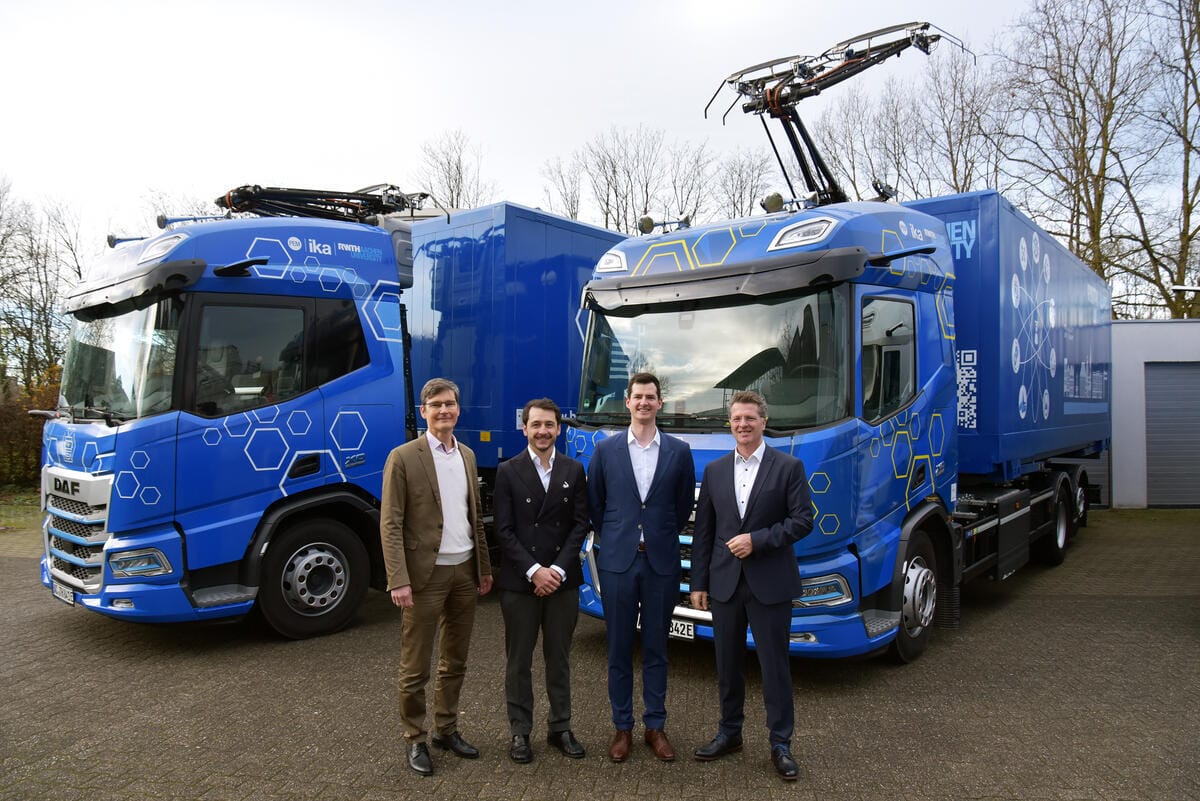
A four-year German research programme examining overhead line charging for battery-electric trucks has concluded, after completing more than 10,000 kilometres of on-road testing with retrofitted commercial vehicles.
The BEV Goes eHighway (BEE) project was led by RWTH Aachen University and launched in January 2022 with funding of about €5.9 million from Germany’s Federal Ministry for Economic Affairs and Climate Action. The research was carried out by the university’s Institute for Automotive Engineering (ika) and the Chair of Production Engineering of E-Mobility Components (PEM), with the aim of assessing charging strategies for long-haul electric trucks.
See also: RWTH Aachen University Secures Road Approval for Modular Fuel Cell-Electric Truck Prototype
At the start of the project, battery-electric trucks typically offered driving ranges of around 300 kilometres, limiting their use in long-distance freight transport. Fast-charging infrastructure was also less developed than it is today, prompting interest in alternative approaches such as “dynamic charging” while driving, either inductively via embedded road coils or through overhead catenary lines.
“Dynamic charging while driving is an important component in the technology mix for decarbonizing freight transport in an ecologically and economically sustainable manner,” said Prof. Lutz Eckstein, head of ika. The BEE project focused on overhead catenary charging and developed a retrofit concept to equip standard production trucks with pantographs.
See also: RWTH Aachen Researchers Complete Project on Faster, Lower-Cost Battery Production
As part of the research, two battery-electric XD Electric trucks supplied by DAF Trucks were modified to include a newly developed current collector system. After receiving road approval, the vehicles were tested on public roads within the ELISA, FESH and eWayBW field trials in the German states of Hesse, Schleswig-Holstein and Baden-Württemberg.
“Powering the battery via overhead lines can help reduce stationary charging and the associated delivery times,” said Prof. Achim Kampker, head of PEM, adding that the approach could improve operational flexibility and potentially allow for smaller battery packs. However, he noted that the absence of permanent catenary infrastructure on Germany’s road network remains a major barrier to wider deployment.
See also: RWTH Aachen Launches Project to Develop Battery Cells with Over 80% Recycled Content
While the trials demonstrated that the technology functions reliably in real-world conditions, further testing is no longer possible. The overhead line infrastructure at all three pilot sites has since been dismantled, effectively bringing Germany’s catenary truck experiments to a close.
The conclusion of the BEE project comes as the market has shifted toward long-range battery-electric trucks capable of covering about 500 kilometres on a single charge, such as the Mercedes-Benz eActros 600 and the MAN eTGX, reducing the immediate need for dynamic charging solutions in long-haul transport.