
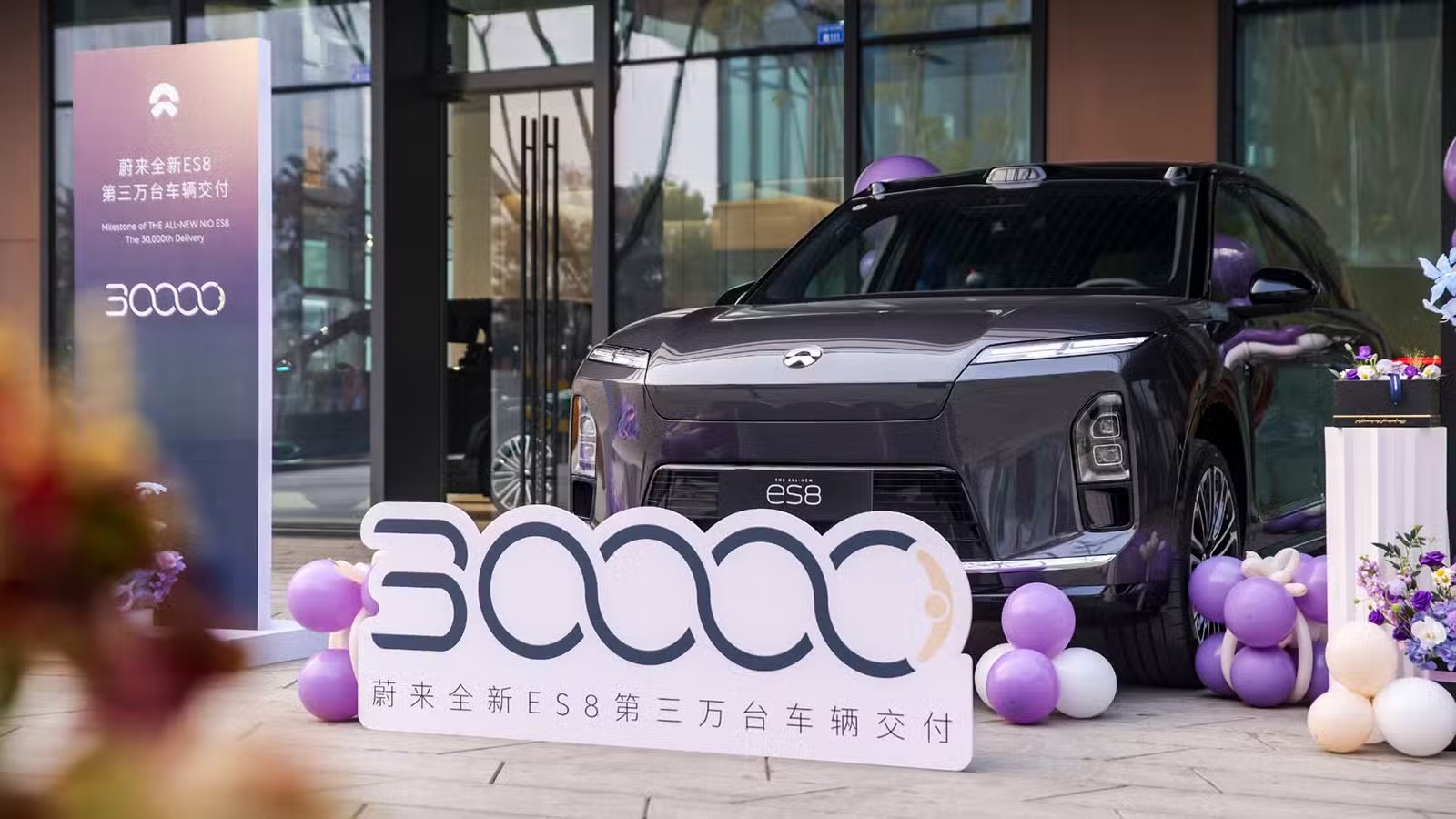
Nio said it has delivered 30,000 units of its third-generation ES8 sport utility vehicle, just 89 days after the model went on sale, underscoring strong demand for its high-end electric offerings in China.
Nio said the milestone makes the all-new ES8 the fastest pure-electric vehicle priced above RMB 400,000 to reach 30,000 deliveries in the domestic market. The company launched the third-generation ES8 at Nio Day 2025 on Sept. 20, with customer deliveries beginning the following day.
See also: Nio Launches Limited-Edition ET5 and ET5 Touring Models to Boost Sedan Demand
The large, three-row electric SUV is offered in six- and seven-seat configurations, with a starting price of RMB 406,800 ($57,770) including the battery pack. It is one of the most expensive models in Nio’s lineup and among the highest-priced vehicles produced by a Chinese automaker.
At the launch event, William Li, Nio’s founder, chairman and chief executive, said production capacity for the model would reach about 40,000 units this year. According to the company, demand exceeded supply early on, with the entire planned annual production volume selling out on the second day after launch.
Initial deliveries were constrained by battery supply, prompting Nio in late September to prioritise 100-kWh battery packs for ES8 production over battery swap station deployment in order to accelerate customer deliveries. The company has not since reported further battery-related constraints, and recent moves by Nio’s sub-brand Onvo to expand battery availability at swap stations suggest supply pressures have eased.
See also: Nio Onvo President Criticizes Large Batteries in EREVs as Resource-Intensive
More recently, however, Nio flagged a new bottleneck. In a statement issued via the Nio App on Wednesday, the company said it is facing chip shortages affecting the rear-seat entertainment system in the ES8. To avoid delivery delays, vehicles produced from Dec. 22 will use an alternative technical solution.
Nio said it would provide subsidies to affected customers and allow them to switch back to the original configuration once chip supply normalises.