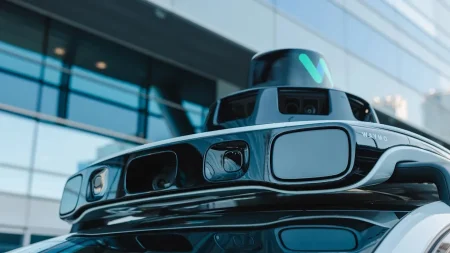





The White House is signalling a push to accelerate the commercial deployment of autonomous vehicles, with senior officials saying federal rulemaking could soon clear the way for cars without steering wheels, as lawmakers revive efforts to establish nationwide standards for the technology.
Michael Kratsios, director of the White House Office of Science and Technology Policy, said autonomous vehicles could be fully legalised within one to two years if regulators move faster. Speaking at a public discussion in Las Vegas on Jan. 7, Kratsios said, “Autonomous vehicles without steering wheels will be completely legalized within 1–2 years,” adding that the main obstacle was no longer technology but regulation.
See also: Automakers Press U.S. Lawmakers, Regulators to Accelerate Autonomous Vehicle Deployment
“Whether autonomous driving becomes reality currently depends on the government, and we must significantly accelerate rule-making,” Kratsios said, describing autonomous vehicles as “a game-changer in our lives in the near future.” His remarks were widely interpreted as a call for an ambitious federal push to speed commercialisation, as the United States seeks to reinforce its lead in artificial intelligence and autonomous systems.
Fully autonomous vehicles without traditional driving controls already exist, including robotaxis developed by Amazon-backed Zoox, but their use remains limited to restricted areas and small user groups. Broader deployment has been constrained by federal exemptions and a patchwork of state-level rules governing vehicle design and operation.
See also: MotorTrend Names Tesla Full Self-Driving Best Driver Assistance System for 2026
Kratsios linked the autonomy push to broader U.S. technology strategy, arguing that leadership in artificial intelligence should translate into global adoption. “The United States has the best chips, AI models, and apps, and there is no reason for anyone in the world not to use American technology,” he said. “We want all developers worldwide to build AI apps on top of American technology.”
Congress is now moving in parallel. In early January, a bipartisan group of lawmakers released a discussion draft of the SELF DRIVE Act, legislation aimed at establishing a federal regulatory framework for autonomous vehicles. The draft was introduced by Republican Representative Bob Latta and Democratic Representative Debbie Dingell and has received backing from the Autonomous Vehicle Industry Association (AVIA), according to congressional aides.
See also: U.S. Congress Advances Legislation to Standardize Autonomous Trucking Rules Nationwide
A legislative hearing on the proposal is scheduled for Jan. 13, 2026, before the House Energy and Commerce Subcommittee on Commerce, Manufacturing and Trade. Separately, the House Energy and Commerce Subcommittee has also been examining proposals to raise the annual cap on autonomous vehicles operating under federal exemptions from 2,500 to as many as 90,000, while limiting state-level rules in favour of unified federal standards.
Industry groups say deployment is already accelerating. AVIA said in May 2025 that autonomous vehicles in the United States had logged more than 145 million miles on public roads, double the total recorded in April 2024. In its 2025 State of AV report, the association said stronger federal policy support was needed to sustain momentum and maintain U.S. competitiveness.